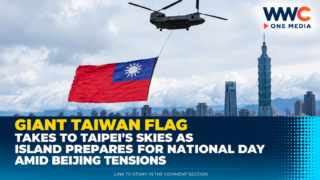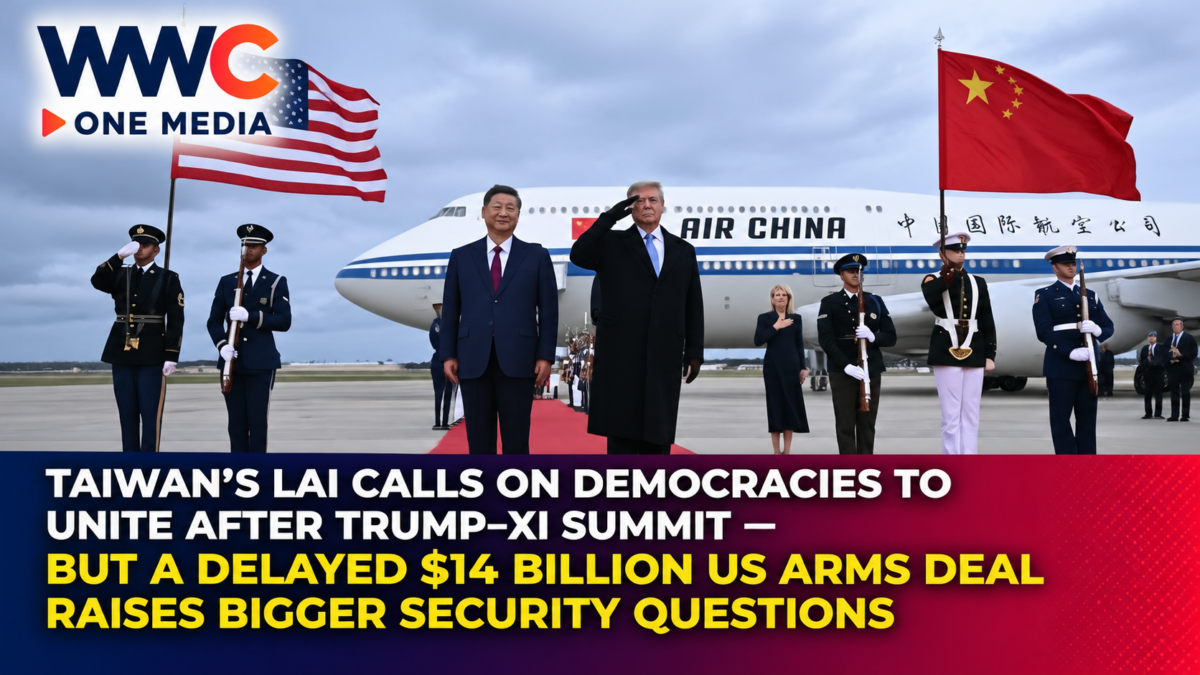
TAIPEI, Taiwan — October 10, 2026 — Taiwan President Lai Ching-te has urged democratic nations across the Indo-Pacific to stand together in protecting regional peace and stability, delivering a firm message to Beijing just days after US President Donald Trump’s diplomatic engagement with Chinese leader Xi Jinping raised fresh questions about Taiwan’s security.
Speaking during Taiwan’s National Day celebrations in Taipei on Saturday, Lai said the island welcomes dialogue between Washington and Beijing aimed at reducing the risk of war.
But he insisted that peace cannot come at the expense of Taiwan’s freedom or its people’s ability to determine their future.
The remarks, delivered outside the Presidential Office Building, reflect Taiwan’s increasingly delicate position between two global powers whose relationship affects trade, security and regional stability.
According to Bloomberg, Reuters and Associated Press, Lai’s appeal for democratic cooperation followed renewed Chinese military pressure and concerns that improving relations between Trump and Xi could complicate US support for Taiwan.
The speech also comes as Washington has reportedly delayed approval of a potential $14 billion arms package for Taipei.
The bigger question is whether Taiwan can strengthen its defenses and international partnerships while the United States and China attempt to manage their rivalry through high-level diplomacy.
Lai Urges Indo-Pacific Democracies to Protect Regional Peace
President Lai’s central message was that Taiwan’s security cannot be separated from the stability of the wider Indo-Pacific.
He called on democratic governments in the region to work together to preserve the existing peace and security arrangements.
The Taiwanese leader framed the issue as one involving international rules, freedom and the ability of smaller societies to resist pressure from more powerful neighbors.
He warned against attempts to alter the Taiwan Strait’s status quo through military intimidation or other forms of coercion.
Lai also emphasized that Taiwan does not seek regional dominance or confrontation.
Instead, he presented the island as a democracy seeking to preserve its existing way of life.
His speech was delivered during the October 10 National Day celebration, also known as Double Ten Day, which commemorates the 1911 uprising that led to the establishment of the Republic of China.
The occasion carries particular symbolic importance for Taiwan, where the Republic of China government has been based since 1949.
Trump–Xi Diplomacy Creates a New Security Dilemma
The timing of Lai’s address is significant.
President Trump and Chinese President Xi Jinping have recently held high-level discussions intended to manage tensions between the world’s two largest economies.
Taiwan remains one of the most sensitive issues in their relationship.
Beijing considers Taiwan part of China and has not renounced the possibility of using force to achieve unification.
Taiwan’s government rejects Beijing’s sovereignty claims and maintains that its future must be determined by its people.
For Taipei, improved relations between Washington and Beijing can be both encouraging and unsettling.
Lower tensions between the powers could reduce the risk of military confrontation.
But Taiwanese officials also want assurances that their security interests will not be overlooked during broader discussions involving trade, technology and regional diplomacy.
Lai’s speech attempted to reconcile these concerns.
He welcomed dialogue between the United States and China while emphasizing that any stable regional arrangement must respect Taiwan’s interests and preserve peace.
A $14 Billion US Arms Package Remains in Question
One of the most consequential developments involves American military support.
Reuters reported on October 7 that Trump had held back a potential $14 billion arms package for Taiwan following his summit with Xi.
The reported delay has raised questions about the timing of additional US military assistance.
American weapons and defense cooperation play an important role in Taiwan’s efforts to deter potential attacks.
For Taipei, delays in approvals or deliveries can complicate military planning.
However, a delayed package is not the same as a permanently canceled agreement.
Nor does it establish that Washington has abandoned its longstanding relationship with Taiwan.
Taiwan’s representative to the United States, Alexander Yui, said relations remained strong despite the uncertainty.
He emphasized that credible deterrence depends on maintaining military capabilities and receiving equipment in a timely manner.
The package’s ultimate status will depend on future decisions by the US administration and other applicable approval processes.
Taiwan Says Stronger Defenses Are Intended to Prevent War
During his speech, Lai defended Taiwan’s military modernization program.
He said the purpose of stronger defenses is to discourage conflict and ensure that any dialogue takes place without coercion.
His government is pursuing improvements in asymmetric military capabilities and domestic defense production.
Asymmetric defense involves strategies and weapons intended to complicate an attack by a larger military force.
Such capabilities can include mobile systems, precision weapons, resilient communications and other equipment designed to make military aggression more difficult and costly.
Taiwan also plans to draw on its strengths in semiconductors, information technology and advanced manufacturing.
The objective is to connect the island’s industrial capabilities with its national security requirements.
These measures are part of a broader effort to improve deterrence.
However, military modernization does not guarantee that conflict will be avoided.
Its effectiveness depends on strategy, readiness, international relationships and the behavior of all parties involved.
China’s Military Pressure Remains a Central Concern
Taiwan’s concerns are reinforced by increased Chinese military and maritime activity around the island.
Beijing has repeatedly conducted exercises and other operations intended to demonstrate its military capabilities.
Taiwan views many of these activities as attempts to pressure its government and change the regional security environment.
China, meanwhile, argues that its operations are legitimate measures to safeguard territorial sovereignty and oppose what it calls separatism.
The two sides fundamentally disagree on Taiwan’s political status.
Reuters reported on October 10 that the United States had criticized recent Chinese maritime activities near Taiwan’s eastern coast as destabilizing.
The report highlighted the presence of a Chinese maritime militia vessel and increased coast guard activity in waters relevant to Taiwan’s maritime security.
Such operations raise concerns about the possibility of pressure being applied below the threshold of conventional armed conflict.
They can also complicate efforts to prevent misunderstandings or accidental escalation.
Washington Warns About Chinese Maritime Activities
The latest American response demonstrates that tensions around Taiwan are not limited to diplomatic statements.
US officials have expressed concern about Chinese operations near the island and encouraged Beijing to engage constructively with Taiwan’s democratically elected government.
The situation is particularly sensitive because Taiwan’s eastern waters could become important for maritime access and resupply during a crisis.
Activity involving coast guard vessels, maritime militia and naval forces can therefore attract close attention from security officials.
However, the presence of vessels near Taiwan does not automatically mean a blockade has begun.
The latest reporting indicates that the Chinese vessels remained outside Taiwan’s restricted waters.
It is important to distinguish between military pressure, possible preparations and a confirmed military operation.
Taiwan and its partners are monitoring developments, but an invasion or blockade has not been announced.
Lai Promises Greater Resilience Across Taiwan’s Economy
Beyond military equipment, Lai emphasized the need to strengthen Taiwan’s ability to function during a national emergency.
His government is working with local authorities and civil society to improve preparedness in essential services.
The priorities include energy, telecommunications, transportation, finance, food supplies and healthcare.
These systems are important because disruptions during a major crisis can affect everyday life even without direct damage to military installations.
A resilient communications network helps emergency agencies coordinate.
Reliable electricity is necessary for hospitals, factories and critical infrastructure.
Stable financial and transportation systems help sustain economic activity.
Taiwan’s focus on civilian resilience therefore complements its military modernization efforts.
The strategy recognizes that national security involves the continuity of society as well as the strength of armed forces.
Taiwan’s Semiconductor Industry Adds a Global Economic Dimension
Taiwan is central to the international semiconductor supply chain.
Its chip manufacturing companies produce advanced components used in artificial intelligence, smartphones, data centers and other technologies.
Taiwan Semiconductor Manufacturing Company, or TSMC, is among the world’s most important chipmakers.
Disruption to Taiwan’s technology industry could have consequences extending far beyond the island.
The United States, China, Japan, South Korea and European economies are connected to semiconductor supply chains involving Taiwanese companies.
For that reason, stability in the Taiwan Strait has become a major concern for business leaders and investors.
Taiwan’s semiconductor capabilities also feature in its growing economic relationship with the United States.
Taiwanese officials have highlighted technology investment and supply-chain cooperation as important elements of the bilateral partnership.
However, economic interdependence does not eliminate geopolitical risks.
It can create powerful incentives for stability while also increasing the global consequences of a potential crisis.
China’s Position Remains Firm
Beijing maintains that Taiwan is part of Chinese territory and that reunification is a national objective.
Chinese President Xi Jinping reiterated opposition to Taiwanese independence and foreign interference during China’s National Day commemorations in late September.
The Chinese government regards the Taiwan issue as an internal matter and rejects political actions it considers supportive of formal independence.
Taiwan’s administration, by contrast, says the island is already self-governing and rejects subordination to Beijing.
These positions remain fundamentally difficult to reconcile.
The international community also operates under varying diplomatic arrangements.
The United States maintains formal diplomatic relations with Beijing rather than Taipei, while preserving substantial unofficial ties with Taiwan.
Washington’s approach has long involved security cooperation and opposition to unilateral changes to the status quo.
This complexity explains why Taiwan is repeatedly discussed during major US–China diplomatic meetings.
US–Taiwan Ties Remain Strong, Taipei’s Representative Says
Taiwan’s representative in Washington sought to calm concerns after the Trump–Xi summit.
Alexander Yui said the relationship between Taiwan and the United States remained robust.
He highlighted defense cooperation and the importance of maintaining credible deterrence.
Taiwanese officials have also pointed to cooperation in technology, semiconductors and industrial supply chains.
The relationship extends beyond security issues to investment and economic development.
These ties provide reasons for both sides to maintain close communication despite diplomatic uncertainty.
However, reassuring statements do not resolve questions about future weapons approvals.
Taipei will continue watching for concrete decisions concerning defense support and military deliveries.
Lai Highlights 30 Years of Democratic Presidential Elections
The National Day speech also marked an important anniversary in Taiwan’s political history.
In 2026, Taiwan is commemorating 30 years since its first direct presidential election.
Lai referred to the 1996 vote as a turning point in the development of the island’s democratic institutions.
The election took place during a period of intense Chinese military pressure.
For Taiwan, the anniversary provides an opportunity to emphasize its democratic system and political identity.
Lai argued that democracy and economic development can reinforce one another.
He also spoke about domestic priorities involving wages, family support, energy policy and opportunities for younger generations.
The broader message was that preserving security is necessary to protect the institutions and living standards that Taiwanese citizens have developed.
Economic Policies Also Feature in Lai’s National Day Address
While international attention focused on China and the United States, Lai also outlined a domestic policy agenda.
He discussed increasing wages, easing financial pressure on families and improving benefits.
The government is working on expanded childcare support and policies intended to address Taiwan’s declining birthrate.
Lai said Taiwan is preparing to introduce monthly NT$5,000 allowances for children from birth until age 18 beginning in 2027.
The proposal is part of a wider package involving childcare, family assistance and housing measures.
He also pledged a pragmatic review of energy options while strengthening the electricity grid and investing in energy resilience.
These proposals show that the administration’s agenda extends beyond military preparedness.
Domestic economic security and public confidence are also important elements of Taiwan’s political stability.
However, announced policy targets still require implementation, funding and administrative execution.
Eswatini’s King Joins National Day Celebrations
The celebrations also highlighted Taiwan’s international diplomatic relationships.
King Mswati III of Eswatini attended the National Day event in Taipei.
Eswatini is one of the limited number of countries maintaining formal diplomatic relations with Taiwan.
During his visit, the king reaffirmed the relationship between the two governments.
The diplomatic connection is significant because Beijing has sought to persuade countries to recognize the People’s Republic of China rather than Taiwan’s government.
Taiwan continues using diplomatic engagement, development cooperation and economic partnerships to maintain its international relationships.
The presence of foreign dignitaries at the National Day celebrations provided a visible reminder of those efforts.
However, such participation should not be interpreted as a new military alliance or security guarantee.
Why the Philippines and ASEAN Should Watch Closely
Developments in the Taiwan Strait carry major implications for Southeast Asia.
Taiwan is geographically close to the northern Philippines, and regional maritime routes connect major trading economies throughout East and Southeast Asia.
Any serious escalation could disrupt commercial shipping, aviation, investment and regional supply chains.
For the Philippines, changes in cross-strait security can also affect discussions about maritime defense, emergency preparedness and relations with major powers.
The country maintains economic connections with both China and Taiwan while also having a defense alliance with the United States.
These relationships make regional stability especially important.
However, the latest speech does not mean a military confrontation is inevitable.
Its significance lies in the continued effort by Taiwan to strengthen deterrence and build international support while avoiding escalation.
For ASEAN governments, maintaining peace and preventing disruptions to trade and transportation remain central interests.
Can US–China Diplomacy Reduce the Risk of Conflict?
The Trump–Xi summit illustrates the possibility of dialogue even between governments with substantial disagreements.
Diplomatic engagement can help clarify positions and reduce the danger of misunderstandings.
But its success depends on what follows.
Taiwanese officials want reassurance that discussions between Washington and Beijing will not weaken the island’s security.
China wants the United States to respect Beijing’s position on Taiwan.
Washington must balance its relationship with China against its longstanding commitments and interests in the Indo-Pacific.
These competing priorities make the diplomatic environment particularly sensitive.
Lai’s speech suggested that he sees no contradiction between welcoming US–China talks and demanding stronger regional support for Taiwan.
His message was that dialogue is valuable when it reduces danger without exposing the island to greater coercion.
The Bigger Picture: Taiwan’s Security Is Becoming a Test of Regional Diplomacy
Taiwan occupies an important position in the security and economic architecture of the Indo-Pacific.
Its democratic institutions, strategic geography and semiconductor industry give developments around the island international significance.
The United States and China remain deeply interconnected economically, but they disagree over issues involving security and political authority.
Taiwan must navigate those tensions while strengthening its own capabilities.
Lai’s appeal to regional democracies is therefore both a political statement and a strategic message.
He wants Taiwan’s security to be viewed as part of the broader regional interest in stability.
Whether that approach succeeds will depend on the actions of foreign governments as well as developments in cross-strait relations.
THE BOTTOM LINE
Taiwan President Lai Ching-te has urged Indo-Pacific democracies to cooperate in maintaining peace and stability following the latest summit between US President Donald Trump and Chinese President Xi Jinping.
In his October 10 National Day address, Lai welcomed dialogue between Washington and Beijing but rejected the idea that Taiwan should surrender its freedom or accept coercion.
The comments came amid continued Chinese military pressure and uncertainty surrounding a reported $14 billion American arms package.
Taiwan is strengthening its defense capabilities, expanding civilian preparedness and emphasizing its economic and technological partnerships with other countries.
However, the situation remains diplomatically sensitive, and none of the latest developments establishes that a military conflict is imminent.
The biggest question is whether the United States and China can reduce tensions through diplomacy without undermining Taiwan’s confidence in its own security.
For Taiwan, the challenge is balancing two urgent priorities: preserving peace in the Taiwan Strait while ensuring that diplomatic compromises do not leave its future dependent entirely on decisions made in Washington and Beijing.