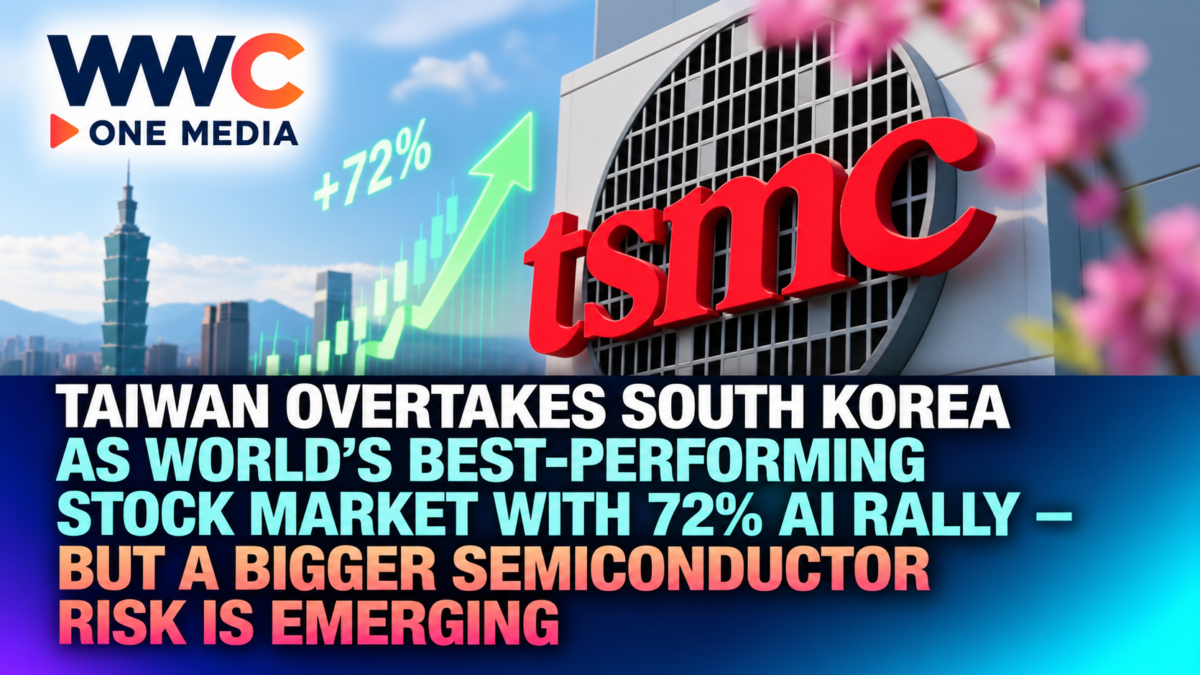
TAIPEI — Taiwan has surged past South Korea to become the world’s best-performing major stock market in 2026, as investors increasingly favor companies supplying the chips, servers and advanced manufacturing technology powering the global artificial intelligence boom.
The Taiex Index has climbed approximately 72% this year, overtaking South Korea’s Kospi, which has gained around 65%, according to Bloomberg’s October 7 report.
The figures place Taiwan and South Korea at the top of a comparison covering more than 90 global equity benchmarks.
But the competition between the two Asian technology powerhouses has taken a dramatic turn.
During the third quarter, Taiwan outperformed South Korea by approximately 23 percentage points—the largest quarterly gap between the markets since the beginning of the century.
The change reflects a growing reassessment of where investors believe the next phase of artificial intelligence spending will generate the strongest earnings.
South Korea has benefited enormously from rising memory-chip prices, but Taiwan offers exposure to a broader network of businesses involved in designing, manufacturing, packaging and assembling the technology required to build AI infrastructure.
That distinction is becoming increasingly important as investors question whether the extraordinary semiconductor rally can continue.
Taiwan Takes the Global Stock Market Crown
For much of 2026, Taiwan and South Korea have competed for leadership in global equity markets.
Both economies occupy essential positions in the artificial intelligence supply chain.
Taiwan is home to Taiwan Semiconductor Manufacturing Company, the world’s largest dedicated contract chipmaker.
South Korea hosts Samsung Electronics and SK Hynix, two of the world’s most important memory-chip manufacturers.
Their technologies are central to modern AI computing.
But the performance of their stock markets has recently diverged.
According to Bloomberg, Taiwan’s benchmark gained approximately 72% in the year through early October, while South Korea’s Kospi rose about 65%.
That puts Taiwan ahead by roughly seven percentage points for the year.
The gap was even more dramatic during the third quarter, when Taiwan outperformed by approximately 23 percentage points.
The reversal shows how quickly investor preferences can change, even between markets benefiting from the same global technology boom.
Why Investors Are Choosing Taiwan Over South Korea
The biggest difference is the structure of each country’s semiconductor industry.
South Korea’s AI investment story has been heavily influenced by Samsung Electronics and SK Hynix.
Both companies manufacture memory chips used in advanced computing systems.
Taiwan, however, offers access to more parts of the technology supply chain.
Its companies participate in semiconductor design, contract manufacturing, advanced packaging, networking equipment, printed circuit boards, server assembly and other essential components.
That gives investors exposure to several different sources of AI-related demand.
A company developing AI processors needs advanced manufacturing.
Those processors require sophisticated packaging.
The finished systems need networking equipment, power-management technology and server infrastructure.
Taiwanese businesses operate across many of those stages.
This could make Taiwan’s earnings outlook less dependent on one particular semiconductor product cycle.
TSMC Remains the Center of Taiwan’s AI Boom
Taiwan Semiconductor Manufacturing Company, better known as TSMC, is central to the rally.
The company manufactures advanced chips designed by major technology customers.
Its manufacturing capabilities are essential to the production of many AI accelerators and high-performance computing processors.
Demand for these products has supported strong revenue growth.
According to TSMC’s official financial disclosures, the company generated approximately NT$514.81 billion in revenue during August 2026.
That represented a 53.3% increase from August 2025.
Revenue for January through August reached approximately NT$3.39 trillion, an increase of 39.3% from the corresponding period last year.
Those figures demonstrate that the AI investment boom is producing substantial sales growth for one of Taiwan’s most important companies.
For investors, that provides fundamental support for the market rally rather than relying entirely on expectations about future technology adoption.
The AI Boom Is Moving Beyond Chips
One of the strongest arguments supporting Taiwan’s stock market is that AI investment is spreading across a wider range of industries.
The first phase of the boom focused heavily on companies designing and manufacturing advanced processors.
But artificial intelligence infrastructure requires much more than individual chips.
Data centers need servers, networking systems, cooling equipment and advanced electronic components.
As AI systems become more powerful, those requirements increase.
Taiwanese manufacturers have established significant positions across several of these markets.
That creates opportunities for companies beyond TSMC.
The result is a broader group of potential beneficiaries as technology companies expand data-center capacity.
This is one reason investors are increasingly examining the entire AI supply chain rather than focusing only on semiconductor manufacturers.
South Korea’s Memory-Chip Giants Have Lost Momentum
While Taiwan has continued advancing, South Korea experienced a sharp reversal during the third quarter.
Shares of Samsung Electronics and SK Hynix declined between approximately 19% and 33% during the three months ended September, according to Bloomberg.
The selloff followed six consecutive quarters of gains supported by rising memory-chip prices.
Earlier in the year, strong demand for high-bandwidth memory helped fuel optimism about Korean semiconductor earnings.
But investors have become increasingly concerned about how long the current memory-chip upcycle can continue.
The memory business has historically experienced periods of strong demand followed by weaker pricing and excess supply.
Those cycles can produce significant fluctuations in semiconductor profits.
The latest selloff suggests investors are becoming more cautious about assuming that exceptional memory pricing will continue indefinitely.
The Financial Times Reports an 18.8% Korean Market Slump
The scale of South Korea’s reversal becomes clearer when examining the broader market.
The Financial Times reported on October 1 that South Korea’s Kospi fell approximately 18.8% during the third quarter.
That made it the world’s worst-performing major stock market over the period covered by the report.
The decline followed an extraordinary rally earlier in 2026.
Even after the third-quarter selloff, Korean equities remained substantially higher for the year.
But the sharp reversal demonstrated how vulnerable technology-heavy markets can become when investor sentiment changes.
The Financial Times also identified leveraged trading and the unwinding of aggressive investment positions as factors that amplified volatility.
For investors, the episode serves as a reminder that strong long-term demand for artificial intelligence does not guarantee steadily rising semiconductor share prices.
High-Bandwidth Memory Is at the Center of the Debate
High-bandwidth memory, commonly called HBM, is essential to many advanced AI computing systems.
These memory chips allow processors to access large volumes of data at extremely high speeds.
That capability is particularly important for training and running sophisticated artificial intelligence models.
SK Hynix and Samsung are major participants in the HBM market.
The rapid expansion of AI data centers has increased demand for their products.
But the investment debate now centers on supply and pricing.
If demand continues growing faster than manufacturing capacity, memory prices could remain elevated.
That would support earnings for Korean suppliers.
However, if producers expand capacity faster than demand, prices could eventually weaken.
Investors are trying to determine which scenario is more likely.
The uncertainty helps explain why South Korea’s memory-chip manufacturers have experienced substantial share-price volatility.
Some Analysts Believe Korea’s Selloff Has Gone Too Far
Not everyone believes Taiwan will maintain its lead.
Citigroup has argued that investors may be underestimating future demand for high-bandwidth memory.
According to Bloomberg, Citi technology analyst Peter Lee suggested that investors should consider buying Samsung and SK Hynix shares.
The argument is that AI infrastructure spending could remain strong enough to support elevated memory demand through 2027.
If memory supply remains constrained, the companies could benefit from stronger pricing and earnings.
That would challenge the view that the current semiconductor cycle is approaching its peak.
The disagreement demonstrates how uncertain the outlook remains.
One group of investors is positioning for slower memory-price growth.
Another believes the market is underestimating the strength of future demand.
The outcome could determine whether South Korea recovers its market leadership.
Taiwan’s Earnings Outlook Is Improving Faster
A major reason for Taiwan’s stronger performance is the direction of corporate earnings forecasts.
According to Bloomberg, analysts have recently been upgrading Taiwan’s earnings expectations more rapidly than those for South Korea.
This marks the first time since March 2025 that Taiwan has achieved that advantage.
The distinction matters because investors generally expect rising stock prices to be supported by future corporate profits.
If earnings forecasts improve, higher share valuations may become easier to justify.
Taiwan’s broad exposure to AI manufacturing creates several possible sources of earnings growth.
Korea’s outlook remains more closely tied to memory-chip pricing.
That makes the timing of the semiconductor cycle especially important for Korean equities.
Bank of America Survey Shows Investors Favor Taiwan
Institutional investor positioning provides another indication of changing sentiment.
A Bank of America survey conducted in September found that approximately 40% of participating fund managers were overweight Taiwan.
Only 25% were overweight South Korea.
Being overweight means holding a larger allocation to a market than the investor’s reference benchmark or neutral position.
The difference suggests that professional investors increasingly prefer Taiwanese equities.
The survey also asked which market would benefit most from the next phase of the AI investment cycle.
Taiwan received approximately 35% of responses.
South Korea received just 5%.
That is a substantial gap.
However, the survey reflects the views of participating fund managers at a particular point in time.
It is not a guarantee of future investment returns.
Taiwan’s Rally Is Becoming Broader
Another important development is the number of Taiwanese stocks participating in the rally.
Bloomberg reported that approximately 10% of Taiex constituents had at least doubled in value during 2026.
The comparable figures were approximately 4.1% for South Korea’s Kospi and 5.7% for Japan’s Nikkei 225.
That suggests Taiwan’s performance is benefiting more companies than a rally concentrated entirely in one major chipmaker.
The distinction is important.
A stock market driven by only one or two large companies can become vulnerable if those companies disappoint.
Broader participation can provide more potential sources of earnings and investment returns.
However, Taiwan’s market remains heavily exposed to the technology sector.
The increased number of winners does not eliminate the risks associated with AI spending.
Taiwan Is More Expensive Than South Korea
The strength of Taiwan’s rally has created a valuation challenge.
According to Bloomberg, the Taiex was trading at approximately 18 times expected earnings over the next 12 months.
South Korea’s Kospi was trading at approximately 5.5 times forward earnings.
That represents a significant difference.
Investors are paying much more for each unit of expected corporate profit in Taiwan than in South Korea.
There are reasons for the gap.
Taiwan has stronger near-term earnings momentum across several AI-related industries.
South Korea faces uncertainty over memory-chip pricing and has historically traded at a valuation discount to many international markets.
But valuation still matters.
A higher price-to-earnings ratio means investors are paying for stronger future performance.
If earnings disappoint, expensive stocks may be more vulnerable to corrections.
South Korea’s lower valuation could become attractive if memory-chip earnings prove more resilient than expected.
Korea’s Valuation Discount Could Become an Opportunity
South Korea’s relatively low valuation is not necessarily evidence that its companies are fundamentally weak.
Samsung and SK Hynix remain important suppliers to the global semiconductor industry.
Their products are essential to AI computing infrastructure.
If memory demand strengthens in 2027, analysts could begin upgrading earnings forecasts again.
That might support a recovery in Korean equities.
However, investors must consider why the market is trading at a discount.
Concerns include the historical volatility of memory-chip earnings, corporate governance issues and broader market risks.
The valuation gap therefore presents both an opportunity and a warning.
Korean stocks may be relatively inexpensive.
But a low valuation does not guarantee an imminent rebound.
Rising Bond Yields Threaten Technology Valuations
Both Taiwan and South Korea face another major challenge: rising global borrowing costs.
U.S. government bond yields have increased sharply amid concerns about inflation, energy prices and fiscal deficits.
Higher yields can reduce the attractiveness of stocks, especially companies valued on expectations of substantial future earnings growth.
Technology shares can be particularly sensitive to changes in interest-rate expectations.
When bond yields rise, investors may demand higher returns from equities.
That can place downward pressure on valuation multiples.
Reuters reported on October 6 that global markets had stabilized somewhat after recent bond-market turbulence, allowing U.S. technology shares to reach fresh records.
But the underlying concerns about inflation and borrowing costs remain.
For Taiwan and South Korea, those developments could influence foreign investment flows and the sustainability of their stock-market rallies.
Global AI Spending Remains a Powerful Support
Despite the risks, demand for AI infrastructure continues to support the semiconductor industry.
Major technology companies are investing heavily in computing capacity.
Artificial intelligence models require substantial processing power.
Data centers need advanced chips, memory, networking equipment and supporting infrastructure.
These requirements create opportunities throughout the Asian technology supply chain.
Taiwan and South Korea are particularly well positioned because they manufacture essential components used in global computing systems.
The United States may lead in developing many AI software platforms and chip designs.
But Asian companies remain essential to turning those designs into physical products.
That is why global investors are paying such close attention to the two markets.
TSMC’s Expansion Also Creates New Challenges
TSMC is expanding manufacturing capacity outside Taiwan.
The company has been investing heavily in the United States as customers and policymakers seek more geographically diversified chip production.
Reuters reported on September 30 that TSMC was evaluating possible additional investment in Texas.
That proposal had not been finalized.
The company has also announced substantial investments in semiconductor manufacturing and advanced packaging facilities in Arizona.
These projects could support long-term growth.
But overseas expansion carries higher construction costs, operational complexity and execution risks.
TSMC must balance strong demand with the expense of building and operating increasingly sophisticated manufacturing facilities.
For investors, future profitability will depend not only on revenue growth but also on manufacturing efficiency and capital spending.
Geopolitical Risk Remains Taiwan’s Biggest Wild Card
Taiwan’s semiconductor leadership comes with a significant geopolitical vulnerability.
The island occupies a central position in the global technology supply chain while facing continuing tensions with China.
Any serious disruption to semiconductor production or transportation could affect technology companies worldwide.
That makes Taiwan’s manufacturing concentration a strategic concern for governments and corporations.
Customers have increasingly explored opportunities to diversify production.
TSMC’s international expansion is part of that broader effort.
However, creating comparable advanced manufacturing capacity elsewhere takes years and requires enormous investment.
Taiwan’s dominant role is therefore unlikely to disappear quickly.
For investors, the challenge is balancing the island’s extraordinary technological importance against geopolitical uncertainty.
South Korea Has Its Own Strategic Advantages
Although Taiwan currently leads the stock-market performance rankings, South Korea retains significant competitive strengths.
Samsung Electronics has major operations spanning memory chips, logic semiconductors, consumer electronics and advanced manufacturing.
SK Hynix is a major supplier of the high-bandwidth memory used in AI computing.
These companies are deeply integrated into the global technology industry.
Their manufacturing capabilities are difficult to replicate.
Demand for increasingly sophisticated AI systems could continue supporting both businesses.
South Korea also possesses substantial expertise in advanced materials, electronics manufacturing and industrial technology.
The country’s recent stock-market weakness does not erase those advantages.
It reflects investor uncertainty about the near-term earnings outlook and the pricing of semiconductor shares.
The Next Phase of AI Could Decide the Winner
The competition between Taiwan and South Korea increasingly depends on how AI infrastructure spending evolves.
If demand broadens across chips, servers, networking and advanced packaging, Taiwan could maintain its advantage.
If high-bandwidth memory becomes an even more critical bottleneck, South Korea could regain momentum.
Both outcomes are plausible.
The distinction is that Taiwan currently offers greater exposure to several areas of AI infrastructure growth.
Korea offers more concentrated exposure to a particularly important component of AI computing.
Investors are deciding which opportunity offers the stronger combination of earnings growth, valuation and risk.
That debate is likely to continue through the remainder of 2026 and into 2027.
October Earnings Will Provide an Important Test
For Taiwan, TSMC’s upcoming financial disclosures will be closely watched.
The company is scheduled to release its September 2026 monthly revenue figures on October 8.
Its third-quarter earnings conference is scheduled for October 15.
Investors will focus on revenue growth, profitability, capital expenditure and management’s outlook for AI-related demand.
In its previous guidance, TSMC projected third-quarter revenue of US$44.6 billion to US$45.8 billion.
The actual results will help determine whether the company’s financial performance continues justifying investor optimism.
Those numbers had not yet been released as of October 7.
The earnings announcement could become an important catalyst for Taiwanese technology stocks.
Wall Street Is Also Betting on the AI Boom
The strength of Taiwanese shares reflects a global investment trend.
U.S. stocks have also benefited from enthusiasm surrounding artificial intelligence.
On October 6, the S&P 500 and Nasdaq reached record highs as investors continued favoring companies exposed to AI infrastructure and corporate earnings growth.
However, the rally has raised concerns about market concentration.
Large technology companies account for a significant portion of major U.S. indexes.
If investor expectations change, weakness in those companies could affect markets internationally.
That includes Taiwan and South Korea, whose semiconductor industries depend heavily on global technology investment.
For Asian investors, developments on Wall Street are therefore increasingly connected to domestic market performance.
What This Means for Asian Investors
Taiwan’s rise highlights the growing importance of technology manufacturing in Asian stock markets.
The AI boom is creating substantial opportunities for businesses that supply the hardware behind advanced computing.
But the rally also demonstrates how quickly investor sentiment can shift.
South Korea led earlier in the year.
Taiwan now holds the top position.
A change in memory-chip pricing, corporate earnings or global interest rates could alter the rankings again.
For investors across Asia, including the Philippines, the development reinforces the importance of distinguishing between enthusiasm for artificial intelligence and the actual earnings generated by individual companies.
A business can operate in a rapidly growing industry without necessarily delivering attractive investment returns at every share price.
Valuation, profitability and financial risk remain essential considerations.
Taiwan Has Taken the Lead—But the AI Race Is Far From Over
Taiwan’s stock-market performance in 2026 has been extraordinary.
Its benchmark has surged approximately 72%.
It has overtaken South Korea in Bloomberg’s global rankings.
Its technology companies are benefiting from rising demand across several parts of the AI supply chain.
And institutional investors increasingly favor the market’s earnings outlook.
But challenges remain.
Taiwanese equities are trading at substantially higher earnings multiples than Korean shares.
Global bond yields remain elevated.
Geopolitical tensions create additional uncertainty.
And investors must determine whether AI-related spending can continue growing fast enough to support current valuations.
South Korea, meanwhile, retains powerful semiconductor companies whose products remain essential to the AI industry.
Its lower stock valuations could attract renewed interest if earnings expectations improve.
Taiwan has won the latest round of the global AI stock-market race.
But the bigger question is whether its broad semiconductor advantage can keep delivering earnings strong enough to justify soaring share prices—or whether South Korea’s beaten-down chip giants are preparing for a comeback that could once again reshape global market rankings.