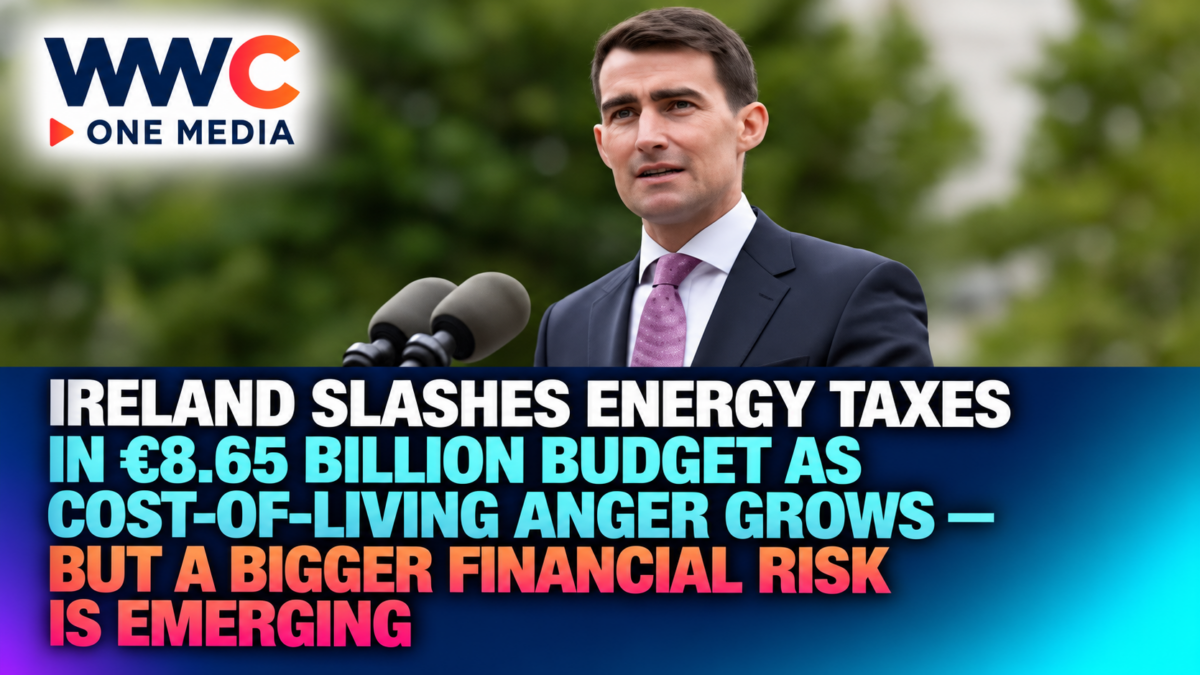
DUBLIN, IRELAND — Ireland has announced sweeping energy-tax relief in a €8.65 billion budget designed to ease mounting pressure on households, businesses and motorists as soaring fuel prices threaten to reignite public protests.
Finance Minister Simon Harris unveiled the measures on October 6, 2026, marking a significant reversal of the government’s previous climate-tax policy.
Under Budget 2027, Ireland will reduce carbon taxes on home-heating oil and natural gas, extend temporary petrol and diesel tax reductions, and introduce additional support for workers and families.
The government says the measures are intended to protect consumers from rising energy costs linked to the ongoing Middle East conflict.
But the policy shift also exposes a difficult financial balancing act.
Ireland is using its strong public finances to shield households from higher costs while becoming increasingly dependent on corporation taxes paid by a relatively small number of multinational companies.
The immediate relief could help families through the winter.
The bigger question is whether Ireland can continue supporting households without weakening the financial reserves it may need during a future economic downturn.
Ireland Makes a Major U-Turn on Carbon Taxes
One of the most important measures is a sharp reduction in carbon taxes on home-heating fuels.
The government announced that the carbon tax on kerosene and natural gas will fall from €63.50 to €48.50 per tonne of carbon dioxide emissions.
That represents a reversal of previous policy.
Before the announcement, the government had planned further increases that would have brought the rate to €78.50 per tonne by May 2027.
Those increases have now been abandoned for the affected fuels.
Harris also pledged that the reduced rates would remain unchanged for the rest of the government’s term.
The decision reflects growing concern about the financial burden facing households that rely on gas or heating oil.
Many families, particularly in rural areas, have limited immediate alternatives to fossil-fuel heating.
Reducing the tax is intended to provide relief without requiring households to replace their heating systems.
How Much Will Irish Households Save?
The lower carbon-tax rates are expected to produce direct savings for many households.
According to The Irish Times, the changes could reduce the cost of a typical 900-litre home-heating oil delivery by approximately €40.
Households using natural gas could save approximately €34 on an average annual gas bill.
The measure is expected to benefit around 1.5 million households that primarily use natural gas or heating oil.
However, these figures represent estimated savings attributable to the tax changes.
They do not guarantee that overall energy bills will fall by the same amounts.
Wholesale fuel prices, supplier charges and future market movements could offset some of the benefit.
That distinction matters because Ireland’s energy market remains exposed to international price volatility.
Petrol and Diesel Tax Relief Extended Until February 2027
Motorists are also receiving additional protection.
Ireland will extend temporary excise-duty reductions on petrol and diesel until February 28, 2027.
The measures were originally introduced in April following public anger over rising fuel prices.
They provide tax reductions equivalent to approximately:
€0.27 per litre of petrol
€0.32 per litre of diesel
The reductions had been scheduled to begin unwinding in November 2026.
Instead, the government will maintain them throughout the winter.
The restoration of the excise duties will then occur gradually in four phases, with the process scheduled to conclude by June 30, 2027.
The extension provides temporary relief for motorists, transport operators and businesses dependent on road transportation.
But it is not a permanent abolition of fuel excise duties.
Carbon Tax on Petrol and Diesel Is Being Frozen, Not Eliminated
Another important distinction concerns carbon taxes on road fuels.
While the carbon tax on home-heating oil and gas is being reduced, the government is taking a different approach to petrol and diesel.
The carbon-tax rate on these fuels will remain at €71 per tonne of CO₂ instead of rising to €78.50 as previously planned.
This means motorists will avoid an additional increase.
However, they will continue paying the existing carbon tax.
The policy combines a freeze on road-fuel carbon taxation with an extension of temporary excise-duty relief.
Both measures are intended to reduce pressure on consumers, but they operate through different tax mechanisms.
Energy Prices Have Become a Political Flashpoint
The Budget follows months of growing frustration over the cost of living.
Rising fuel prices have affected households, farmers, delivery companies and other businesses.
Ireland experienced significant fuel-related protests earlier in 2026.
The demonstrations highlighted growing dissatisfaction among motorists and industries heavily dependent on diesel.
The government responded with temporary fuel-tax reductions in April.
However, international energy pressures continued.
The conflict involving Iran and the wider Middle East has contributed to volatility in global oil and gas markets.
Because Ireland imports much of the energy it consumes, international price movements can have a substantial impact on domestic costs.
For the government, the political consequences are increasingly difficult to ignore.
Budget 2027 Includes €8.65 Billion in Measures
The energy-tax changes form part of a wider fiscal package.
Ireland’s Budget 2027 includes approximately €8.65 billion in measures, comprising around €7 billion in additional public spending and €1.65 billion in income-tax measures.
The government also announced changes designed to improve disposable income and reduce household expenses.
These include higher income-tax thresholds, increased social welfare payments, additional childcare support and housing-related tax relief.
The standard-rate income-tax cutoff will increase by €2,500 to €46,500.
That allows eligible workers to earn more before entering the higher income-tax band.
The government also announced additional support for families facing childcare expenses.
Together, the measures aim to reduce the impact of inflation while supporting domestic economic activity.
Ireland Can Afford Tax Cuts That Many European Countries Cannot
Ireland occupies an unusual position among European economies.
While several governments are struggling with large deficits and high borrowing costs, Ireland continues to benefit from substantial corporation-tax receipts.
The country’s public finances have been strengthened by profits generated by multinational companies operating there.
Major American technology and pharmaceutical businesses contribute significant amounts of tax revenue.
The Financial Times reported that Ireland expects a government surplus of approximately €6.7 billion in 2026, rising to around €9.5 billion in 2027.
These figures help explain why Ireland has room to introduce tax relief and increase public spending.
But they also highlight an important vulnerability.
Much of the country’s financial strength depends on corporate profits that could change unexpectedly.
Multinational Tax Revenue Is Ireland’s Biggest Fiscal Risk
Ireland’s economic model has attracted substantial foreign investment.
Companies operating in technology, pharmaceuticals and other high-value industries have helped generate employment, exports and government revenue.
However, the concentration of corporation-tax receipts creates risks.
A slowdown in global technology spending could affect corporate profitability.
Changes in international tax rules could alter where multinational profits are recorded.
And economic or political developments in the United States could influence investment decisions.
That means the government cannot assume that today’s unusually strong tax receipts will continue indefinitely.
The Irish Fiscal Advisory Council has repeatedly warned about relying too heavily on potentially volatile corporation-tax revenue.
The concern is particularly important when temporary revenue is used to finance spending commitments that may become permanent.
Fiscal Watchdog Warns Budget Could Weaken Public Finances
Ireland’s independent fiscal watchdog has raised concerns about the government’s spending plans.
Following the Budget announcement, the Irish Fiscal Advisory Council warned that the measures could place public finances on a weaker long-term path.
Its concern centers on the growing dependence on high-risk corporation-tax receipts.
The council also warned that spending increases could outpace sustainable revenue growth.
According to The Irish Times, the watchdog estimated that the underlying deficit, excluding excess corporation-tax receipts, could widen from approximately €12 billion in 2026 to €20 billion by 2030.
These are estimates of the underlying fiscal position, not the government’s headline budget surplus.
The difference is critical.
Ireland can report an overall surplus while still facing an underlying imbalance if exceptional multinational tax revenue is excluded.
Inflation Remains a Serious Problem
The government’s relief measures come as inflation continues to put pressure on households.
Reuters reported that Irish inflation had reached approximately 3.9%.
Higher energy costs have contributed to that pressure.
Fuel prices affect more than household heating and motorists.
They also influence transportation, agriculture, manufacturing and distribution.
When businesses face higher operating costs, some of those expenses may eventually be passed on to consumers.
That can increase food prices and the cost of other essential products.
Energy-tax reductions may help moderate those pressures.
However, they cannot eliminate the effects of global inflation or international supply disruptions.
Climate Policy Faces a Difficult Political Test
The carbon-tax reversal also raises questions about Ireland’s climate commitments.
Carbon taxes are intended to make fossil-fuel consumption more expensive and encourage households and businesses to adopt cleaner alternatives.
The government had previously planned gradual increases as part of its broader climate strategy.
Reducing the tax on home-heating fuels represents a significant departure from that approach.
Supporters of the change argue that households should not be penalized when affordable alternatives are unavailable.
They also contend that emergency energy-price pressures justify temporary or targeted relief.
Environmental critics may argue that freezing or reducing carbon taxes weakens incentives to transition away from fossil fuels.
The government must therefore balance immediate affordability with long-term emissions reduction.
That challenge is unlikely to disappear when international energy prices stabilize.
Renewable Energy Could Offer a Longer-Term Solution
Ireland’s exposure to fossil-fuel price volatility has renewed attention on energy security.
Reducing dependence on imported fuels could make households and businesses less vulnerable to global market shocks.
Renewable electricity, home insulation, heat pumps and improved energy efficiency could all contribute to that goal.
However, transitioning away from fossil-fuel heating requires investment.
Many households cannot afford major renovations or new heating systems without financial assistance.
That means carbon-tax policy is only one part of the solution.
The government must also consider how to make cleaner alternatives affordable and accessible.
Otherwise, families may remain dependent on fuels whose prices are determined largely by international events.
Fuel Protest Leaders Say the Budget Does Not Go Far Enough
Despite the concessions, the government’s measures have not satisfied all critics.
The Irish Examiner reported on October 6 that fuel protest organizers were considering renewed demonstrations.
They argued that extending existing tax relief does not sufficiently reduce petrol and diesel prices.
For motorists already struggling with high fuel costs, avoiding a future tax increase may provide less immediate relief than a further reduction in pump prices.
The continuing threat of protests illustrates the political challenge facing the government.
Even substantial fiscal measures may fail to satisfy voters if their day-to-day expenses remain elevated.
That could place pressure on ministers to consider additional assistance.
Why the Budget Matters Beyond Ireland
Ireland’s policy response offers a useful example of how governments are managing the economic consequences of global energy volatility.
Countries around the world face similar pressures.
Households want protection from expensive fuel.
Businesses want predictable operating costs.
Governments need sufficient revenue.
And policymakers remain committed to longer-term energy transitions.
Ireland’s approach demonstrates that even governments with relatively strong public finances may struggle to balance these competing priorities.
The decision to reduce carbon taxes could also influence debates elsewhere in Europe.
However, other governments may not have the same financial flexibility.
Ireland’s unusually strong corporation-tax revenues make its fiscal position different from that of many European neighbors.
The Real Test Comes When Temporary Relief Ends
The government has made clear that some fuel-tax reductions will eventually be reversed.
Temporary petrol and diesel excise-duty relief is scheduled to begin unwinding after February 2027.
The full restoration is planned by the end of June.
That timetable could create another political challenge.
If global fuel prices remain high, restoring taxes may increase costs for motorists and businesses.
The government could then face renewed pressure to extend relief.
But repeated extensions would reduce tax receipts and complicate fiscal planning.
At the same time, the commitment to keep home-heating carbon taxes frozen could reduce future revenue relative to previous policy plans.
The longer energy-price pressures continue, the harder it may become to restore the original tax framework.
Ireland Has Bought Relief—But Not Energy Security
Budget 2027 provides immediate support for households and businesses.
The reduction in home-heating carbon taxes will lower tax-related costs for many families.
The extension of fuel-duty reductions will protect motorists from scheduled increases through the winter.
Additional tax and welfare measures will support disposable income.
But the Budget does not eliminate Ireland’s dependence on volatile international energy markets.
Nor does it resolve the government’s increasing reliance on multinational corporation-tax receipts.
Those challenges will continue beyond the current fiscal year.
Ireland has chosen to ease the burden on households today, even if doing so means reversing part of its long-term carbon-tax strategy.
The bigger question is whether the government can maintain that relief if energy prices remain elevated, public spending continues growing and the multinational tax revenues supporting its budget begin to weaken.
For Irish households, the immediate benefit is lower energy taxation. For policymakers, the real challenge may come when the financial cost of maintaining that protection becomes harder to ignore.