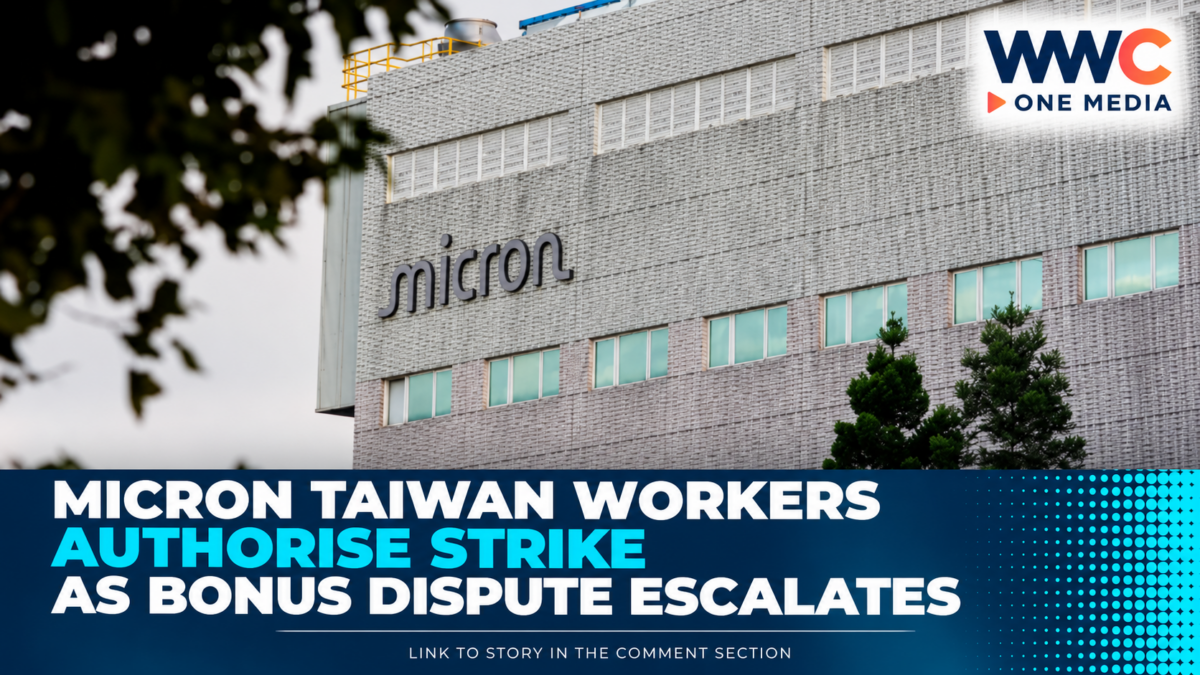
TAIPEI, Taiwan — Workers at Micron Technology’s Taoyuan operations have overwhelmingly authorised strike action in a dispute over the company’s bonus system, escalating a labour conflict at one of the world’s major memory-chip production hubs.
The Taoyuan union said 1,994 members voted in favour of strike action, representing 99 per cent of those who cast valid ballots. Of 2,258 eligible members, 2,012 voted, meaning 88.3 per cent of the entire eligible membership backed the move.
However, the vote does not mean a strike has started. The union has not set a date for industrial action and is still considering its next steps, including the possibility of a short-notice or “surprise” strike if negotiations fail.
Bonus dispute at the centre of conflict
The dispute centres on Micron’s Incentive Pay Plan (IPP) and the union’s demand for a more transparent and permanent profit-sharing arrangement.
The Taoyuan union wants a system under which 15 per cent of Micron’s operating profit would be distributed to employees. Union leaders argue that the existing system does not adequately share the company’s strong financial performance with workers and has limitations on incentive payments.
The disagreement comes after a strong year for Micron, driven in large part by demand for memory chips used in artificial intelligence infrastructure.
The union criticised the company for announcing its fiscal 2026 employee rewards while mediation was still underway, arguing that the payments did not resolve its demand for a permanent profit-sharing mechanism.
Micron offered large one-time rewards
Micron announced in September that Taiwan-based employees would receive substantial additional rewards following what the company described as an “extraordinary year”.
The package included a NT$1 million cash bonus, equivalent to about US$31,400, for employees in Taiwan. Micron said the broader package could bring total employee rewards for the fiscal year to between roughly 35 and 68 months of base pay, depending on the employee and compensation structure.
The union, however, argues that one-time payments do not replace the permanent profit-sharing mechanism it is seeking.
The company has said it respects its employees’ legal rights and remains committed to engaging with unions through established dialogue and mediation processes.
No strike date has been announced
Despite the overwhelming strike vote, there is still an opportunity for the dispute to be resolved through negotiations.
Union chairman Jerry Lin said the union hopes Micron’s board will put forward concrete proposals following meetings scheduled in the United States on Oct. 8 and 9.
If negotiations fail, the union has not ruled out announcing strike action at short notice.
The union is also encouraging members to take leave and attend a rally in Taipei on Oct. 19, although it has stressed that the rally itself is not a strike.
Why a Micron strike matters to the chip industry
The labour dispute carries significance beyond Micron’s workforce because Taiwan is a major manufacturing centre for memory semiconductors.
Micron employs about 15,000 people in Taiwan, with separate unions representing employees at its Taoyuan and Taichung operations. Together, the unions represent more than 80 per cent of Micron’s Taiwan workforce.
Micron’s Taiwan facilities produce DRAM and high-bandwidth memory (HBM) products, which are increasingly important for AI servers and data-centre infrastructure.
A prolonged disruption could therefore add pressure to an already tight memory-chip market, although the extent of any supply impact would depend on whether a strike actually occurs and how long it lasts.
Taoyuan is not the only union in dispute with Micron
Micron’s Taichung union is also negotiating with management but has not yet authorised a strike.
A second round of mediation is scheduled for Oct. 22, and the Taichung union has indicated that it could consider a strike vote if talks fail to produce progress.
The situation therefore remains fluid, with Micron facing pressure from organised workers at more than one of its Taiwan operations.
The Taoyuan union’s decision is nevertheless the first major escalation to receive formal strike authorisation.
Company says it remains committed to negotiations
Micron said it takes employees’ concerns seriously and remains committed to working with its unions in good faith.
The company has not indicated that it accepts the union’s proposed 15 per cent profit-sharing model.
Instead, it has pointed to the existing dialogue and mediation process as the appropriate avenue for resolving the dispute.
Taiwan’s labour ministry said it respected the union’s decision and urged Micron to take workers’ concerns seriously, put forward concrete proposals and continue negotiations.
AI boom puts workers and chipmakers under pressure
The dispute comes at a time when the semiconductor industry is benefiting from exceptionally strong demand for memory used in AI systems.
Micron has been among the companies benefiting from the rapid expansion of AI infrastructure, while tight supplies have increased the strategic importance of its manufacturing capacity.
That environment has also strengthened workers’ argument that employees should receive a greater share of the financial gains generated by the company’s performance.
For Micron, however, any prolonged disruption would come at a sensitive time for an industry where production capacity, delivery schedules and supply commitments are closely watched by customers.
What happens next
For now, there is no confirmed Micron strike in Taoyuan.
The union has secured authorisation to strike, but the next step depends on negotiations and the company’s response to workers’ demands.
The Oct. 19 rally and upcoming discussions with Micron management could provide opportunities for the two sides to reach an agreement before industrial action begins.
If no settlement is reached, the possibility of a strike at Micron’s Taoyuan operations could become an increasingly important issue for the global memory-chip market.
For workers, the dispute is about establishing a more transparent and lasting way to share in Micron’s profits. For the company and its customers, the immediate concern is avoiding a disruption at a critical point in the global AI semiconductor supply chain.