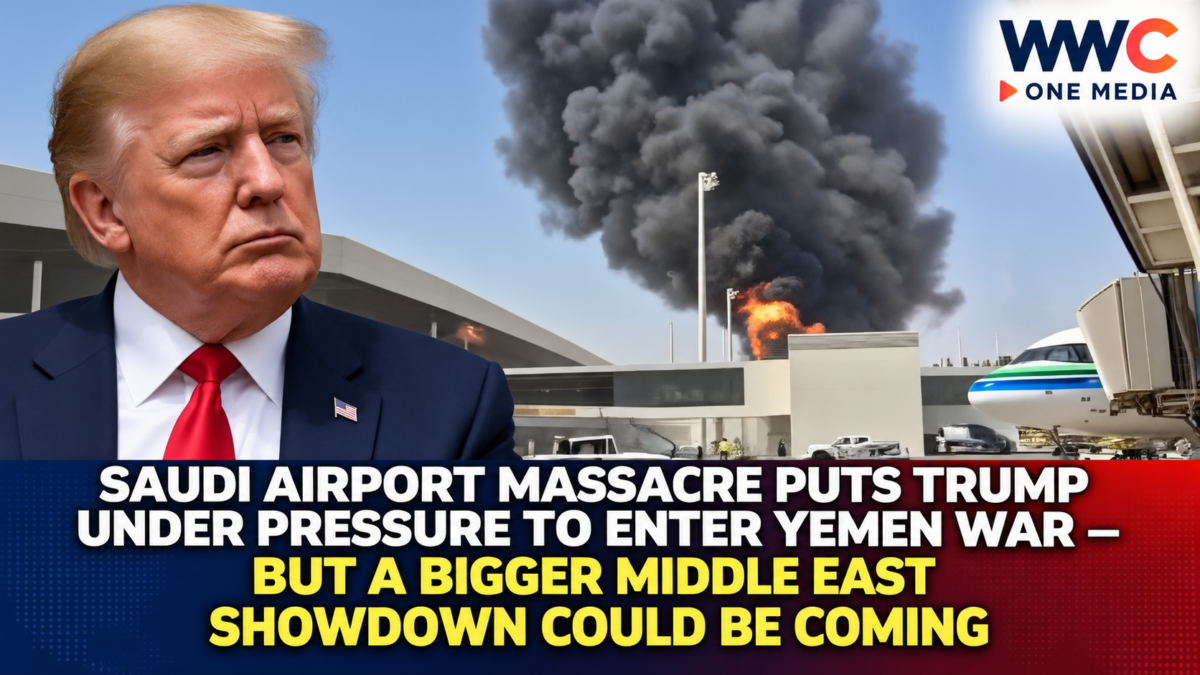
RIYADH, Saudi Arabia / WASHINGTON — October 14, 2026 — A series of deadly missile and drone strikes against Saudi Arabia’s main international airport has triggered a dangerous escalation in the Middle East, placing US President Donald Trump under growing pressure to expand American military involvement in Yemen.
The attacks on King Khalid International Airport in Riyadh killed more than a dozen people, including an American citizen, and wounded hundreds, according to Saudi authorities and international news agencies.
The violence has disrupted flights, shaken confidence in the kingdom’s air defenses and intensified fears that Yemen’s conflict could become another major front in the wider confrontation involving the United States and Iran.
Bloomberg reported on October 12 that Washington was considering whether to increase its role in the Saudi-led campaign against Yemen’s Iran-aligned Houthi movement.
The United States is already assisting Saudi Arabia with intelligence, targeting information and aerial refueling, according to Bloomberg. But directly joining Saudi-led attacks would represent a significant expansion of that role.
Trump has publicly indicated that such involvement is under consideration.
The pressure intensified on October 13, when the president accused the Houthis of attempting to manipulate energy prices ahead of the November US midterm elections.
Meanwhile, fighting continued in Yemen, Saudi Arabia launched fresh strikes against Houthi-controlled facilities, and Saudi energy infrastructure faced renewed attacks.
The Saudi airport strikes have turned a regional security crisis into a major test for Washington. But the bigger question is whether direct US intervention would deter the Houthis — or draw America into another prolonged war while global oil supplies remain under threat.
Deadly Attack on Riyadh’s Main Airport
The most devastating incident occurred on Saturday, October 10, when a missile struck King Khalid International Airport.
Saudi authorities initially reported at least 12 deaths and more than 300 injuries.
Among the victims were Saudi citizens and foreign nationals, including a citizen of the United States.
Reuters identified the initial reported fatalities as four Saudis, two Bangladeshis and citizens of the United States, Jordan, Palestine, Syria, Sudan and Egypt.
The attack struck a major civilian transportation hub used by international travelers.
Airport operations were suspended, flights were diverted and emergency services transported casualties to hospitals.
Saudi authorities condemned the strike, while the Houthis claimed responsibility.
Subsequent reports revised the death toll and counted additional attacks. Bloomberg reported at least 16 fatalities across the weekend assaults; Reuters and other outlets have published differing later totals.
The most important verified point is that multiple attacks caused mass civilian casualties. Their reported death tolls should not be treated as a single fixed figure without specifying the date and source.
Another Projectile Hits the Airport on Sunday
The violence continued on October 11.
Saudi officials reported that another projectile struck Terminal 4 of King Khalid International Airport.
The attack killed a Pakistani national and wounded 11 people.
It also triggered a fire and caused further disruption.
Saudi-led coalition officials reported additional missile and drone activity around the kingdom.
The repeated attacks raised serious questions about airport security and the effectiveness of Saudi Arabia’s defensive systems.
They also showed the Houthis’ ability to continue launching strikes despite Saudi military operations.
For passengers and airlines, the uncertainty created immediate safety concerns.
International flight connections were affected, while governments and diplomatic missions issued warnings about the deteriorating security environment.
Why Trump Is Considering a Larger US Role
Saudi Arabia is a longstanding strategic partner of the United States.
The two countries cooperate on military training, intelligence, weapons procurement and regional security.
Washington also has major interests in preventing disruptions to international oil markets and Red Sea shipping routes.
But the latest attacks create a difficult decision for Trump.
A stronger military response might help reassure Saudi Arabia and increase pressure on the Houthis.
It could also expose US personnel and facilities to retaliatory attacks.
According to Bloomberg, the United States has already provided support to the Saudi campaign through intelligence, targeting and aerial refueling.
The president has said he is considering joining attacks against the Houthis.
However, as of October 14, the reporting reviewed does not establish that Trump has formally authorized the specific expanded intervention discussed in Bloomberg’s article.
Planning, public threats and military action are separate developments.
Trump Accuses Houthis of Trying to Drive Up Oil Prices
On October 13, Trump accused the Houthis of deliberately escalating attacks to increase oil prices before the US midterm elections.
The president linked their actions to Iranian influence and the broader conflict in the Middle East.
Higher fuel prices have become politically sensitive in the United States.
Expensive gasoline and diesel can affect transportation, manufacturing, agriculture and household spending.
The conflict has already generated substantial uncertainty in international energy markets.
However, Trump’s assertion about the Houthis’ intended electoral impact remains a political and intelligence-related claim.
The militants have publicly framed their attacks around the Saudi-led military campaign and the wider regional conflict.
Their stated justification does not excuse attacks on civilians, but it is important to distinguish a group’s declared motives from an independently proven plan to influence American elections.
Saudi Arabia’s Air Defenses Face a Serious Test
Saudi Arabia has spent heavily on sophisticated military systems, including American-made equipment.
Yet protecting an enormous country against repeated missile and drone attacks is difficult.
The Houthis have developed more advanced capabilities over years of fighting.
They have used ballistic missiles, cruise missiles and armed drones to strike infrastructure and military targets.
Some weapons can approach from different directions, complicating detection and interception.
Large international airports are particularly sensitive targets because even a limited attack can disrupt thousands of passengers.
Associated Press reporting highlights the challenges facing Saudi defenses despite the kingdom’s considerable military resources.
The issue is not necessarily that every defensive system has failed.
Rather, a determined opponent can launch repeated attacks that impose substantial costs and occasionally penetrate a country’s defenses.
Saudi Warning System Comes Under Scrutiny
Reuters reported on October 12 that Saudi Arabia’s public missile-warning system had stopped issuing alerts before the deadly airport attacks.
The report raised questions about why members of the public had not received warnings ahead of the strikes.
Early-warning systems are important because they can give civilians time to seek shelter.
However, their effectiveness depends on reliable detection and sufficient time between an identified threat and its impact.
Saudi officials had not publicly provided a complete explanation of the reported interruption.
The absence of public alerts therefore deserves scrutiny, but it should not be presented as proof of deliberate wrongdoing without further evidence.
The airport tragedy has made civilian protection an increasingly urgent issue.
Saudi Arabia Intensifies Its Military Campaign in Yemen
Saudi Arabia is responding through renewed military operations.
Saudi-backed forces have been attempting to regain strategic territory in Yemen, particularly around the Red Sea coast and Bab al-Mandab Strait.
The area is crucial because it connects the Red Sea with the Gulf of Aden.
Controlling territory around the waterway provides military and commercial advantages.
The Houthis have resisted the offensive and launched retaliatory attacks against Saudi targets.
On October 13, Saudi-led strikes hit facilities in Houthi-controlled Yemen, including fuel-related infrastructure near Sanaa.
The Houthis subsequently targeted locations in Saudi Arabia, including the area around the headquarters of Saudi Aramco in Dhahran.
The exchange underscores the danger of escalation.
Each side has incentives to demonstrate military strength, but repeated retaliation can make negotiations more difficult.
Saudi Aramco Attack Raises New Oil Security Fears
The reported attack near Saudi Aramco’s headquarters added another concern to the crisis.
Saudi Arabia is one of the world’s most important oil-producing countries.
Its energy infrastructure is critical to global supply.
The October 13 incident reportedly caused limited damage, and the accounts reviewed did not establish major disruption to Aramco’s nationwide production.
Nevertheless, threats to energy facilities can influence market expectations.
Oil traders consider not only the quantity of crude currently available but also the possibility of future disruptions.
If investors believe production, storage or transportation infrastructure could be attacked, prices may rise even before physical supply is significantly affected.
The latest violence therefore has consequences beyond the immediate military battlefield.
Oil Prices Rise as Middle East Risks Intensify
Reuters reported that oil prices increased on October 12 amid renewed attacks and regional uncertainty.
Brent crude traded around $106.65 a barrel in that report.
US West Texas Intermediate crude rose to approximately $93.74.
These are prices reported for that trading session, not a guaranteed current market quotation.
The market is responding to several overlapping risks.
They include conflict involving Iran, threats to maritime routes, attacks on Saudi infrastructure and uncertainty over energy exports.
A wider US military campaign in Yemen could increase volatility.
However, the effect on oil prices would depend on the scope of operations, shipping disruptions and the response of other producers.
Higher prices are a risk, not an inevitable outcome of every military escalation.
The Bab al-Mandab Strait Could Become Another Major Flashpoint
The Bab al-Mandab Strait is among the most strategically important maritime passages in the world.
It connects the Red Sea to the Gulf of Aden.
Commercial vessels using the Suez Canal typically transit through this area.
The Houthis have demonstrated the ability to threaten shipping with missiles, drones and other weapons.
The route’s importance has increased as disruptions around the Strait of Hormuz have complicated energy transportation.
Additional instability in the Bab al-Mandab could force shipping companies to reconsider routes.
Longer journeys around Africa may increase fuel consumption, transit times and transportation costs.
Those expenses can eventually affect businesses and consumers far from the Middle East.
However, the precise impact depends on actual maritime conditions and shipping decisions.
Houthis Warn Against Direct American Intervention
The Houthis have indicated that a deeper US military role could trigger retaliation.
Their political representatives have warned that American interests could become targets if Washington joins the Saudi offensive.
The warnings raise the stakes for US policymakers.
A direct attack on Houthi positions might weaken some military capabilities.
But it could also provoke further attacks against American assets or regional partners.
The consequences would depend on the type of operation and the militants’ response.
This creates a familiar strategic dilemma.
Military pressure may provide short-term deterrence, but it can also deepen a conflict if neither side has a credible path toward de-escalation.
Iran’s Role Complicates Washington’s Decision
Iran has long been associated with support for the Houthi movement.
The relationship includes military technology, training and political backing, according to Western and regional assessments.
But the Houthis also have their own political objectives and operate within Yemen’s domestic conflict.
Not every tactical decision should automatically be attributed to direct Iranian orders without evidence.
The broader US-Iran confrontation makes the situation particularly dangerous.
Actions in Yemen could influence security conditions elsewhere in the Middle East.
The possibility of retaliation against energy infrastructure or international shipping gives both Washington and Riyadh additional reasons to assess the consequences of escalation carefully.
Iran has also indicated interest in mediation, although an effective diplomatic agreement has not emerged from the latest exchanges.
Saudi Arabia’s Economic Transformation Is Under Threat
The violence comes at a difficult time for Crown Prince Mohammed bin Salman’s economic ambitions.
Saudi Arabia is seeking to expand tourism, entertainment, foreign investment and industries beyond oil.
Major airports, conference centers and transport infrastructure are central to that strategy.
The kingdom has also been hosting important international energy and business events.
Repeated missile attacks create reputational and economic risks.
Companies may reconsider travel plans, delay investments or increase security spending.
However, the scale of the longer-term economic impact cannot yet be measured reliably.
The attacks create uncertainty, but they do not establish that Saudi Arabia’s broader economic development plans have been abandoned.
Yemen’s Humanitarian Crisis Is Getting Worse
Behind the regional security debate is a worsening humanitarian emergency.
The International Organization for Migration reported on October 7 that more than 200,000 people had been displaced in Yemen since the renewed fighting intensified in September.
Families have fled combat zones with limited access to shelter, food and essential services.
The United Nations estimates that more than 22 million people in Yemen will require humanitarian assistance and protection during 2026.
Approximately 18.3 million people are acutely food insecure.
The humanitarian situation is especially severe in communities already affected by years of conflict.
An expanded international military campaign could further damage civilian infrastructure and complicate relief operations.
Any response to the airport attacks must therefore consider the safety of civilians on both sides of the border.
Renewed Fighting Around Taiz Deepens the Emergency
Yemen’s Taiz region has experienced renewed fighting and worsening humanitarian conditions.
Reuters reported on October 13 that shelling, road restrictions and rising prices were making daily life increasingly difficult.
Access to food, water and transportation has deteriorated.
The strategic significance of Taiz and surrounding territory has made the area an important battleground.
But military operations have also increased hardship for ordinary families.
The crisis demonstrates why Yemen cannot be understood solely through the lens of Saudi Arabia, Iran or US security policy.
It is also a domestic conflict involving fragmented political authorities and millions of vulnerable civilians.
What the Philippines and Asia Should Watch
The regional escalation has potential implications for Asian economies.
Many countries depend heavily on energy imports, and international oil prices influence transportation and production costs.
For the Philippines, sustained energy-price increases could create pressure on fuel expenses, electricity costs and inflation.
The Middle East is also an important destination for overseas Filipino workers.
Security warnings and flight disruptions can affect travel planning and overseas employment logistics.
However, no specific new Philippine evacuation order or confirmed casualty among Filipino nationals has been established by the sources reviewed for this article.
Any country-specific developments should be based on announcements from Philippine authorities.
The broader Asian concern is that prolonged disruption to oil supplies and maritime trade could raise costs across regional economies.
What Happens Next?
Several developments will determine whether the crisis escalates further.
US military decision: Washington must decide whether to maintain its current support or authorize additional operations.
Saudi airport security: Authorities will need to stabilize civilian aviation and strengthen defenses against repeated attacks.
Houthi retaliation: Further launches against airports, oil facilities or shipping could increase pressure for a military response.
Saudi military operations: The outcome of the campaign in Yemen will influence the Houthis’ ability to retain strategic territory.
Energy markets: Traders will watch for disruptions to production, exports and maritime transportation.
Diplomatic efforts: Regional governments may pursue talks to prevent further escalation.
Humanitarian conditions: The scale of displacement, hunger and civilian casualties will remain a critical measure of the conflict’s impact.
The Bigger Question: Will Trump Enter Another Middle East War?
The Riyadh airport attacks have transformed an already volatile security situation.
Saudi Arabia has demonstrated that even advanced military defenses cannot eliminate the threat from repeated missile and drone strikes.
The Houthis have shown they can impose significant human and economic costs.
The United States now faces pressure to act more forcefully on behalf of a key regional partner.
But the decision carries serious consequences.
A military escalation could increase pressure on the Houthis and reassure Saudi Arabia.
It could also expose American forces to retaliation, widen the conflict and further threaten international shipping.
Diplomatic restraint offers another possibility but may be politically difficult after the deaths of civilians, including an American.
For Trump, the crisis intersects with energy prices, domestic electoral pressure and the broader confrontation with Iran.
Saudi Arabia’s deadly airport attacks have brought the Yemen war closer to direct American involvement. But the biggest decision remains ahead: Will Trump expand US military action to protect a key ally — or could that choice ignite a larger regional conflict, sending oil prices higher and trapping Washington in another costly Middle East war?