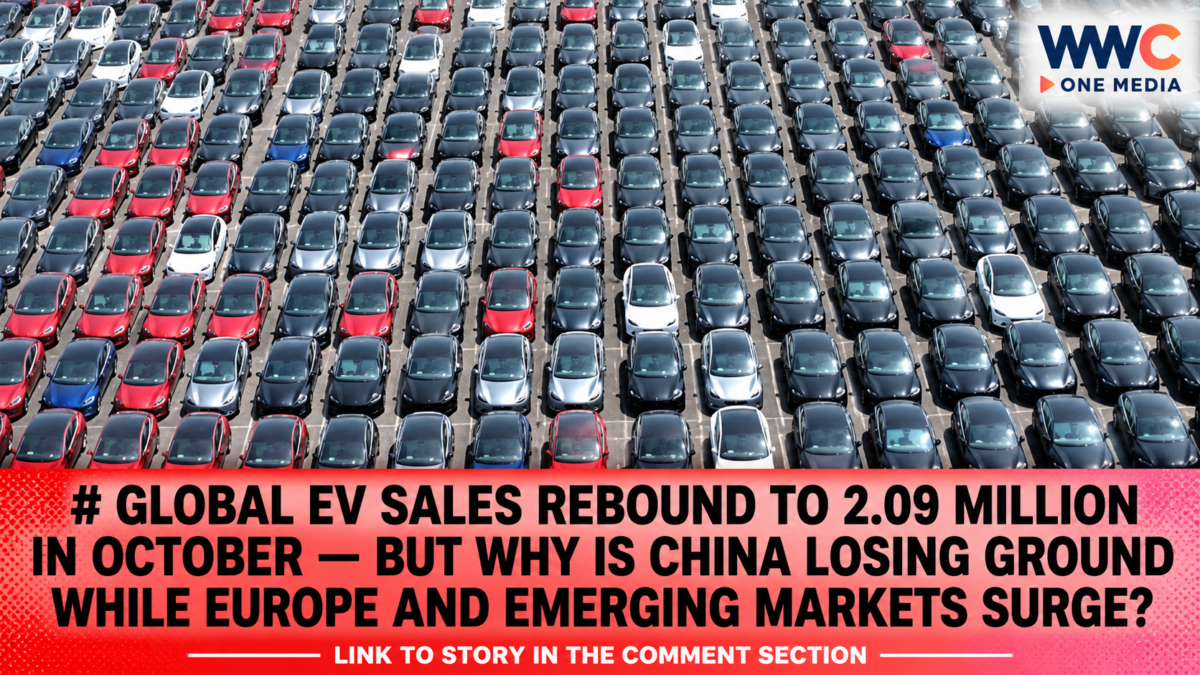
GLOBAL — The worldwide electric-vehicle market has returned to growth, with more than 2 million battery-electric and plug-in hybrid vehicles sold in October 2026. But beneath the encouraging headline is a dramatic shift in where the industry’s momentum is coming from.
Global sales of new battery-electric vehicles (BEVs) and plug-in hybrid electric vehicles (PHEVs) increased 8% year over year to approximately 2.09 million units, according to figures released by UK-based research firm Benchmark Mineral Intelligence on November 12.
The latest figures ended the previous month’s annual decline and lifted worldwide sales for the first 10 months of 2026 to approximately 17.5 million vehicles, up 5% from the same period last year.
However, the recovery is not being driven equally by the world’s biggest automotive markets.
Europe delivered another strong performance, North America returned to annual growth, and markets outside the traditional EV powerhouses expanded rapidly. China, meanwhile, recorded another year-over-year decline in its domestic EV market as manufacturers increasingly relied on overseas buyers.
The numbers suggest that electric vehicles are not losing their global appeal. Instead, the market is undergoing a major geographical shift — one that could reshape the competition between Chinese manufacturers, European automakers and established American brands.
GLOBAL EV SALES CLIMB 8% AS THE MARKET RETURNS TO GROWTH
Benchmark Mineral Intelligence reported that worldwide sales of battery-electric and plug-in hybrid vehicles reached 2.09 million units in October.
That represented an 8% increase compared with October 2025, although sales were approximately 3% lower than September’s 2.15 million units.
The distinction matters.
The annual increase indicates that the market is selling more electrified vehicles than it did a year ago. The monthly decline, however, shows that sales did not continue September’s record-setting pace.
For January through October, global EV sales reached approximately 17.5 million units, representing 5% growth year over year.
The industry is therefore expanding, but not at the same speed across every region.
The latest performance also follows a difficult September, when global EV sales declined 2% year over year. At that time, weakness in China and North America outweighed Europe’s record-breaking performance.
October’s figures suggest that the global market has regained some momentum, although the underlying regional differences remain significant.
EUROPE BECOMES ONE OF THE BIGGEST DRIVERS OF EV GROWTH
Europe emerged as one of the strongest performers in October.
The region recorded approximately 510,000 EV sales, representing a 36% increase compared with the same month last year.
Battery-electric vehicles were particularly strong, with sales increasing 49%, while plug-in hybrids grew by 7%, according to Benchmark data reported by Electrek.
The performance reflects several factors supporting Europe’s transition toward electric mobility.
Government incentives, rising fuel prices, European Union emissions requirements and a growing selection of electric models have helped encourage consumers to consider alternatives to conventional petrol and diesel vehicles.
Germany was among the notable performers. Fully electric vehicle sales there reportedly rose almost 80% year over year to more than 95,000 units.
The United Kingdom also recorded a 30% annual increase, while Portugal saw electric vehicles account for approximately 55% of new car sales in October.
Nevertheless, October sales were 17% lower than September’s total. September had benefited from seasonal registration activity in some European markets, particularly the United Kingdom.
The stronger year-over-year comparison provides a clearer indication of the region’s underlying expansion.
Europe’s performance is becoming increasingly important because it demonstrates that EV demand can continue growing even as other major markets experience temporary weakness.
CHINA’S DOMESTIC EV MARKET WEAKENS — BUT EXPORTS ARE BOOMING
China remains the world’s largest electric-vehicle market, but its latest performance reveals a growing contradiction.
Benchmark estimated that Chinese EV sales reached approximately 1.14 million units in October, down 12% from the same month in 2025.
However, Chinese manufacturers are increasingly finding customers outside their domestic market.
Benchmark reported that passenger-car new-energy vehicle exports approached 600,000 units in October, setting another monthly record.
Separate figures from China’s automotive industry association, reported by CnEVPost, showed that total new-energy vehicle exports reached approximately 606,000 units, up around 140% year over year.
These figures use a broader Chinese new-energy vehicle classification, which includes battery-electric vehicles, plug-in hybrids and other electrified vehicle categories. They should not be treated as identical to Benchmark’s global passenger and light-duty EV sales figures.
The export boom is particularly important because domestic demand remains under pressure.
The Associated Press reported that China’s total passenger-vehicle exports reached approximately 927,000 units in October, up 62.3% year over year. Domestic passenger-vehicle sales, meanwhile, declined 27.4% to approximately 1.7 million units.
The figures illustrate why Chinese automakers are increasingly looking overseas.
With intense competition, price pressure and weaker domestic demand, international markets are becoming an increasingly important destination for manufacturers seeking to maintain production and sales growth.
For a closer look at how this export expansion is changing the international automotive industry, read WWC ONE MEDIA’s report, China’s 7-Million-Car Export Boom Puts BYD and Chery on Global Collision Course — But Could Tariffs and Hidden Costs Crush Their Profits?.
NORTH AMERICA RETURNS TO GROWTH — BUT THERE IS A CATCH
North America recorded approximately 130,000 EV sales in October, an increase of 24% compared with October 2025.
It was the region’s first year-over-year increase of 2026.
At first glance, this looks like a significant turnaround for the North American electric-vehicle industry.
But Benchmark data manager Charles Lester warned that the improvement needs to be viewed in context.
October 2026 was the first month being compared with a period after the expiration of the US federal electric-vehicle tax credit.
The federal incentive ended for vehicles acquired after September 30, 2025. Its expiration triggered a sharp decline in American EV sales, creating a much lower comparison base for October 2026.
In other words, the latest annual increase does not automatically mean US demand has returned to its previous levels.
Benchmark described the American market as having stabilised at a lower level rather than fully recovered.
North American sales were also broadly flat compared with September, while the region remained down approximately 21% for the first 10 months of the year.
That makes the distinction between an annual rebound and a genuine recovery particularly important.
Automakers still face questions about affordability, consumer incentives, charging access and the ability to sell electric vehicles without relying heavily on government support.
EMERGING MARKETS ARE GROWING FASTER THAN THE TRADITIONAL EV POWERHOUSES
Perhaps one of the most striking findings from October’s report is the performance of markets outside China, Europe and North America.
These markets recorded approximately 300,000 EV sales, representing an 85% year-over-year increase.
For the first 10 months of 2026, sales in these markets reached approximately 2.6 million units, up 93%.
Their combined monthly sales were also higher than North America’s October total.
The growth reflects the increasing availability of Chinese electric vehicles, expanding model choices and rising interest in electrified transportation across countries in Asia, Latin America and other regions.
Australia and Brazil were among the markets reporting particularly strong growth.
However, rapid sales expansion does not necessarily mean every manufacturer is making healthy profits. Greater competition, discounting, distribution costs and uneven charging infrastructure can make it difficult for companies to convert rising sales into sustainable earnings.
This is one reason the global EV market is becoming more complicated: more countries are buying electric vehicles, but manufacturers must still compete on price, technology, reliability and after-sales support.
WHAT THE GLOBAL EV BOOM MEANS FOR THE PHILIPPINES
The changing global market is particularly relevant to Southeast Asia, where Chinese automakers are expanding their presence and electric-vehicle adoption is gaining momentum.
The Philippines is one example.
BYD Cars Philippines reported sales of 28,399 vehicles from January through August 2026, representing approximately 99% growth compared with the same period in 2025.
The company had already surpassed its full-year 2025 sales total with four months remaining in 2026.
The expansion reflects growing consumer interest in electrified transportation and the increasing availability of vehicles from Chinese manufacturers.
WWC ONE MEDIA previously examined the company’s local performance in BYD Philippines Nearly Doubles Sales to 28,399 Units — But One Type of Vehicle Is Driving Almost 80% of the Boom.
The broader Philippine automotive market is also showing signs of transition.
Industry figures reported by WWC ONE MEDIA showed that electrified-vehicle sales among CAMPI and TMA members increased sharply during the first eight months of 2026, even as total vehicle sales weakened.
The report, Philippine Vehicle Sales Plunge 18% in August as Bad Weather Disrupts Market, While EV Demand Surges, highlighted the contrast between a softer conventional vehicle market and rising demand for electrified models.
But selling more EVs is only part of the challenge.
The country also needs accessible charging stations, reliable electricity, trained technicians and stronger after-sales support.
The expansion of charging infrastructure is therefore becoming increasingly important. WWC ONE MEDIA explored that issue in Festival Mall’s EV Charger Now Doubles as a Digital Billboard — But Filinvest’s Bigger Plan Goes Beyond One Mall.
For Filipino motorists, a growing selection of electric and hybrid vehicles could mean more choices and potentially more competitive prices. However, the actual benefits will depend on vehicle pricing, financing, maintenance costs and the availability of convenient charging facilities.
TESLA, BYD AND OTHER AUTOMAKERS FACE A MORE COMPETITIVE MARKET
The latest figures also highlight the increasingly complex competitive environment facing established EV manufacturers.
Tesla remains one of the world’s most influential electric-vehicle companies, but it is competing in a market where Chinese manufacturers are expanding internationally and traditional automakers are increasing their electric offerings.
Tesla delivered 486,532 vehicles in the third quarter of 2026, exceeding Wall Street expectations, although deliveries remained slightly below the same period a year earlier.
That performance demonstrated the company’s continuing scale, but also highlighted the difference between beating market forecasts and achieving year-over-year growth.
WWC ONE MEDIA previously examined those contrasting trends in Tesla Delivers 486,532 Vehicles and Beats Wall Street — But the Bigger EV Recovery Is Far From Even.
For Chinese manufacturers such as BYD, the international expansion offers an opportunity to reach customers beyond a domestic market facing intense competition.
But overseas growth also creates new risks.
Trade restrictions, tariffs, local manufacturing requirements and changing tax incentives could affect the economics of exporting vehicles.
The European Union and China, for example, have been discussing trade measures affecting Chinese-built electrified vehicles. China has also announced changes to its export VAT rebate policy for new-energy vehicles that are scheduled to take effect in 2027.
These developments could influence where manufacturers build vehicles, how much they charge and which markets receive priority.
IS THE ELECTRIC-VEHICLE INDUSTRY ENTERING A NEW PHASE?
October’s figures offer encouraging news for the global electric-vehicle industry, but they do not prove that every market has recovered.
Europe is expanding strongly. Emerging markets are growing rapidly. North America has returned to annual growth, although the comparison base makes the rebound less impressive than the headline suggests.
China remains the largest EV market, but its manufacturers are increasingly dependent on exports as domestic demand weakens.
That combination could change the balance of power in the global automotive industry.
For consumers, more competition could mean additional choices, improved technology and potentially more affordable electric vehicles.
For automakers, however, the challenge is becoming more demanding. They must expand sales while protecting profit margins, navigating trade restrictions and investing in the infrastructure needed to support a larger electric fleet.
The global EV market has returned to growth.
But the bigger question is no longer simply whether people are buying electric cars.
It is which countries, manufacturers and consumers will benefit most as the next phase of the electric-vehicle transition unfolds.