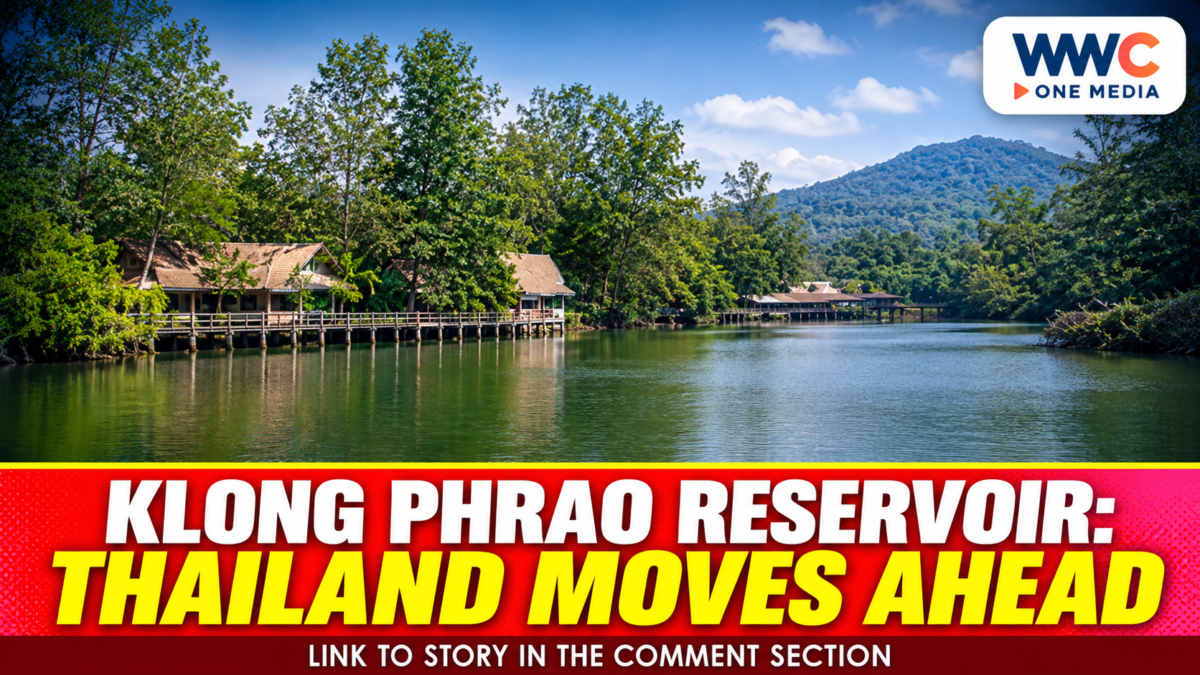
Thailand’s plan to build the Klong Phrao Reservoir on Koh Chang has reached another important government milestone, but official records show that environmental safeguards remain a central issue. On Nov. 3, 2026, the Cabinet approved in principle a draft royal decree to remove approximately 79 rai and 40 square wah of land from Mu Ko Chang National Park so the Royal Irrigation Department can proceed with the reservoir project. Thai Government
The decision could help address Koh Chang’s long-standing water supply problems, particularly during the dry season. But it also brings a difficult trade-off into focus: the island needs more reliable water infrastructure, while the land involved forms part of a nationally protected natural area.
The government’s own documents make clear that the project has undergone environmental assessment. They also show that authorities previously raised concerns about water quality, wastewater, forest loss and the need to protect biodiversity. That makes the central question bigger than whether the reservoir can be built. It is whether the environmental protections attached to the project will be properly implemented.
Why Thailand Wants the Klong Phrao Reservoir
The Klong Phrao Reservoir is intended to improve water security in Ban Klong Phrao, on Koh Chang in Trat province.
The Royal Irrigation Department’s project proposal identifies several objectives: reducing dry-season water shortages, providing stored water for agriculture and household consumption, supporting tourism, and improving local economic and social conditions.
The original technical plan describes a rockfill dam with a clay core, a crest length of 348 metres and a height of 24.5 metres. Its planned storage capacity is 2.35 million cubic metres.
The project’s proposed distribution system is designed to cover 1,780 rai in Moo 4 of Ban Klong Phrao, including 954 rai of irrigated agricultural land. The plan also includes supplying raw water for household use in the covered area. Ministry of Agriculture and Cooperatives+1
These figures explain why the project has remained on the government’s agenda for years. Reliable water supplies matter not only to residents but also to farms and tourism businesses that depend on the island’s infrastructure.
Koh Chang’s water challenge also reflects a broader issue facing tourism destinations: development increases demand for basic services, but the natural resources supporting those services are limited.
The National Park Land Is the Main Legal Hurdle
The proposed reservoir requires land that currently falls within Mu Ko Chang National Park.
Under Section 7 of Thailand’s National Parks Act B.E. 2562, the withdrawal of all or part of a national park must be carried out through a royal decree. Where only part of a park is removed, a map showing the revised boundary must also accompany the decree.
That legal requirement explains why the Cabinet’s Nov. 3 decision matters. It approved the principle of a draft royal decree covering approximately 79 rai and 40 square wah in Koh Chang district, Trat province, and directed that the draft be sent to the Council of State for review. Thai Government+1
However, approval in principle is not the same as a completed legal withdrawal. The draft still has to pass the required review and legal process before the change in park boundaries takes effect.
The distinction is important because the Cabinet has authorised the next step in the process, not declared that all remaining legal requirements have already been completed.
Thailand has faced similar questions over the use of protected and state forest land for public infrastructure. WWC previously examined the wider debate in its report on forest land applications and the challenges facing Thailand’s land management system.
The Environmental Assessment Did Not End the Debate
One of the most important details in the official project file is the history of its environmental review.
The Royal Irrigation Department completed the project’s environmental impact assessment in February 2012. The engineering design had been completed earlier, in August 2009.
But the existence of an EIA does not mean every environmental concern has automatically been resolved.
The National Park Committee’s recommendations, recorded in the government documentation, called for further research into alternatives that could reduce water consumption, including water recycling.
It also raised concerns that the EIA did not sufficiently address potential effects on water quality. The committee recommended additional modelling to explain how the reservoir could affect water quality, particularly because wastewater management on an island can be more difficult than on the mainland.
The committee also warned that increased water availability could encourage tourism and other activity, potentially raising water consumption and wastewater volumes after construction.
It therefore called for appropriate wastewater management measures and further assessment of construction-related environmental effects. Ministry of Agriculture and Cooperatives+1
These recommendations are significant because they come from the official government review process. They show that the environmental questions surrounding Klong Phrao are not simply objections raised outside government.
The project’s long-term environmental performance will depend on how these recommendations are translated into construction requirements, monitoring and ongoing management.
The Government Has Also Acknowledged Forest and Ecosystem Risks
The latest Cabinet summary contains another important qualification.
Although the relevant agencies did not object in principle to the draft royal decree, the Office of the National Economic and Social Development Council specifically called for attention to forest loss during construction and after the project is completed.
It recommended measures to restore forest areas and reduce ecological impacts as much as possible.
The Cabinet summary also records that the Ministry of Interior called for strict compliance with relevant laws, regulations and Cabinet decisions. Thai Government
This means the government’s decision should not be interpreted as a declaration that the reservoir will have no effect on nature.
Rather, the official record recognises the need to proceed while managing the environmental consequences.
That distinction is especially important for an island where forests, watersheds and natural landscapes are part of the environmental system supporting local communities and tourism.
WWC has also examined the environmental pressures created by major infrastructure projects in eastern Thailand, including the proposed Khlong Wang Tanot reservoir and its implications for forests and wildlife. That is a separate project, but it illustrates the broader challenge of balancing water infrastructure with environmental protection.
Funding Has Been Allocated, but Delivery Still Matters
The Klong Phrao project has received government budget allocations over several fiscal years.
The Cabinet summary records allocations of 207.77 million baht for fiscal years 2021 to 2026, followed by another 46.57 million baht for fiscal year 2027.
These allocations indicate that the project has moved beyond an early planning concept and has received public funding for implementation.
However, the figures should not be confused with confirmation that the entire project has been completed or that all construction and environmental requirements have been fulfilled.
The government’s original project documentation listed an estimated construction period of three years, from 2021 to 2023, and an estimated budget of 450.025 million baht. Those are the figures in the earlier project plan, not proof that the project was completed within that original timetable. Thai Government+1
The difference between the original plan and the later budget allocations also makes updated project reporting important. Residents and taxpayers need clear information about construction progress, revised schedules, spending and the status of environmental safeguards.
What Happens Next?
The immediate next step is the legal review of the draft royal decree by the Council of State.
After that process, the relevant authorities must complete the remaining legal and administrative steps before the proposed change to the national park boundary can take effect.
The environmental responsibilities will continue beyond that decision. The Royal Irrigation Department and other agencies will need to address the concerns recorded in the government documents, including forest restoration, water-quality protection, wastewater management and biodiversity conservation.
The project’s success should ultimately be measured on two fronts: whether it provides a dependable water supply for Koh Chang and whether it protects the natural systems that make the island viable for residents, agriculture and tourism.
A reservoir may improve water security, but the benefits will be harder to sustain if the surrounding environment is not properly managed.
Frequently Asked Questions
1. Where will the Klong Phrao Reservoir be built?
The project is planned for Ban Klong Phrao in Koh Chang district, Trat province, Thailand.
2. How much water will the reservoir hold?
The original project design specifies a storage capacity of 2.35 million cubic metres.
3. Has the Cabinet approved the removal of national park land?
On Nov. 3, 2026, the Cabinet approved in principle a draft royal decree covering approximately 79 rai and 40 square wah. The draft was sent to the Council of State for review, so the legal withdrawal should not be treated as completed.
4. Has the reservoir undergone an environmental assessment?
Yes. The Royal Irrigation Department’s project documentation says the environmental impact assessment was completed in February 2012. Government records also contain recommendations for further attention to water quality, wastewater, forest restoration and ecosystem protection.
5. Will the reservoir have no impact on Koh Chang’s environment?
The official records do not establish that there will be no environmental impact. They identify measures and concerns that authorities must address to reduce the project’s effects on forests, water quality and the wider ecosystem.