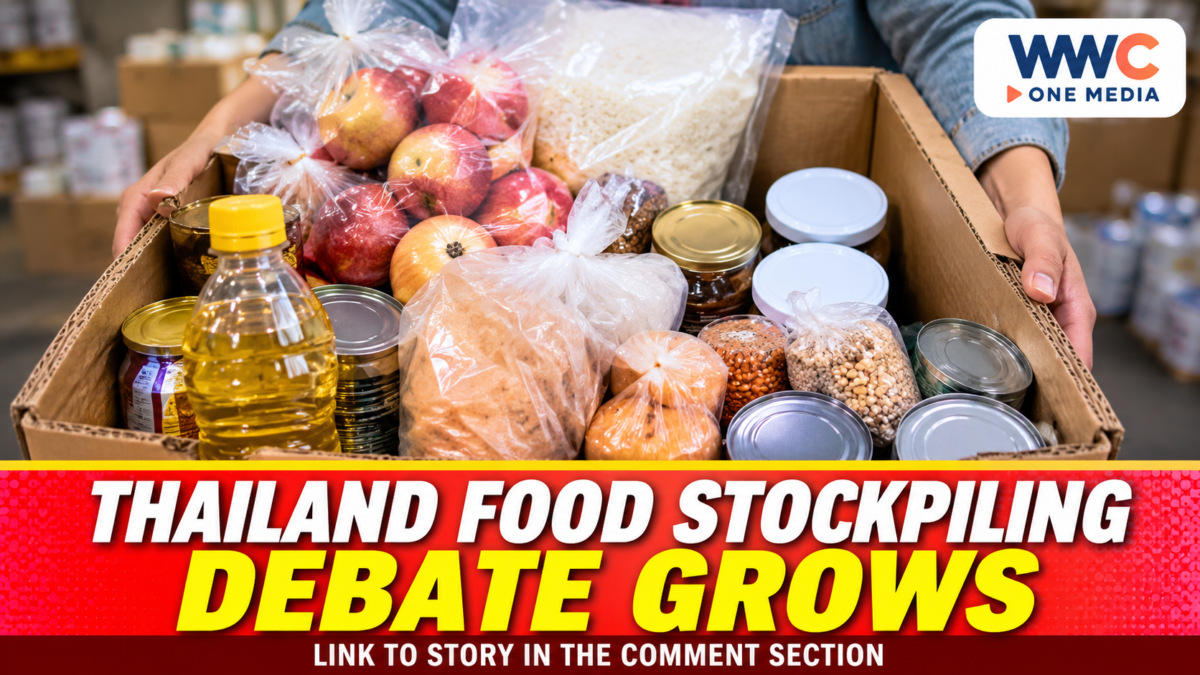
Thailand is facing a growing debate over household emergency preparations after a nationwide survey found that most respondents had heard about calls in other countries to keep several days of food, drinking water and essential supplies. The discussion has prompted closer monitoring of retail inventories, even as government officials maintain that the country has enough food and consumer goods to meet domestic demand.
The issue is not simply whether Thai households should keep emergency provisions. It also raises questions about how governments communicate risks, how retailers respond when buying patterns change, and whether the country’s food distribution network can withstand disruptions caused by severe weather or international tensions.
A survey published by the National Institute of Development Administration (NIDA) provides a measure of public awareness and concern. Separately, Thailand’s Department of Internal Trade has confirmed that consumer-goods sales increased compared with normal periods, but cautioned that several factors contributed to the rise. NIDA Poll นิด้าโพล โพลแห่งแรกของประเทศไทย+1
Food stockpiling enters the public conversation
NIDA Poll interviewed 1,310 adults nationwide on Nov. 2–3, 2026, using telephone interviews and a multistage probability sampling method. The survey examined public awareness of international recommendations for households to prepare three to seven days’ worth of food, medicine, drinking water and other necessities.
Of the respondents, 77.63% said they had heard about the recommendations, while 22.37% had not.
Among the 1,017 respondents who were aware of the reports, concern was mixed. Some 35.89% said they were not worried at all, while 32.84% said they were not very worried. Another 26.94% were somewhat concerned, and 4.33% said they were very concerned. NIDA Poll นิด้าโพล โพลแห่งแรกของประเทศไทย
The figures suggest that awareness of overseas emergency-preparedness advice has spread widely, but that it has not translated into uniform public alarm.
The survey also asked whether Thailand should issue a similar public advisory. Among those familiar with the overseas recommendations, 48.57% preferred waiting until the situation became clearer before issuing a warning. Another 36.09% wanted an advisory issued as soon as possible, while 15.34% said no announcement was necessary. NIDA Poll นิด้าโพล โพลแห่งแรกของประเทศไทย
That division points to a communication challenge: authorities must encourage sensible preparation without creating the impression that a shortage or national emergency is already underway.
Retail sales increased, but panic buying is not the only explanation
Thailand’s Department of Internal Trade addressed the issue after meeting on Nov. 4 with wholesale and retail operators, convenience-store businesses, local retailers and major consumer-goods manufacturers.
In its Nov. 6 update, the department said overall sales of consumer goods had increased compared with normal periods. However, it identified several possible contributors rather than attributing the entire increase to panic buying.
These included households in flood-affected areas purchasing essential goods for home use, increased spending at the beginning of the month after salaries were paid, and additional purchases supported by government spending programmes.
Local retailers also recorded sales growth of about 5% associated with the State Welfare Card and the Thai Help Thai Plus (60/40) programme. Department of Internal Trade
This distinction is important. A rise in grocery sales does not, by itself, establish that consumers are hoarding supplies because they expect a national crisis.
The government’s Nov. 9 statement reinforced that point, saying the increase had multiple drivers and could not be explained by panic buying alone. It also said retailers had reported sufficient inventories at distribution centres and that manufacturers were prepared to increase production if demand rose. Thai Government
For the retail sector, the immediate task is to keep goods moving and replenish store shelves as demand changes. For consumers, the available official information does not establish a need to rush out and purchase unusually large quantities of food or household necessities.
Why emergency preparation is being discussed
The wider discussion has been shaped by two different types of risk: international uncertainty and domestic natural disasters.
Thailand’s government has referred to overseas recommendations for keeping essential supplies for at least 72 hours. At home, emergency-bag preparation has also been discussed in connection with possible flooding and other disasters.
The distinction matters because a household emergency kit is intended to help people manage the first days of an incident, particularly when transport, utilities or access to assistance may be disrupted. It does not necessarily mean that a country is preparing for war or expecting food shortages.
On Nov. 7, Prime Minister Anutin Charnvirakul said Thailand remained strong in food and energy security and urged people to continue their normal routines. He clarified that discussions about 72-hour emergency kits did not mean the country was entering a state of war or experiencing food scarcity. Thailand Government Public Relations
The government had also issued a clarification on Nov. 2 stating that Thailand’s National Security Council had not issued an advisory instructing households to stockpile essential supplies for 72 hours because of the Middle East situation. Thailand Government Public Relations
These statements underline the difference between general disaster preparedness and an official warning of a food-supply emergency.
What the survey says about Thailand’s perceived risks
NIDA’s findings also show that public concerns extend beyond food availability.
When respondents were asked what future developments could affect Thailand enough to make households consider keeping several days of essential supplies, major flooding was the most frequently cited concern, at 34.58%.
Energy shortages followed at 28.24%. A further 26.34% said there were no particular issues they considered worrying. Other concerns included a nationwide internet outage at 24.27%, a possible third world war at 22.98%, and cyberattacks at 21.15%. NIDA Poll นิด้าโพล โพลแห่งแรกของประเทศไทย
The results are perceptions recorded during the survey, not forecasts that these events will occur. They nevertheless show that emergency preparedness is being considered in a broader context that includes infrastructure, energy and natural hazards.
For Thailand, the practical question is whether emergency planning can protect households while preserving confidence in the normal supply chain.
Why food security depends on distribution, not just production
A country can produce substantial quantities of food and still face local supply problems if roads are flooded, warehouses are inaccessible, electricity is interrupted or distribution networks are disrupted.
That is why the department’s discussions with retailers and manufacturers covered not only available stock but also distribution centres, production capacity and inventory management.
The department also discussed risks to storage and distribution systems, including reports from overseas about attacks involving refrigeration or cooling controls. Its consultations with Thai businesses had not identified signs of similar abnormalities or attacks in Thailand at the time of the Nov. 6 update. Department of Internal Trade
The issue has relevance beyond Thailand. In the Philippines, the National Food Authority’s rice buffer stocks serve as a government reserve that can support responses to emergencies and market disruptions. WWC previously examined the agency’s effort to manage existing inventory while preparing to rebuild reserves ahead of the wet-season harvest in its report on the NFA’s rice buffer-stock strategy.
The Philippine experience also illustrates why weather-related disruptions deserve attention. Flooding can damage farms, interrupt fishing and delay deliveries even when the country as a whole is not facing a shortage. WWC has previously reported on the pressure typhoons can place on food prices and agricultural supply.
Thailand’s situation is different, but the underlying lesson is similar: food security depends on the ability to produce, store and move essential goods when conditions become difficult.
What happens next
The immediate focus in Thailand is likely to remain on monitoring consumer-goods inventories, retail demand and the readiness of manufacturers and distribution networks.
The Department of Internal Trade has said it will continue coordinating with businesses and relevant agencies to ensure that supplies remain sufficient. It has also reminded consumers that unfair sales practices and excessive pricing can be reported through the department’s 1569 hotline. Department of Internal Trade+1
The government’s public messaging will also matter. Clear explanations of emergency-preparedness advice can help households prepare for floods and other disruptions without interpreting routine precautions as evidence of an impending food crisis.
For consumers, the available official statements support a measured approach: prepare for realistic household emergencies, pay attention to government announcements and avoid unnecessary bulk buying.
The longer-term test will be whether Thailand can maintain reliable food production and distribution during periods of uncertainty. Emergency readiness is not measured only by how much food households store, but also by whether essential goods can continue reaching communities when normal systems are disrupted.
Frequently Asked Questions
Is Thailand experiencing a food shortage?
Thai government statements dated Nov. 7 and Nov. 9 said the country had sufficient food and consumer goods and that officials had not identified signs of a nationwide shortage. Thailand Government Public Relations+1
Did Thailand order households to stockpile food for 72 hours?
No. Thailand’s National Security Council clarified that it had not issued an advisory requiring households to stockpile essential supplies for 72 hours because of the Middle East situation. Thailand Government Public Relations
Why did consumer-goods sales increase?
The Department of Internal Trade identified several possible reasons, including purchases in flood-affected areas, beginning-of-month spending after salary payments, and spending supported by government programmes. It did not attribute the entire increase to panic buying. Department of Internal Trade
What emergency risks concerned Thai respondents most?
In NIDA’s Nov. 2–3 survey, major flooding was the most frequently cited concern at 34.58%, followed by energy shortages at 28.24%. These figures represent respondents’ views, not predictions of future events. NIDA Poll นิด้าโพล โพลแห่งแรกของประเทศไทย
Does preparing an emergency kit mean a food crisis is expected?
No. The Thai government described 72-hour emergency preparation as a general measure for disasters and other emergencies, not evidence that the country was facing war or food scarcity. Thai Government+1