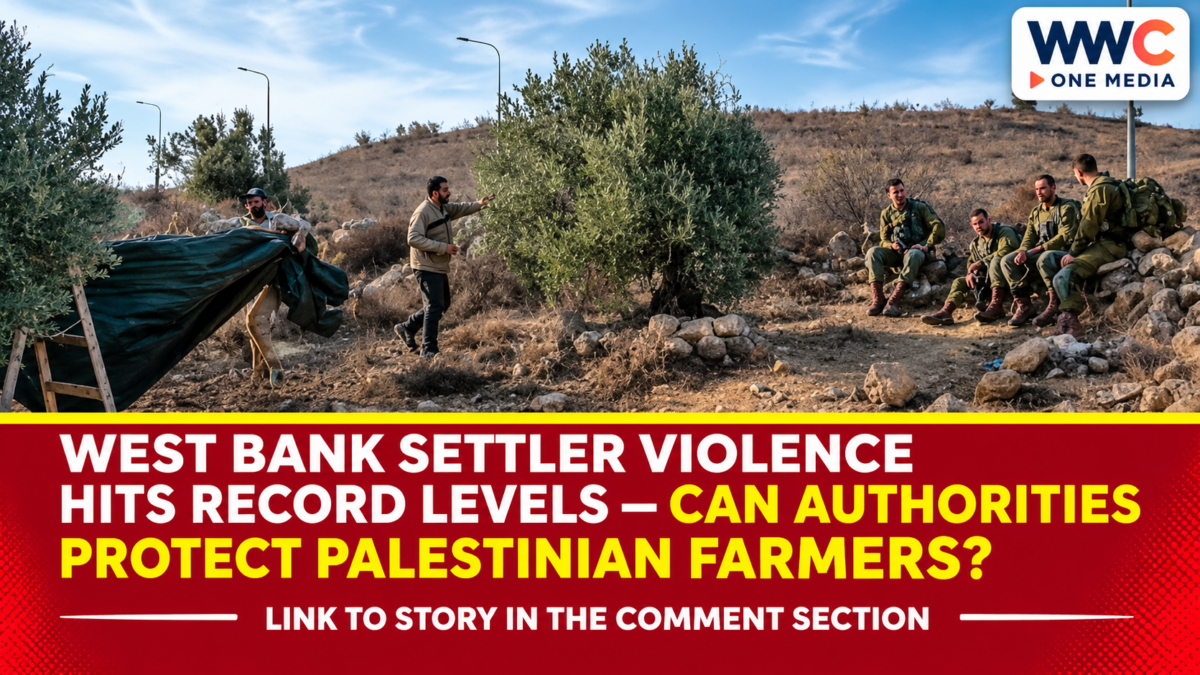
WEST BANK — United Nations humanitarian organisations renewed calls on Israeli authorities on Nov. 20 to protect Palestinian farming communities after documenting an unprecedented level of violence during the annual olive harvest. West Bank settler violence has increasingly disrupted agricultural activities, damaged productive assets and contributed to the displacement of Palestinian families.
Humanitarian monitoring recorded 428 harvest-related settler attacks resulting in casualties or property damage between Sept. 1 and Nov. 16, 2026.
The findings raise concerns extending beyond immediate civilian safety. For communities dependent on agriculture, restrictions on access to farmland and damage to productive resources could have lasting economic consequences.
West Bank Settler Violence Reaches Historic Levels
October 2026 registered 467 settler attacks involving casualties or property damage, based on updated United Nations humanitarian monitoring published on Nov. 13.
The monthly figure was the highest recorded since monitoring began in 2006.
Between Nov. 10 and 16, humanitarian monitors documented another 40 incidents across 30 communities.
Although the weekly figure was below the 2026 average of 53 incidents, it did not erase the accumulated impact of previous attacks.
The figures represent documented humanitarian incidents rather than judicial findings establishing criminal responsibility in every case.
Earlier this month, WWC examined efforts by former Israeli military officials to support Palestinian olive farmers, highlighting the broader debate surrounding civilian protection.
The latest humanitarian records provide further evidence of the challenges facing agricultural communities as the harvesting season approaches its conclusion.
Agricultural Losses Could Extend Beyond This Year’s Harvest
The Humanitarian Country Team’s Nov. 20 statement estimated that between 80,000 and 100,000 Palestinian families in the West Bank depend on the olive sector.
Olive cultivation and related production account for approximately 15% of agricultural gross domestic product.
This makes disruption to the harvest an economic concern as well as a humanitarian issue.
Damage to mature trees can affect future production, while the loss of harvested produce can immediately reduce household earnings.
From an economic perspective, these are two distinct forms of loss. One reduces current income, while the other threatens the productive capacity needed to generate income in subsequent years.
Businesses connected to processing, transportation and agricultural supplies could also experience indirect consequences if farming activity declines.
The available records do not establish a comprehensive monetary estimate of the damage. Consequently, the full economic cost remains uncertain.
Displacement Creates Additional Pressure on Communities
The Nov. 18 humanitarian situation report estimated that settler violence and associated restrictions had displaced approximately 6,800 Palestinians across 137 communities since January 2023.
The report also documented the complete displacement of 51 communities during that period.
Displacement can create substantial challenges for affected households, particularly when their livelihoods depend on access to agricultural property.
Families relocating elsewhere may need alternative accommodation, employment opportunities and access to public services while determining whether they can safely return.
The wider consequences of displacement were also examined in WWC’s earlier coverage of Palestinian families returning to damaged homes in Hebron.
That separate episode involved an Israeli military operation rather than exclusively settler violence, illustrating the importance of distinguishing between different causes of displacement.
The recovery requirements of affected communities may nevertheless overlap, particularly regarding housing, essential infrastructure and household livelihoods.
Essential Infrastructure Also Faces Damage
Agricultural property is not the only resource affected by the documented incidents.
Humanitarian monitoring identified damage to residential buildings, commercial facilities and essential infrastructure during the Nov. 10–16 reporting period.
More than 200 water, sanitation and hygiene infrastructure items had been damaged, destroyed or seized in settler attacks since the beginning of 2026, the Nov. 18 report documented.
Damage to these facilities can impose additional burdens on communities already facing economic difficulties.
For agricultural households, unreliable water access may affect both domestic requirements and farming activities.
Local enterprises may also face repair expenses and interruptions to their operations.
Analysis: Restoring essential infrastructure is an important component of recovery, but reconstruction alone may be insufficient if communities continue to experience insecurity.
Long-term assistance must therefore consider whether repaired facilities can remain accessible and functional.
Why Government Accountability Matters
Humanitarian organisations have called on Israeli authorities to ensure that Palestinian farmers can reach their agricultural property safely and that those responsible for attacks are held accountable.
Effective enforcement requires distinguishing between suspected offences, established evidence and judicial findings.
Responsibility for criminal acts should be determined individually. The conduct of people accused of violence must not be attributed collectively to Israeli citizens, Jewish communities or any other religious or national group.
The protection of Palestinian civilians is also a subject of international diplomatic engagement, as explored in WWC’s previous coverage of the United States ambassador’s visit to a West Bank community affected by settler violence.
From a policy perspective, the effectiveness of official commitments can be assessed through measurable outcomes, including reliable access to farmland, reductions in documented attacks and transparent legal proceedings.
Security arrangements must protect civilians while ensuring that allegations are investigated fairly.
What Happens Next?
The humanitarian organisations’ Nov. 20 statement urged authorities to improve farmers’ access to their land before the remaining harvesting opportunities disappear.
Subsequent monitoring reports may provide additional evidence about whether civilian protection has improved and whether agricultural disruptions are continuing.
For affected households, recovery will also depend on the condition of their productive assets and their ability to resume normal economic activity.
The broader political dispute surrounding the West Bank remains unresolved.
However, protecting civilians, maintaining access to essential services and investigating suspected offences are immediate concerns that can be evaluated independently of the territory’s longer-term political future.
The record-breaking figures establish the scale of the present humanitarian challenge. The next test will be whether concrete measures produce a measurable improvement in conditions for affected communities.
Frequently Asked Questions
How many harvest-related settler attacks were recorded in the West Bank in 2026?
UN humanitarian monitoring documented 428 incidents involving casualties or property damage between Sept. 1 and Nov. 16.
Why is the Palestinian olive harvest economically important?
An estimated 80,000 to 100,000 Palestinian families in the West Bank rely on the olive sector, which represents approximately 15% of agricultural GDP.
How many Palestinians have been displaced by settler violence and related restrictions?
Approximately 6,800 people were displaced between January 2023 and the Nov. 18, 2026 reporting update.
What measures have humanitarian organisations requested?
They have called for safe access to farmland, civilian protection and accountability for people responsible for attacks.
Do humanitarian incident figures establish criminal guilt?
No. Humanitarian monitoring documents incidents and their consequences. Individual criminal responsibility must be established through appropriate legal processes.