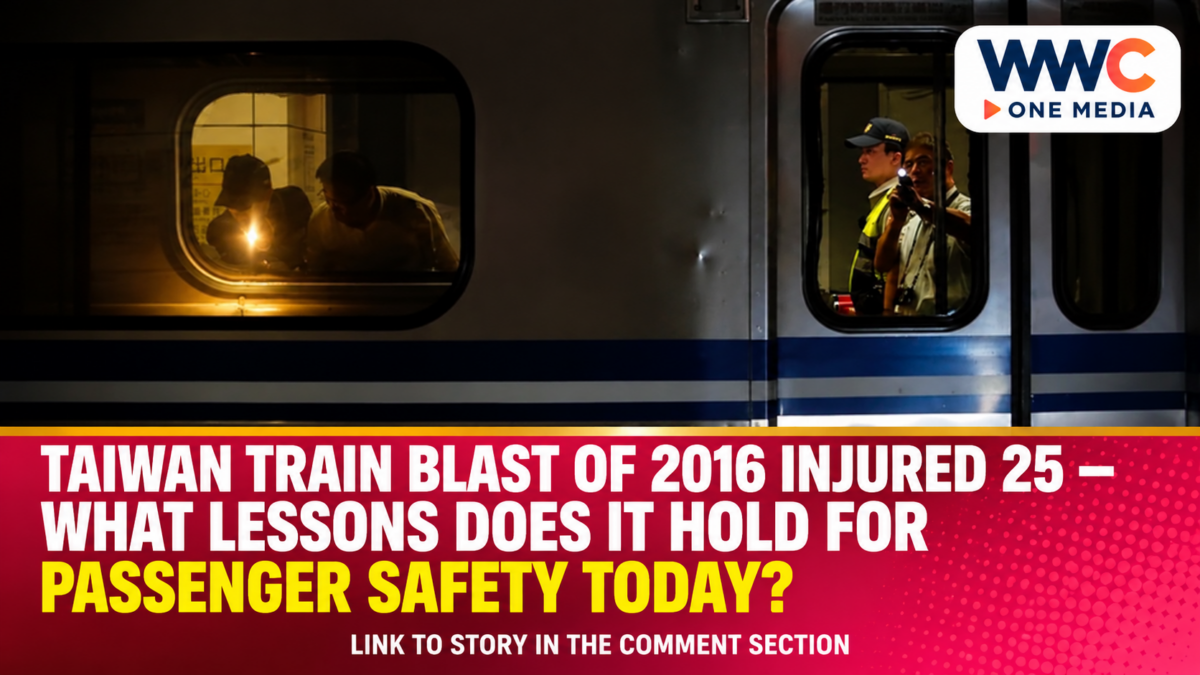
TAIPEI, Taiwan — The Taiwan train blast of July 7, 2016, left 25 people injured and prompted a coordinated response involving emergency medical personnel, police and criminal investigators. Official government records document both the immediate medical response and the subsequent criminal investigation.
More than a decade after the incident, the case offers an important perspective on how public transportation systems should balance passenger accessibility, security, emergency preparedness and recovery.
The explosion was not a recent incident. Its continuing relevance lies in the institutional responsibilities it highlighted and the importance of protecting passengers beyond the immediate emergency.
Taiwan train blast: What official records establish
Taiwan’s Ministry of Health and Welfare documented the explosion aboard a local passenger train operated by the Taiwan Railway Administration on July 7, 2016.
Emergency responders transported 25 injured people to nearby hospitals for medical treatment.
A separate government record published by the Taipei District Prosecutors Office documented the participation of several law enforcement agencies in the criminal investigation.
These included the Railway Police Bureau, Criminal Investigation Bureau and units of the Taipei City Police Department.
The official records highlight two distinct responsibilities during a public transportation emergency: protecting affected passengers and establishing the circumstances surrounding the incident.
Although these responsibilities are connected, each requires different professional expertise and institutional resources.
For transport operators, this distinction is important when designing emergency response programmes that extend beyond routine railway operations.
Railway security requires cooperation across institutions
The investigation demonstrated the involvement of railway police, local law enforcement and prosecutorial authorities.
From a public policy perspective, coordination between institutions is particularly important when an emergency involves potential criminal conduct.
Railway operators must consider passenger protection and service management, while investigators must independently establish the circumstances of an incident.
Medical personnel, meanwhile, have a separate responsibility to provide appropriate treatment to affected individuals.
Similar questions about institutional responsibility are examined in WWC’s coverage of railway security and investigative responsibilities in India.
An effective transport security framework should therefore define responsibilities clearly rather than assume that a single organisation can manage every aspect of an emergency.
Regular coordination exercises, appropriate staff training and reliable communication systems can help institutions prepare for situations requiring a collective response.
Passenger recovery extends beyond physical injuries
One significant aspect of Taiwan’s official response was the government’s recognition of the psychological needs of people affected by the incident.
The Ministry of Health and Welfare specifically emphasised that mental well-being deserved attention alongside physical treatment.
That approach provides a broader understanding of what passenger recovery should involve.
From a policy standpoint, emergency assistance should not necessarily end when an injured passenger leaves a hospital or when transportation services return to normal.
Affected individuals may benefit from access to appropriate professional support, reliable information and established channels through which they can seek assistance.
This does not mean that every person affected by the 2016 incident experienced lasting psychological difficulties. Individual medical outcomes cannot be assumed without supporting records.
Instead, the government’s response demonstrates why emergency preparedness should recognise both physical and psychological welfare.
Railway reliability and passenger security are different challenges
Railway performance is frequently discussed in terms of punctuality, equipment reliability and service availability.
However, operational reliability alone cannot establish whether a transportation system is adequately prepared for every possible emergency.
Taiwan’s transportation safety framework has also developed beyond the institutional arrangements that existed in 2016.
In February 2024, the Taiwan Transportation Safety Board published the results of a separate railway investigation involving a train fire in 2022.
That investigation included recommendations addressing operational procedures and regulatory oversight. The board also identified the restructuring of the former Taiwan Railway Administration into Taiwan Railway Corporation.
The later investigation was unrelated to the 2016 explosion and should not be interpreted as a direct consequence of it.
Nevertheless, it illustrates how documented investigations can help identify opportunities for institutional improvement.
WWC’s analysis of Singapore’s railway reliability and infrastructure renewal programme examines the complementary challenge of maintaining dependable transportation infrastructure.
What the incident means for Asian transportation systems
For transportation policymakers across Asia, the historical Taiwan case offers a useful opportunity to examine emergency preparedness without treating an isolated incident as evidence of widespread danger.
Investment in transportation infrastructure should be accompanied by consideration of emergency communications, staff preparedness, passenger assistance and coordination with public authorities.
These considerations are particularly relevant for railway networks serving large urban populations and international travellers.
WWC’s coverage of Singapore’s security preparedness for the cross-border RTS Link explores another regional example of emergency planning.
The Philippine transport sector can likewise consider the importance of integrating emergency preparedness into infrastructure development and daily operational management.
This is a policy consideration rather than an assertion that Philippine railways face the same circumstances as Taiwan experienced in 2016.
Public confidence should be supported by transparent procedures, responsible communication and credible institutional accountability.
What happens next
The 2016 Taiwan train explosion remains a historical criminal case, not an unfolding emergency in November 2026.
Its relevance today is primarily educational.
Transportation authorities can use historical incidents to assess whether existing emergency procedures remain appropriate, whether institutional responsibilities are sufficiently clear and whether passengers have access to effective assistance.
The central challenge is to maintain accessible public transportation while ensuring that safety considerations remain part of long-term operational planning.
For passengers, the enduring lesson is the importance of following official safety instructions and relying on verified information during emergencies.
For policymakers, the case reinforces the value of preparedness, institutional cooperation and passenger-centred recovery.
Frequently asked questions
When did the Taiwan train blast happen?
The incident occurred on July 7, 2016. It is not a new incident in November 2026.
How many people were injured in the Taiwan train explosion?
Taiwan’s Ministry of Health and Welfare recorded 25 injured people who received hospital treatment.
Which authorities investigated the incident?
Official records document the involvement of railway police, criminal investigators, Taipei police units and prosecutorial authorities.
Why is the 2016 Taiwan railway incident still relevant?
It provides a historical case study in emergency medical response, institutional coordination, passenger welfare and public transportation preparedness.