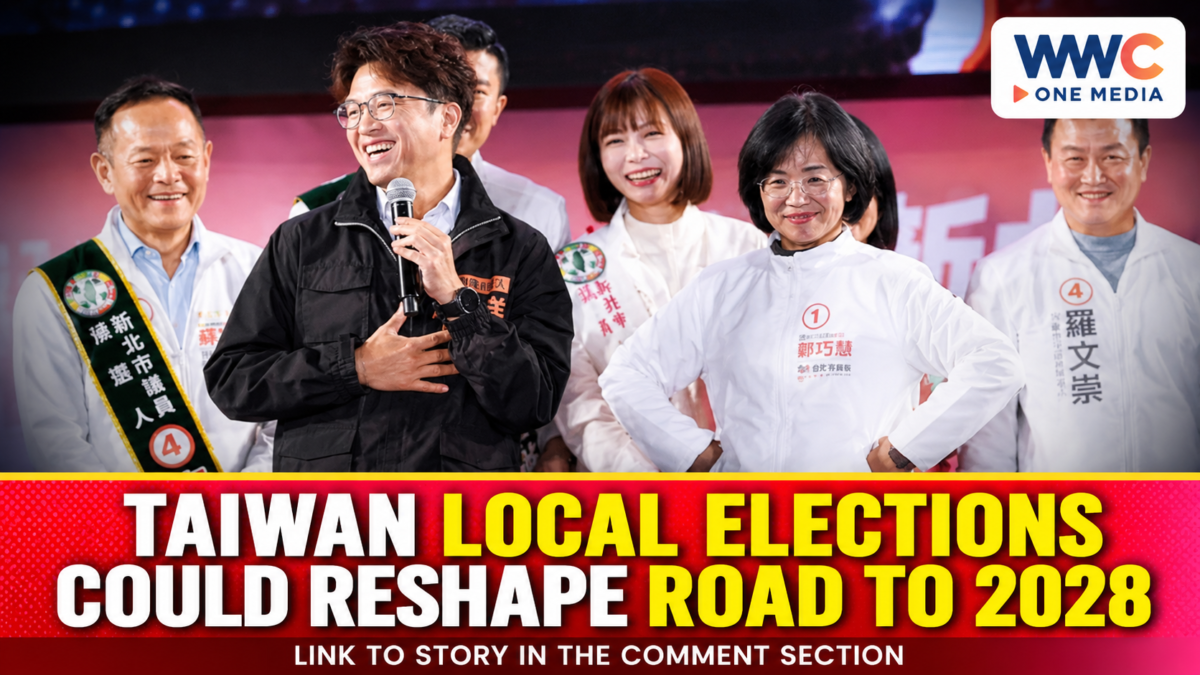
TAIPEI, Taiwan — November 26, 2026 — Taiwan is heading into a major electoral test on November 28, with nearly 19.6 million eligible voters preparing to choose local leaders across the island. Although President Lai Ching-te is not on the ballot, the results could influence the political balance ahead of Taiwan’s next presidential election in 2028.
The governing Democratic Progressive Party (DPP) and the opposition Kuomintang (KMT) are competing for control of important municipalities and county governments. Their performances will offer a measure of party strength, local political organisation and public confidence in candidates seeking to shape Taiwan’s future.
But the election carries a crucial distinction: voters are not choosing a president, changing the national government or directly deciding Taiwan’s relationship with Beijing. They are selecting local officials whose political fortunes could nevertheless influence the next national campaign.
The outcome may provide an early indication of which political forces enter the 2028 race with stronger momentum. The bigger question is whether local victories can translate into national support.
Taiwan’s 2026 local elections: What voters will decide
The Central Election Commission has scheduled the nine-in-one local elections for Saturday, November 28, from 8 a.m. to 4 p.m. local time.
The vote covers nine categories of local public office, including special-municipality mayors, county and city leaders, councillors, township chiefs, representatives and village or borough chiefs.
The commission has confirmed that 11,051 positions are to be filled. A total of 19,695 people registered as candidates, with 19,100 qualifying after the eligibility review.
The six special municipalities holding mayoral elections are:
- Taipei
- New Taipei
- Taoyuan
- Taichung
- Tainan
- Kaohsiung
These cities are important centres of government, industry, commerce and population. Their mayors and councils influence local infrastructure, transportation, land-use decisions, public services and development priorities.
The election is therefore more than a contest between party labels. It will determine who manages local government and which political groups gain influence over municipal decision-making.
WWC has previously examined the final campaign stretch and the issues shaping Taiwan’s DPP–KMT contests, including the importance of local administration beyond the headline mayoral races.
Why the DPP and KMT are watching the results closely
For Lai and the DPP, the elections provide an opportunity to demonstrate that the governing party retains political support beyond the national presidency.
A strong performance could strengthen the party’s local organisation, improve its position in important cities and give its leadership greater confidence as preparations for the next national election develop.
A weaker result could create pressure to reassess campaign strategy, candidate selection and the administration’s political messaging.
The KMT has a different opportunity. Winning or retaining major local offices could strengthen its organisational network and provide prominent local leaders with greater influence in the opposition’s future presidential calculations.
The Taiwan People’s Party (TPP) also has an interest in the outcome. Its local performance could affect its bargaining position and its ability to influence future political alliances.
However, local elections do not necessarily predict presidential results. Voters may choose a mayor based on transportation, housing, employment, public safety or a candidate’s administrative record. Presidential elections involve a broader national debate, including defence, economic strategy and cross-strait relations.
The Centre for Strategic and International Studies has also cautioned against treating the November vote as a direct referendum on Lai or as a dependable forecast of the 2028 presidential result.
Taipei and the major cities could shape the political narrative
Taipei is among the most closely watched contests because it is Taiwan’s capital and a major centre of government, business and media.
The broader competition across New Taipei, Taoyuan, Taichung, Tainan and Kaohsiung will also matter. A party that performs well across several major municipalities could gain a stronger platform for national political campaigning.
But no single mayoral victory will determine the next presidential nominee.
Local leaders can build political profiles through their performance in office, but a presidential campaign requires broader appeal, party support and the ability to address national issues. The local results may therefore influence the political environment in which potential candidates position themselves without automatically making any individual the frontrunner.
For a deeper look at how Taiwan’s local campaigns are developing, WWC has also examined the election-security debate and the safeguards against illegal foreign campaign funding.
The nuclear referendum adds another major test
The November 28 voting day will include a separate nationwide referendum, National Referendum Case No. 22, on nuclear power.
The official question asks whether voters support the government using nuclear power to revitalise the economy and abolish the nuclear-free homeland energy policy.
The referendum is politically significant because energy reliability is closely connected to Taiwan’s industrial future. Semiconductor manufacturing and other advanced industries require dependable electricity supplies, while policymakers must also consider energy costs, nuclear safety, waste management and environmental commitments.
The result will provide a measure of public support for changing the direction of energy policy. It will not, by itself, restart a nuclear power plant. Any return to nuclear generation would still require the relevant regulatory, technical and safety processes.
For regional businesses and technology supply chains, the debate matters because Taiwan plays a major role in semiconductor production. Energy policy can affect the long-term operating environment for manufacturers and the industries that depend on them.
The referendum also means voters will be making decisions on two distinct matters: who should govern locally and whether the country should reconsider its nuclear-energy policy.
China remains in the background, but this is not a vote on Beijing
Taiwan’s relationship with mainland China remains one of the island’s most consequential national issues. Beijing claims Taiwan as part of its territory, while Taiwan’s government maintains that its future should be determined by its people.
However, mayors, county magistrates and local councillors do not set Taiwan’s national foreign or defence policy. The November 28 elections should not be presented as a direct vote on cross-strait relations.
The results could still matter politically. Local victories may strengthen parties and leaders who will later participate in national debates over defence spending, diplomacy and engagement with Beijing.
Taiwan’s regional participation also illustrates the difference between political tensions and practical economic cooperation. Its rare ministerial-level visit to China for an APEC meeting showed how official engagement can take place within established multilateral arrangements even when the wider political relationship remains difficult.
For Asia-Pacific economies, Taiwan’s political direction matters because the island is deeply connected to regional trade, technology production and supply chains. But the local election result alone will not determine those relationships.
What happens next after November 28?
The immediate outcome will be the distribution of local political power across Taiwan’s cities and counties. The Central Election Commission’s published timetable sets December 4 as the deadline for reviewing and announcing elected candidates.
The results will give the DPP, KMT and TPP new information about their electoral strengths and weaknesses before the 2028 national campaign takes shape.
For Lai, the vote will provide a political assessment midway through his four-year presidential term. For the opposition, it will show whether local campaigning can translate into a stronger nationwide position.
The most important measure, however, will come after the election. Winning candidates will have to turn campaign promises into budgets, infrastructure projects, public services and policies that residents can evaluate.
Taiwan’s November 28 elections will not choose its next president. But they could influence who enters the 2028 contest with stronger political networks, greater public visibility and a more convincing claim to national leadership.
The ballots will decide local governments. The political consequences could reach much further.