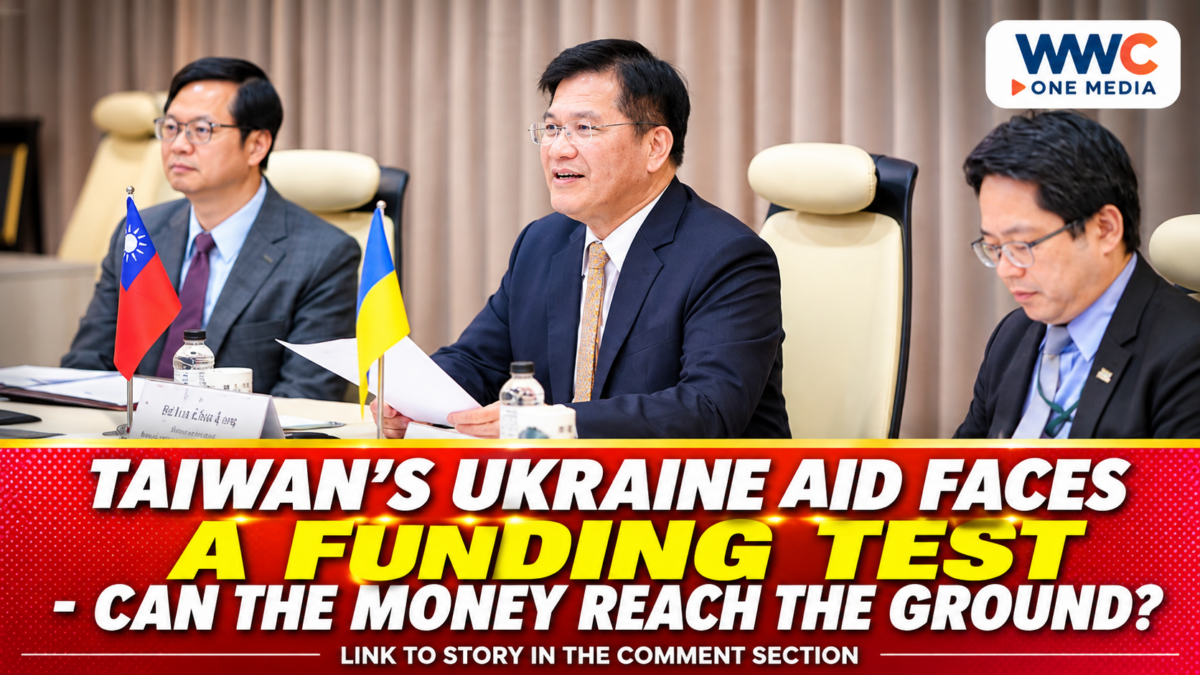
Taiwan is continuing to support Ukraine’s recovery through reconstruction funding, healthcare projects and cooperation with European partners. But the programme faces a difficult question: can Taipei turn its financial commitments into measurable results while the war continues to complicate access, implementation and oversight?
For fiscal year 2026, Taiwan allocated NT$763.24 million for cooperation with the United States and European countries on Ukraine’s reconstruction, refugee resettlement and post-war recovery.
The allocation is significant, but it is not simply a cheque for rebuilding damaged infrastructure. The budget covers commissioned projects and external assistance, while the government is also working through development agencies, hospitals, telecommunications companies and European partners.
The funding has also drawn scrutiny in Taiwan’s legislature. Lawmakers raised concerns about the programme’s high budget carryover rate and the difficulties of conducting reconstruction work while the conflict remains unresolved.
That makes the next stage of Taiwan’s Ukraine assistance a test not only of international solidarity, but also of public spending, project delivery and accountability.
Taiwan sets aside NT$763.24 million for Ukraine
The 2026 allocation appears under Taiwan’s Ministry of Foreign Affairs programme for international cooperation, humanitarian assistance and reconstruction.
The approved budget review document breaks the NT$763.24 million allocation into two components:
- NT$469.462 million in commissioned-service expenses.
- NT$293.778 million in external donations.
Together, the two components total NT$763.24 million.
The programme covers cooperation with the United States and European countries to assist Ukraine’s reconstruction, support refugee resettlement and contribute to post-war recovery.
The amount is lower than the NT$1.8 billion allocated for related assistance in 2023. The legislative review record also documents reductions in subsequent annual allocations, reflecting the difficulty of implementing reconstruction projects amid continuing conflict.
However, a lower annual allocation does not necessarily mean Taiwan has abandoned its support. It also reflects the challenge of planning and executing projects in a country where security conditions can change rapidly.
Why lawmakers are questioning the spending
The funding has not escaped scrutiny in Taiwan’s Legislative Yuan.
The budget review record highlights concerns about the high level of unspent funds carried over from previous years. It notes that the 2023 allocation was NT$1.8 billion and that the feasibility of some on-the-ground reconstruction projects was affected by the prolonged fighting.
The review also records a proposed freeze of NT$30 million from the 2026 allocation. The release of the frozen amount was made conditional on the Ministry of Foreign Affairs submitting a written report to the legislature’s Foreign Affairs and National Defense Committee within two months and obtaining approval.
This is an important distinction: the legislative action concerns a portion of the budget and its release conditions. It does not establish that the entire Ukraine assistance programme was suspended or that the funds were misused.
The scrutiny reflects a wider public-finance question. When a government allocates money for overseas reconstruction, it must show not only that the spending has a humanitarian or diplomatic purpose, but also that projects are feasible, partners are properly assessed and funds can be accounted for.
The ministry has described lengthy negotiations for certain projects as a reason for delays in executing earlier allocations. In a conflict environment, agreements involving local governments, international organisations and European partners can take time to finalise.
But delays also make transparent reporting more important. Legislators and taxpayers need to know which projects have started, which remain under negotiation and how much funding has actually been disbursed.
Healthcare projects show where Taiwan’s assistance is going
One of the clearest examples of Taiwan’s involvement is its smart healthcare project in Lviv, western Ukraine.
The Taiwan International Cooperation and Development Fund, known as TaiwanICDF, is working with the Lviv City Government and local healthcare partners to strengthen hospital information systems at two medical institutions: St. Panteleimon Hospital and St. Nicholas Children’s Hospital.
The project began on Aug. 25, 2026, and is scheduled to run until Aug. 24, 2029.
Its objectives include improving emergency and intensive-care operations, strengthening hospital servers and network infrastructure, and integrating at least 100 smart medical devices, software systems or AI applications into hospital information systems.
The project also includes training for medical and information-technology personnel.
This is a practical example of how Taiwan’s technology and healthcare expertise can contribute to Ukraine’s recovery even while the war continues. It is not limited to rebuilding physical facilities; it also seeks to improve the systems that hospitals use to manage patients and deliver care.
The initiative connects with a wider debate about the role of technology in rebuilding essential services. WWC has examined Taiwan Cement’s proposed investment in Ukraine’s construction industry, another example of how Taiwanese involvement in Ukraine can extend beyond traditional humanitarian assistance.
Emergency response and refugee support remain part of the programme
Taiwan’s assistance also includes emergency-response capacity.
TaiwanICDF’s project titled Enhancing Emergency Response Capacities in Ukraine is designed to strengthen the country’s State Emergency Service and emergency medical services.
The project includes specialised rescue training, pre-hospital emergency medical assistance, mass-casualty response preparation and equipment support for emergency personnel.
It also covers training facilities and triage equipment for selected regional commands and emergency-response institutions.
The project began on Nov. 1, 2025, and is scheduled to end on Jan. 31, 2027. The Polish Center for International Aid is the executing agency, while TaiwanICDF oversees implementation.
These programmes address immediate wartime needs while supporting longer-term institutional resilience.
Taiwan is also working with Central and Eastern European partners on Ukrainian refugee resettlement. Cooperation with countries including the Czech Republic, Lithuania, Poland and Estonia forms part of the wider assistance framework.
The refugee component matters because displacement creates long-term pressure on housing, healthcare, education and employment systems in host countries.
WWC’s coverage of Europe’s proposed winter energy ceasefire for Ukraine has examined another part of the recovery challenge: protecting essential infrastructure while attacks continue.
Taiwan is also pursuing economic and diplomatic ties
Taiwan’s Ukraine programme has a diplomatic and economic dimension alongside its humanitarian objectives.
The Ministry of Foreign Affairs has identified stronger Taiwan-Ukraine relations, cooperation with European partners and opportunities for Taiwanese companies as part of its broader approach.
Reconstruction could create demand for technology, healthcare systems, telecommunications, infrastructure and industrial services. Taiwanese companies may be able to contribute expertise in these areas, although opportunities depend on security conditions, financing, contracts and the eventual pace of recovery.
That economic dimension should not be confused with guaranteed commercial returns. Reconstruction projects can take years, and investment decisions in a country affected by war carry substantial operational and financial risks.
Taiwan’s approach also sits within a wider security debate. The war in Ukraine has influenced how governments assess infrastructure resilience, emergency preparedness and the protection of critical services.
WWC has explored Taiwan’s push for multi-layered defences using lessons from Ukraine, illustrating how the conflict has shaped policy discussions far beyond Europe.
What happens next?
The immediate test is whether Taiwan’s Ministry of Foreign Affairs can demonstrate measurable progress in projects funded through the 2026 allocation.
The NT$30 million freeze also puts a specific reporting obligation on the ministry. The legislature’s review requires a written report and committee approval before that amount can be released.
For the wider programme, the key indicators will be actual disbursements, completed project milestones, independent oversight and evidence that assistance reaches intended beneficiaries.
Taiwan’s smart healthcare initiative in Lviv and its emergency-response programme show that some projects have defined implementation periods, objectives and partner organisations. These details provide a more concrete basis for assessing performance than headline budget totals alone.
But the continuing war makes implementation difficult. Reconstruction plans may need to be adjusted, partnerships may take time to finalise and on-site monitoring can be constrained by security conditions.
Taiwan has a clear interest in maintaining its international partnerships and supporting Ukraine. The harder task is proving that public money is being translated into sustainable improvements.
The question facing Taipei is no longer simply how much it is willing to commit to Ukraine. It is whether it can show where the money goes, what it delivers and how effectively the results are monitored.
Frequently asked questions
How much did Taiwan allocate for Ukraine assistance in 2026?
Taiwan allocated NT$763.24 million for cooperation with the United States and European countries on Ukraine’s reconstruction, refugee resettlement and post-war recovery.
Why did Taiwan’s Ukraine aid budget face legislative scrutiny?
Lawmakers raised concerns about high carryover rates, delays in project implementation and the feasibility of reconstruction work while the war continues.
Was Taiwan’s entire Ukraine aid budget frozen?
No. The legislative review record specifies a NT$30 million freeze from the 2026 allocation, conditional on a written report and approval by the relevant committee.
What healthcare assistance is Taiwan providing to Ukraine?
TaiwanICDF is implementing a smart healthcare project in Lviv that aims to improve hospital information systems, emergency and intensive-care operations, medical technology integration and staff training.
Which countries are working with Taiwan on Ukraine assistance?
Taiwan’s cooperation framework includes European partners such as the Czech Republic, Lithuania, Poland and Estonia, alongside Ukrainian institutions and international organisations.
Does Taiwan’s Ukraine assistance include commercial opportunities?
Yes. Taiwan’s stated objectives include encouraging Taiwanese businesses to invest and participate in technological exchanges in Ukraine. Actual opportunities depend on security conditions, project financing and commercial agreements.