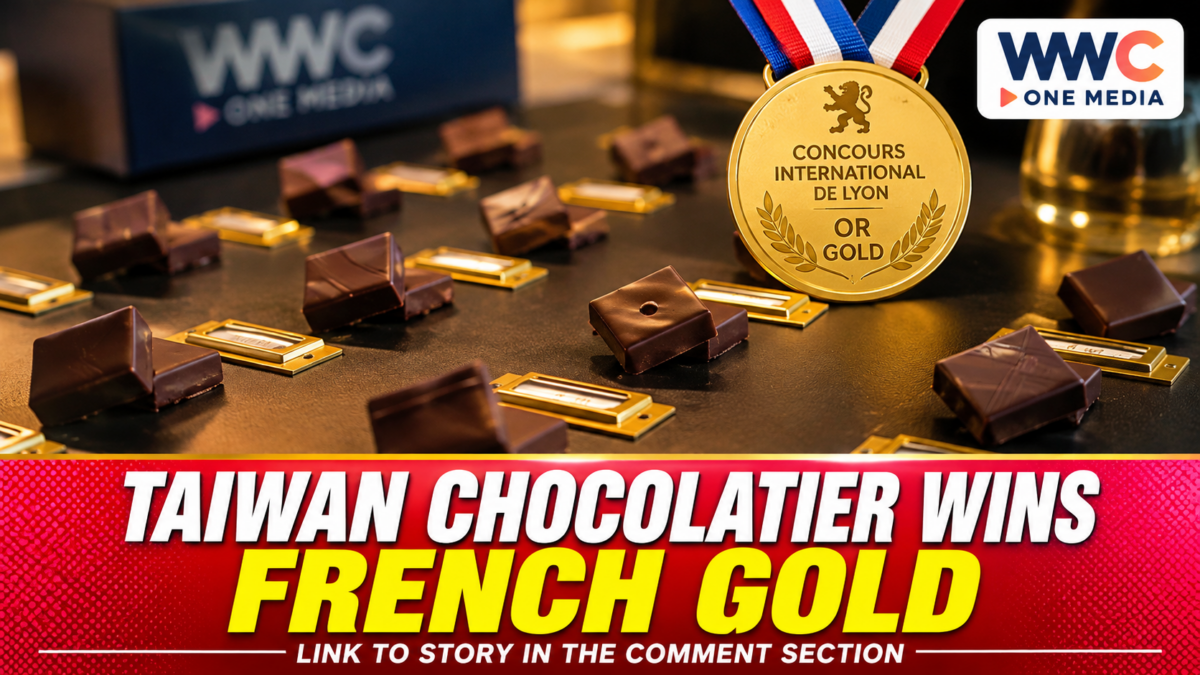
TAIPEI, Taiwan — A Taiwanese chocolatier has earned international recognition in one of France’s established chocolate guides, and one of its most distinctive creations is made with an ingredient more commonly associated with savoury cooking: soy sauce.
Yu Chocolatier (畬室), based in Taipei, received a Gold distinction in the 2027 edition of Le Guide des Croqueurs de Chocolat. Four of its filled chocolates were recognised: soy sauce, oolong tea, Cognac and its signature dark chocolate, known as “Yu”.
The recognition puts a spotlight on Taiwan’s growing presence in artisan chocolate, while demonstrating how a local culinary ingredient can be adapted into a product associated with French confectionery traditions.
The standout creation is the caramel soy sauce bonbon. Rather than relying on the familiar salted-butter approach used in French salted caramel, the chocolatier incorporates Taiwanese black-bean soy sauce into its chocolate filling.
The result is an unusual combination of sweet, savoury and roasted flavours that has attracted attention from the French chocolate community.
Why the soy sauce chocolate caught attention
The soy sauce bonbon is more than a novelty flavour. Its construction draws on the relationship between two culinary traditions.
Yu Chocolatier’s product description identifies Taiwanese black soy sauce, matured over two years, as a central ingredient. The chocolatier combines it with house-made caramel and dark chocolate, creating a filling designed to bring together umami and sweetness.
The French guide’s judges highlighted the bonbon’s seaweed, honey and caramel notes, alongside the roasted aroma of the chocolate. Their assessment described the creation as a work of art.
This approach gives the product a recognisable Taiwanese element without abandoning the techniques associated with European artisan chocolate.
The chocolatier’s four recognised creations also show that its approach extends beyond one unusual ingredient. Each bonbon has a different flavour identity, ranging from heavily roasted tea to Cognac and a signature dark chocolate.
Four bonbons, four distinct flavour identities
The four recognised creations represent different ingredients and influences.
Caramel Soy Sauce combines Taiwanese black soy sauce with caramel and dark chocolate. The chocolatier describes the soy sauce as double-matured over two years, giving the filling a deeper savoury character.
Classic Oolong uses traditionally processed oolong tea, with roasted tea aromas blended into milk chocolate. The flavour draws on Taiwan’s established tea culture.
Cognac combines fine V.S.O.P. Cognac with dark chocolate. Its profile brings together notes associated with the spirit, including vanilla and oak, with the character of cacao.
Yu, the brand’s signature dark chocolate bonbon, represents the chocolatier’s own style. The company describes it as a balanced creation developed through an extended period of refinement.
Together, the four products show how a chocolatier can draw on local ingredients, French influences and individual craftsmanship without forcing every creation into one definition of national identity.
The company has also introduced a 12-piece gift box featuring three pieces of each recognised flavour. Its published product listing gives the price as NT$1,660, although availability and ordering conditions may change.
What makes the French guide significant?
The recognition comes from the Club des Croqueurs de Chocolat, a French chocolate association founded in Paris in 1981.
For its 2027 guide, the organisation says nearly 180 chocolatiers from France and other countries are featured. Its members tasted more than 700 chocolates, including filled bonbons and chocolate bars, through an independent blind-tasting process.
The guide uses distinctions including Gold, Silver and Bronze for selected chocolate products, alongside other awards and recommendations. Its annual publication is aimed at chocolate enthusiasts and people interested in artisan chocolate craftsmanship.
The 2027 edition was released in October 2026, with the guide also made available during the Salon du Chocolat in Paris from Oct. 28 to Nov. 1.
For a small artisan producer, recognition in an established international guide can provide visibility beyond its home market. It can also introduce consumers to flavours and production approaches they may not encounter in conventional confectionery.
The distinction should not be confused with a Michelin star or a general ranking of every chocolate company worldwide. It is recognition within the Club’s own tasting and guide system.
Yu Chocolatier’s route from Taiwan to France
Founder and head chocolatier Cheng Yu-hsuan (鄭畬軒) developed his craft through a combination of self-directed learning and professional training.
He began teaching himself chocolate-making at 19, later studied pastry at Ferrandi Paris and trained at Pavillon Ledoyen and artisan chocolate businesses in France.
After returning to Taiwan in 2015, he established Yu Chocolatier in Taipei. The business has since built a profile around handcrafted chocolates that combine technical methods with distinctive flavour development.
The brand’s earlier international milestones include medals at the International Chocolate Awards in 2016 and an invitation to exhibit at the Salon du Chocolat in Paris.
Its latest recognition adds another international reference point for Taiwan’s artisan chocolate sector.
The company’s work also reflects a wider development across Asian food businesses: local ingredients and culinary traditions are increasingly being adapted for premium products aimed at international consumers.
That shift can be seen in other parts of the region’s food economy. In the Philippines, for example, efforts to strengthen the domestic coffee industry are placing greater emphasis on quality, planting materials and farmer support, as explored in WWC’s report on the new coffee development programme in Mindanao.
Vietnam’s coffee sector offers another example of how agricultural products and changing consumer demand can reshape local industries, including the shift by some farmers towards durian production.
Why Taiwan’s food identity matters in the global market
The award also raises a broader question about how countries present their food identity internationally.
Traditional ingredients can provide a strong starting point, but successful premium products often depend on more than simply using something locally produced. Processing, presentation, consistency and the ability to communicate a product’s story can all influence how consumers respond.
Taiwan’s tea culture and black-bean soy sauce provide recognisable foundations for Yu Chocolatier’s creations. The Cognac bonbon, meanwhile, shows how the brand incorporates French influences into its range.
This balance is important in a market where artisan chocolate makers compete not only on taste but also on craftsmanship, originality and brand identity.
Other destinations in Asia are also developing food and tourism experiences around distinctive local products. WWC has examined how award-winning coffee and village experiences are drawing attention to Chiang Mai, while its coverage of Thailand’s agricultural preparations for possible El Niño conditions highlights the importance of protecting the agricultural foundations behind regional food products.
For Taiwan, the challenge is turning international recognition into sustained demand while preserving the quality and individuality that helped the products stand out.
What happens next?
Yu Chocolatier’s four recognised bonbons give the Taipei-based business a stronger platform among international chocolate enthusiasts. The company’s official product listing already presents the four flavours together in a special gift box celebrating the distinction.
The award does not, by itself, establish how much additional business the brand will gain or whether it will expand into new markets. Those outcomes will depend on its future commercial decisions, production capacity and ability to reach customers outside Taiwan.
For now, the recognition offers a clear example of how Taiwanese ingredients can find a place in an internationally recognised confectionery tradition.
The most memorable part of the story may be the simplest: a familiar savoury ingredient has become the centrepiece of a premium chocolate creation.
Frequently asked questions
What is Yu Chocolatier?
Yu Chocolatier (畬室) is a Taipei-based artisan chocolate business founded by Cheng Yu-hsuan.
What award did Yu Chocolatier receive?
Four of its filled chocolates received a Gold distinction in the 2027 edition of Le Guide des Croqueurs de Chocolat.
Which Yu Chocolatier flavours were recognised?
The four flavours are caramel soy sauce, classic oolong, Cognac and the signature dark chocolate “Yu”.
What makes the soy sauce chocolate unusual?
It uses Taiwanese black-bean soy sauce with caramel and dark chocolate, combining savoury umami with sweetness.
Who publishes Le Guide des Croqueurs de Chocolat?
The guide is published by the Club des Croqueurs de Chocolat, a French chocolate association founded in Paris in 1981.