TAIPEI AND BRUSSELS — Nov. 27, 2026 — Democracies are confronting an increasingly difficult security challenge: how to defend public debate against coordinated foreign information manipulation without weakening the openness and freedom that make democratic societies work.
Taiwan has spent years responding to disinformation campaigns that its National Security Bureau attributes to China. Europe, meanwhile, has developed its own systems for detecting and countering foreign information manipulation and interference.
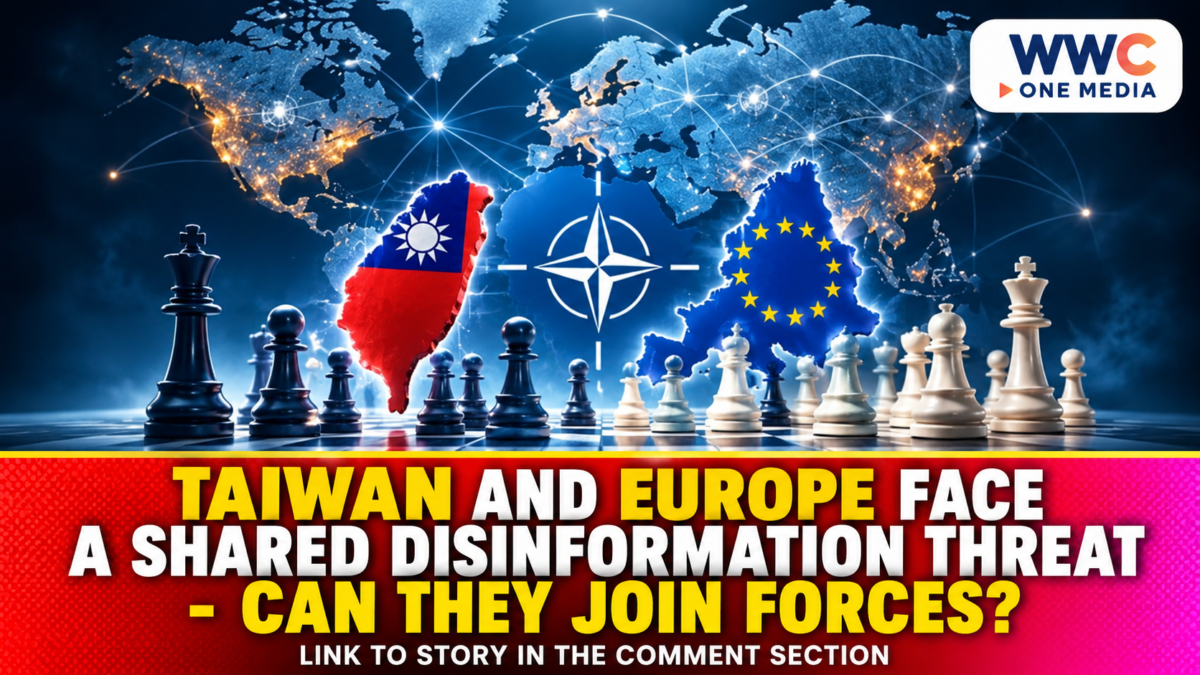
The two experiences are now at the centre of a policy argument for closer cooperation. The question is whether Taiwan’s frontline experience and Europe’s institutional infrastructure could be combined into a stronger international response.
The proposal is not a confirmed agreement between Taipei and the European Union. It is a strategic recommendation that has gained relevance as governments confront AI-generated content, coordinated online accounts and campaigns designed to deepen political divisions.
Taiwan’s experience shows how information manipulation can spread
Taiwan’s National Security Bureau recorded 2.159 million instances of disinformation targeting the island in 2024, compared with 1.329 million in 2023.
Its report described activity across Facebook, video platforms, online forums, X and other channels. It also recorded 28,216 inauthentic accounts in 2024, an increase of 11,661 from the previous year.
The bureau identified several methods in its assessment, including the use of inauthentic accounts to flood comment sections, the impersonation of Taiwanese users, manipulated videos and the amplification of narratives during military exercises.
It also warned about the use of generative artificial intelligence to produce accounts, images, videos and text at scale. The report described deepfake videos purporting to show Taiwanese political figures making statements they had not made.
These methods illustrate why information operations are not limited to publishing a false story. A campaign can involve creating artificial identities, repeating a narrative across platforms and making coordinated material appear to represent genuine public opinion.
The bureau also described the use of proxy accounts and websites that it said were designed to obscure connections to official Chinese sources.
These are assessments published by Taiwan’s security agency. They should be distinguished from independently adjudicated findings about the responsibility of particular individuals or organisations.
Taiwan has built a government-wide response
Taiwan’s response is not limited to asking social-media users to identify suspicious posts.
The National Security Bureau said the government had established a whole-of-government mechanism for reporting and responding to information threats. In 2024, 3,900 instances of disinformation were reported to government ministries and departments to support response planning.
The bureau also said it conducted more than 100 international exchange activities in 2024 to share experience in preventing disinformation and strengthening the ability of democratic partners to respond to information manipulation.
That international dimension is important. Foreign influence campaigns can cross borders, use multiple languages and rely on networks of accounts, websites and intermediaries operating outside the country being targeted.
Taiwan’s experience is therefore relevant to other democracies facing similar challenges, even when the political circumstances and the actors involved differ.
The island’s experience with AI-generated political material is also becoming increasingly relevant as its November 28 local elections approach. WWC has examined how artificial intelligence could become another battlefield in Taiwan’s election environment.
The central concern is not that every controversial post is foreign-directed. It is that coordinated manipulation can make it harder for voters to distinguish authentic political debate from manufactured activity.
Europe’s system offers a different set of tools
The European Union has developed an institutional framework for addressing foreign information manipulation and interference, commonly referred to as FIMI.
The European External Action Service (EEAS) says it has strengthened its ability to identify, analyse and respond to these activities since 2015.
Its approach goes beyond checking whether individual statements are true or false. It examines coordinated behaviour, the networks involved and the methods used to manipulate public discussion.
The EU’s FIMI Toolbox is organised around four broad pillars: situational awareness, resilience building, disruption and regulation, and external action.
The framework includes the Rapid Alert System, which allows EU member states and institutions to exchange information and coordinate responses. It also involves support for independent media, civil society, fact-checking networks and media-literacy initiatives.
The European Commission has separately highlighted the importance of protecting media freedom and pluralism while strengthening the ability of citizens to assess online information.
Its public information on democratic resilience cites a November 2025 Eurobarometer survey in which 79% of Europeans said they were worried about disinformation influencing voters, while 70% feared foreign interference in elections.
These concerns give the issue a broader political dimension. The challenge is not simply whether a government can identify a false post, but whether citizens continue to trust legitimate institutions, independent journalism and the democratic process.
Artificial intelligence is changing the scale of the problem
The growing use of generative AI adds another layer of complexity.
The EEAS’s March 2026 report on foreign information manipulation said AI tools had become embedded in Russian and Chinese information operations. It described how AI can make it easier to produce large volumes of written content, images and videos at relatively low cost.
The report also warned that information manipulation can target the wider information environment, including the material people encounter when using large language models and other digital tools.
This creates a problem for traditional fact-checking.
A fabricated video may circulate before journalists or investigators can establish its origin. A coordinated network can repeat the same claim across different platforms, making it appear more widely accepted than it really is.
The objective of such activity may not always be to persuade people to support a particular political position. It can also be to weaken confidence in public institutions, deepen existing divisions or discourage participation in elections.
The EEAS has argued that responses should focus on the structures and methods supporting these operations, rather than treating every misleading post as an isolated incident.
That distinction is important because removing individual pieces of content may not dismantle the networks responsible for producing and distributing them.
Why closer Taiwan-Europe cooperation is being proposed
The argument for cooperation rests on complementary experience.
Taiwan has dealt with sustained information threats in a politically sensitive security environment. Its government has developed reporting mechanisms and international exchanges while working with civil society and other partners.
Europe has built a broader institutional framework that includes cross-border information sharing, regulatory tools, diplomatic responses and programmes to strengthen media literacy.
A structured partnership could allow both sides to exchange information about tactics, compare methods of identifying coordinated activity and improve training for researchers, journalists and public institutions.
It could also support cooperation on AI-generated content, the identification of deceptive online networks and the development of common standards for documenting information manipulation.
The National Interest argument for cooperation is a policy proposal, not evidence that a formal EU-Taiwan mechanism has already been established.
The distinction matters because Taiwan’s international political status creates diplomatic sensitivities. Any practical cooperation would need to consider the EU’s existing policies and the different legal and institutional responsibilities of the participating organisations.
For European policymakers, Taiwan’s experience could provide useful operational insight. For Taiwan, European expertise could offer opportunities to strengthen international coordination and improve the visibility of information threats beyond the Indo-Pacific.
The danger of defending openness by restricting it
There is also a difficult question at the centre of the debate: how can governments counter foreign manipulation without giving authorities excessive control over public discussion?
A democracy must protect legitimate criticism, opposition speech, independent journalism and public disagreement. A controversial opinion is not automatically disinformation, and criticism of a government should not be treated as evidence of foreign interference.
The EEAS itself describes FIMI as a pattern of intentional and coordinated manipulation that can involve state and non-state actors. Its framework focuses on behaviour and networks, rather than simply labelling unpopular views as hostile.
That approach is essential if governments want public confidence in their response.
WWC has also examined Singapore’s approach to information resilience, including the challenge of responding to potentially manipulative online activity while preserving space for legitimate debate.
The broader European security environment presents related concerns about the use of digital platforms and online networks for covert activity. WWC’s report on Europe’s growing spy-recruitment problem through messaging applications explores a different security threat, but highlights why investigators must distinguish ordinary online activity from specific, evidence-backed operations.
For Taiwan and Europe, the same principle applies: transparency, clear evidence and independent scrutiny are essential to a credible response.
What happens next?
The immediate question is whether Taiwan and European institutions can turn shared concerns into practical cooperation.
Potential areas include joint research, information-sharing arrangements, training, common analytical methods and stronger links between independent researchers and civil society organisations.
Such cooperation would not eliminate disinformation or guarantee that future elections remain free from foreign influence. It could, however, improve the ability of democratic institutions to recognise coordinated campaigns and respond before manipulated narratives spread further.
Taiwan’s experience and Europe’s institutional framework offer different strengths. Bringing them closer together could help develop a more coordinated response to a problem that increasingly crosses national borders.
But the most important test will be whether democracies can defend their information environments without sacrificing the freedoms that make those environments open in the first place.
Frequently asked questions
What is foreign information manipulation and interference?
Foreign information manipulation and interference, or FIMI, refers to intentional and coordinated behaviour designed to manipulate information environments and influence political or social processes. It can involve state or non-state actors and their proxies.
Why is Taiwan concerned about Chinese information operations?
Taiwan’s National Security Bureau has documented what it identifies as disinformation campaigns targeting the island. Its 2024 report recorded 2.159 million instances of disinformation and described methods involving inauthentic accounts, impersonation, manipulated content and AI-generated material.
How does the European Union counter disinformation?
The European External Action Service uses a FIMI framework involving situational awareness, resilience building, disruption and regulation, and external action. Its work includes information sharing, support for independent media and civil society, and cooperation with international partners.
Are Taiwan and the European Union already operating a formal joint information-defence system?
The policy argument for closer cooperation does not establish that a formal joint Taiwan-EU system has been created. Existing information exchanges and international activities should not be confused with a new bilateral or institutional agreement.
Can AI-generated content influence elections?
AI can make it easier to produce convincing images, videos and text at scale. Such material can be used in coordinated campaigns, although the presence of AI-generated content alone does not establish who created it or whether it was intended to influence an election.
How can citizens identify possible disinformation?
Readers should check the original source of a claim, compare it with reliable reporting and official records, examine whether images or videos have been taken out of context, and avoid sharing unverified material. A suspicious post should not automatically be treated as proof of foreign interference.