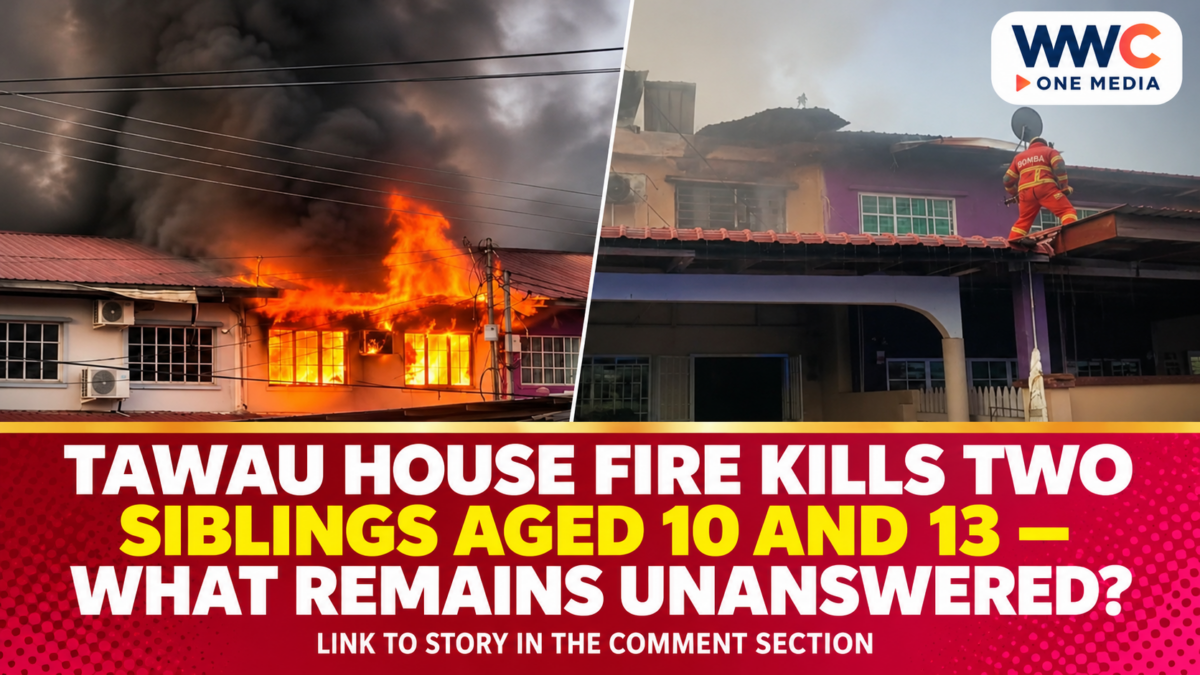
TAWAU, SABAH, MALAYSIA — Two young siblings lost their lives after a residential fire broke out in Tawau, Sabah, on Friday, Nov. 20, 2026, leaving a family mourning the deaths of a 13-year-old boy and his 10-year-old sister.
Four other occupants escaped the burning property as emergency personnel responded to the incident.
The fatal Tawau house fire has renewed attention on residential fire safety, emergency escape routes and the importance of preparing households for emergencies involving children.
While firefighters prevented the blaze from spreading to neighbouring properties, the circumstances that led to the children’s deaths require further clarification.
Tawau House Fire Claims Two Young Lives
Emergency personnel received a distress call at 6:13 a.m. Firefighters reached the affected residence nine minutes later and began firefighting and rescue operations.
The children’s mother and three other children managed to escape, but the two siblings remained inside the burning residence.
Both children were subsequently discovered during the emergency operation.
Firefighters prevented the flames from reaching two neighbouring homes, limiting the spread of the residential fire.
Emergency operations also received assistance from police and local utility personnel.
Questions Remain Over the Cause of the Fire
The circumstances surrounding the outbreak of the fire remain unclear.
A definitive determination of its origin would require a technical examination of the affected property and the conditions present when the fire began.
It would be premature to attribute the incident to an electrical malfunction, household appliance or any other potential ignition source without established findings.
The tragedy comes amid continuing public attention to residential and building safety, an issue examined in WWC ONE MEDIA’s coverage of Malaysia’s fire safety framework.
The available information does not establish whether the residence had functioning smoke detectors or whether particular structural features affected the children’s ability to escape.
Emergency Escape Routes Remain Essential
Malaysia’s residential fire safety recommendations encourage households to identify two possible emergency escape routes from each room and ensure that occupants understand how to use them.
Families should periodically review their evacuation arrangements, particularly when children or individuals requiring assistance live in the residence.
A household emergency plan should account for the possibility that a commonly used exit may become inaccessible.
Residential fire preparedness has also featured in WWC ONE MEDIA’s coverage of fire safety following the Sik house fire.
These general precautions are not findings about the Tawau property and should not be interpreted as evidence of negligence by the affected family.
The Importance of Early Fire Detection
Smoke detectors are among the preventive measures recommended for residential properties.
Installing detection devices on each floor can provide occupants with an opportunity to recognise danger and begin evacuating.
Households are also encouraged to avoid overloading electrical circuits and to keep combustible materials away from ignition sources.
Early detection and emergency escape arrangements serve different but complementary purposes. Receiving a warning does not necessarily mean that every occupant has a safe means of leaving the building.
Residents should consider both aspects when reviewing household fire preparedness.
Emergency Response and Community Safety in Sabah
The Tawau incident illustrates the importance of coordinated emergency operations when a residential fire threatens occupants and surrounding properties.
The response involved firefighting personnel, police and utility services.
Emergency coordination also featured in WWC ONE MEDIA’s earlier coverage of a multi-vehicle emergency along the Semporna–Tawau road, another incident requiring assistance from Sabah’s emergency responders.
However, containing a residential blaze and determining its cause are separate responsibilities.
A successful containment operation does not necessarily establish how the fire started or explain the conditions that occupants encountered before emergency personnel arrived.
What Happens Next?
Further official findings could clarify the origin of the Tawau house fire and the circumstances that prevented the two children from escaping.
Until such information becomes available, questions concerning the condition of the residence, the availability of emergency exits and the sequence of events inside the property should remain open.
The immediate human toll is clear: two children died, while four other occupants escaped.
For the bereaved family, the incident represents an irreparable personal loss. Any subsequent examination of the tragedy should respect their privacy and avoid unsupported assumptions about their actions.