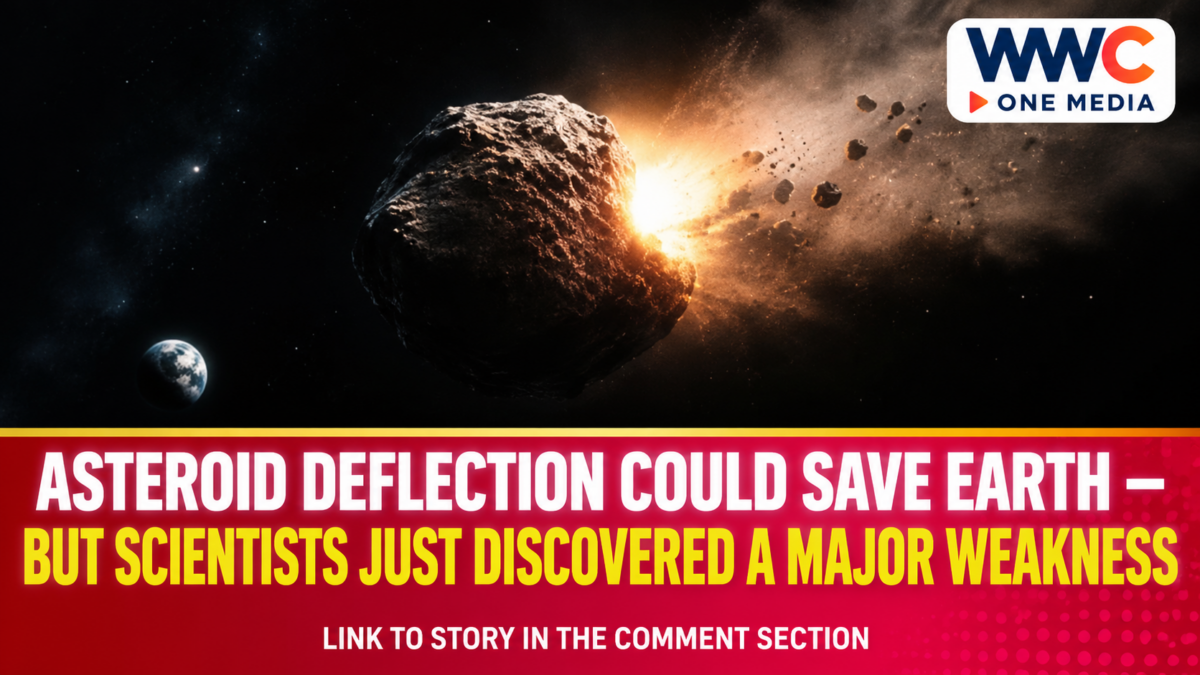
ALBUQUERQUE, United States — A potential strategy for protecting Earth from a dangerous asteroid faces a significant scientific challenge after researchers discovered that the irregular shape of a space rock could substantially influence the effectiveness of asteroid deflection.
Scientists at Sandia National Laboratories have developed a computer model examining how asteroids respond to intense X-ray radiation, revealing uncertainties that could complicate future planetary-defence missions.
The research, published in the scientific journal Icarus, highlights the importance of understanding an asteroid’s physical characteristics before attempting to alter its trajectory.
While nuclear-powered asteroid deflection remains a theoretical option, the findings demonstrate why protecting Earth would require more than simply developing powerful technology.
Asteroid deflection faces a complicated scientific challenge
Planetary defence aims to identify potentially hazardous objects in space and develop methods to prevent them from colliding with Earth.
One proposed approach involves using radiation to alter an asteroid’s movement without destroying the entire object.
However, predicting how a naturally irregular space rock would respond remains difficult.
Asteroids are not uniformly shaped objects. Their physical characteristics introduce uncertainties that simplified scientific models may not adequately represent.
The latest research incorporates more realistic asteroid geometry into computer simulations, providing scientists with a better understanding of the challenges associated with hypothetical deflection missions.
The findings also reinforce the importance of distinguishing between theoretical scientific capabilities and technologies that have already been demonstrated in space.
Why understanding asteroids matters
Asteroids offer scientists an opportunity to investigate the history and development of the solar system.
Japan has contributed to this field through its Hayabusa2 mission, which successfully returned material from asteroid Ryugu to Earth in December 2020.
Studying returned asteroid samples allows researchers to examine physical and chemical characteristics that cannot always be determined through distant astronomical observations alone.
These investigations complement broader efforts to improve humanity’s understanding of near-Earth objects.
The scientific challenges associated with such expeditions are also explored in coverage of Japan’s Hayabusa2 asteroid exploration mission.
Although asteroid exploration and planetary defence have different immediate objectives, both depend on reliable scientific information about objects travelling through space.
NASA has already demonstrated asteroid deflection
Humanity has made significant progress in testing alternative methods of planetary defence.
On Sept. 26, 2022, NASA’s Double Asteroid Redirection Test, commonly known as DART, deliberately collided with Dimorphos, a small asteroid orbiting the larger asteroid Didymos.
Subsequent scientific observations established that the collision shortened Dimorphos’ orbital period by approximately 33 minutes.
Neither asteroid posed a threat to Earth.
The experiment demonstrated that a spacecraft collision could alter an asteroid’s motion, establishing an important milestone in planetary-defence research.
DART used a conventional spacecraft impact rather than a nuclear explosion, making it fundamentally different from the theoretical approach examined in the latest Sandia research.
The distinction matters because a successful demonstration of one deflection technique does not automatically establish the effectiveness of every other proposed method.
Early detection remains central to protecting Earth
Developing deflection technologies is only one part of the planetary-defence challenge.
Identifying potentially hazardous asteroids sufficiently early is another essential component.
NASA is developing the Near-Earth Object Surveyor, or NEO Surveyor, a space telescope specifically designed to discover potentially hazardous asteroids and comets.
The observatory will use infrared technology to detect objects that may be difficult to identify using visible-light observations.
Its launch is currently scheduled for no earlier than September 2027.
The mission is intended to address important gaps in existing astronomical observation capabilities.
Reliable spacecraft operations and scientific data collection are also central to other major exploration programmes, including the NASA Voyager mission.
Together, these scientific undertakings illustrate the importance of dependable technology and long-term investment in space research.
What the discovery means for Asia-Pacific space research
Planetary defence is a global scientific concern rather than a challenge confined to any individual country.
Space research, astronomical observations, scientific computing and international cooperation are all relevant to improving humanity’s understanding of potentially hazardous objects.
For Asia-Pacific economies, the latest research provides additional context for ongoing discussions about the development of advanced space technologies and scientific partnerships.
These discussions extend across multiple areas, including ASEAN space cooperation initiatives and international exploration programmes such as the Japan-Europe BepiColombo mission.
Such projects have different objectives, but they provide useful context for the complexity of conducting scientific missions beyond Earth.
The Sandia findings do not announce a new international asteroid-deflection mission or establish that any Asia-Pacific government is preparing a nuclear planetary-defence programme.
Instead, the study adds to the scientific knowledge that could inform future research and international discussions.
What happens next?
Further research is necessary before scientists can establish how complete asteroids might respond to hypothetical radiation-based deflection attempts.
The latest computer model has limitations, particularly in predicting whether an entire asteroid could break apart.
Additional scientific investigations will be needed to improve these predictions and understand the behaviour of different asteroid materials.
NASA’s demonstrated spacecraft-impact approach, Japan’s asteroid exploration research and future astronomical detection missions represent separate but complementary areas of scientific progress.
The central challenge remains turning scientific understanding into dependable planetary-defence capabilities.
For now, the latest discovery is a reminder that even humanity’s most ambitious proposals for protecting Earth must contend with uncertainties about the natural objects they are intended to redirect.