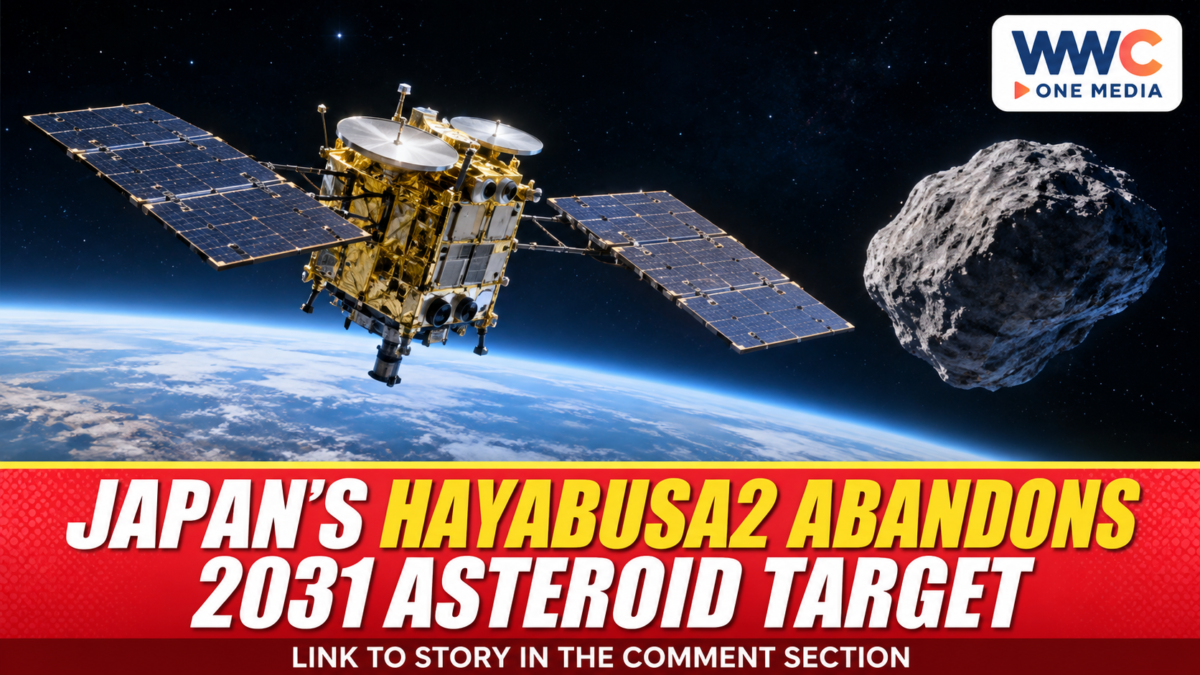
Japan’s Hayabusa2 spacecraft will no longer pursue its planned rendezvous with asteroid 1998 KY26 in 2031 after problems with its ageing ion propulsion system forced the Japan Aerospace Exploration Agency (JAXA) to redesign the mission. In a plan presented on Nov. 17, the agency selected a much smaller asteroid, 2015 BM510, for a high-speed flyby scheduled for April 2028.
The decision changes the mission’s destination, but not its scientific purpose. JAXA wants to use the spacecraft’s remaining capabilities to investigate an unusual asteroid while developing navigation techniques that could eventually support planetary-defence missions.
The revised plan also offers a revealing look at a challenge facing long-duration space exploration: even a spacecraft that has already completed an extraordinary mission can become limited by the gradual deterioration of its equipment.
Why Hayabusa2 could no longer follow its original route
Hayabusa2 launched on Dec. 3, 2014, and returned its sample capsule to Earth in December 2020 after collecting material from asteroid Ryugu.
Rather than ending the spacecraft’s operations after delivering the samples, JAXA moved it into an extended mission in July 2022. The next major objective was asteroid 1998 KY26, with arrival planned for July 2031. ISAS+1
That journey depended heavily on the spacecraft’s ion engines, which provide the sustained acceleration needed for long-distance manoeuvres.
JAXA’s Nov. 17 technical presentation describes how the propulsion system deteriorated over time. Three ion-engine units had already required operating-life extension measures, while the remaining unit, ITR-B, developed a short circuit in its ion source in August 2026.
The agency had attempted to extend the unit’s operating life by increasing propellant flow from September 2023. However, operating above the design flow rate eventually contributed to the ion-source short circuit and a power-system failure. JAXA | 宇宙航空研究開発機構+1
Engineers subsequently confirmed that combining the B neutraliser with the D ion source could allow some continued operation. But the remaining operating life could not be predicted reliably.
The original rendezvous with 1998 KY26 required an estimated velocity change of 650 metres per second and more than 10,000 hours of engine operation. JAXA concluded that this requirement could no longer be supported with sufficient confidence.
The agency therefore chose a mission that could be carried out using the spacecraft’s remaining propulsion resources.
The new target is only 17 to 74 metres wide
Webb Detects Extremely Small Main Belt Asteroid – NASA Science
The replacement target, 2015 BM510, is a near-Earth asteroid estimated to measure between 17 and 74 metres across.
JAXA classifies it as a D-type asteroid, a category associated with primitive objects that may contain substantial amounts of organic material and water-bearing compounds. The agency’s presentation also identifies it as a fast rotator, with an estimated rotation period of approximately 0.81 hours, or about 49 minutes. JAXA | 宇宙航空研究開発機構
That rapid rotation makes the object scientifically interesting.
Researchers want to understand how a small, potentially fragile asteroid can remain intact while spinning so quickly. Strong rotational forces can place considerable stress on an object’s structure, raising questions about its composition, internal strength and formation.
D-type asteroids are also of interest because studying them could help scientists investigate connections between primitive asteroids and comets.
JAXA says there is currently no established precedent for a spacecraft mission to a D-type fast-rotating asteroid. If Hayabusa2 completes the planned observation, it could provide a new set of measurements for planetary scientists.
A difficult flyby with very little time for navigation
The new mission will not involve landing on or orbiting 2015 BM510.
Instead, Hayabusa2 is expected to pass the asteroid at high speed, with JAXA targeting a closest approach of several hundred metres from its centre.
The planned relative speed is approximately 6 kilometres per second. The agency’s mission scenario schedules the flyby for April 2028. JAXA | 宇宙航空研究開発機構
One major difficulty is that the asteroid is extremely small and faint. JAXA estimates that the spacecraft’s optical navigation camera may not be able to identify it until roughly 10 hours before the closest approach.
That is a much shorter observation window than the 14 days available during the spacecraft’s July 2026 flyby of asteroid Torifune.
The navigation sequence will therefore require ground-based instructions followed by autonomous guidance aboard the spacecraft.
This is where the mission becomes particularly demanding. The spacecraft must identify a faint target, calculate its relative position and adjust its flight path accurately within a limited period.
JAXA describes the operation as an exceptionally difficult flyby. Its success would demonstrate how spacecraft can approach very small objects that are difficult to observe from a distance.
Torifune gave the team a valuable test
The change of target does not mean Hayabusa2 has lost its ability to conduct close asteroid observations.
On July 5, 2026, the spacecraft successfully flew past asteroid Torifune. JAXA’s presentation recorded a closest distance of approximately 400 metres from the asteroid’s surface, with a relative speed of 5.3 kilometres per second.
The spacecraft passed approximately 744 metres from the asteroid’s centre. Its closest approach was about 120 metres from the intended target point. JAXA | 宇宙航空研究開発機構
That operation provided practical experience in precise navigation around a small celestial body.
JAXA intends to build on those capabilities for the 2015 BM510 encounter, although the new target presents different challenges because it is considerably smaller and harder to observe.
The agency also plans to continue scientific observations during the journey, including measurements of zodiacal light, diffuse galactic light, exoplanets and other observable asteroids and comets. JAXA | 宇宙航空研究開発機構
Japan’s broader investment in planetary exploration can also be seen in its Martian Moons eXploration mission to study Phobos, which builds on the country’s experience in deep-space navigation and sample-return operations.
Why this could matter for planetary defence
The revised mission has implications beyond asteroid science.
Planetary defence involves identifying objects that could threaten Earth and developing ways to reduce the risk of an impact. One proposed approach is to send a spacecraft into an asteroid to alter its trajectory.
But doing that safely requires extremely accurate navigation, especially when the target is small and its orbit must be determined from limited observations.
JAXA says the techniques developed for Hayabusa2’s new flyby could contribute to future asteroid-deflection missions. The ability to guide a spacecraft accurately towards a small object could help make a deliberate collision mission more feasible. JAXA | 宇宙航空研究開発機構
That does not mean Hayabusa2 will attempt to change 2015 BM510’s orbit. The current mission is designed for observation and technology demonstration, not asteroid deflection.
The distinction is important. Developing the ability to reach a small asteroid is one step; demonstrating that a spacecraft can safely and predictably change the path of a potentially hazardous object is another.
The wider international space sector is also working to improve access to space and develop new capabilities, including through commercial rocket-launch programmes and regional cooperation on space technology and orbital safety.
For the Philippines and other countries with growing space programmes, these developments show why space research involves more than launching satellites. Navigation, observation, data-sharing and the ability to respond to hazards are also essential capabilities.
What happens next
JAXA’s revised schedule calls for trajectory-control operations beginning in late October 2026 and continuing for approximately one to two months. Ground-based observations of the asteroid are planned around the end of 2026 and early 2027.
The agency is targeting the flyby in April 2028.
The original 2031 rendezvous with 1998 KY26 is no longer the mission’s destination under the revised plan. Instead, JAXA intends to use the spacecraft’s remaining operational life to complete a closer-term encounter with 2015 BM510.
Hayabusa2 has already achieved its original sample-return objective. Its next test is different: whether a spacecraft approaching 12 years in operation can still deliver precise scientific observations despite ageing propulsion equipment.
If the 2028 encounter succeeds, the mission could add important knowledge about fast-spinning asteroids while demonstrating navigation techniques that may one day help protect Earth.
Frequently asked questions
1. Why did Japan change Hayabusa2’s destination?
JAXA found that deterioration and failures in the ion propulsion system made the original journey to asteroid 1998 KY26 too demanding to carry out reliably.
2. What asteroid will Hayabusa2 visit instead?
The spacecraft is now scheduled to fly past near-Earth asteroid 2015 BM510 in April 2028.
3. How big is asteroid 2015 BM510?
JAXA estimates that it measures between 17 and 74 metres across.
4. Will Hayabusa2 land on the new asteroid?
No. The revised mission involves a high-speed flyby, with the spacecraft expected to pass several hundred metres from the asteroid’s centre.
5. Can Hayabusa2 prevent an asteroid from hitting Earth?
The spacecraft is not being sent to deflect an asteroid. However, the navigation techniques developed during its mission could contribute to future planetary-defence technologies designed to alter the paths of potentially hazardous objects.