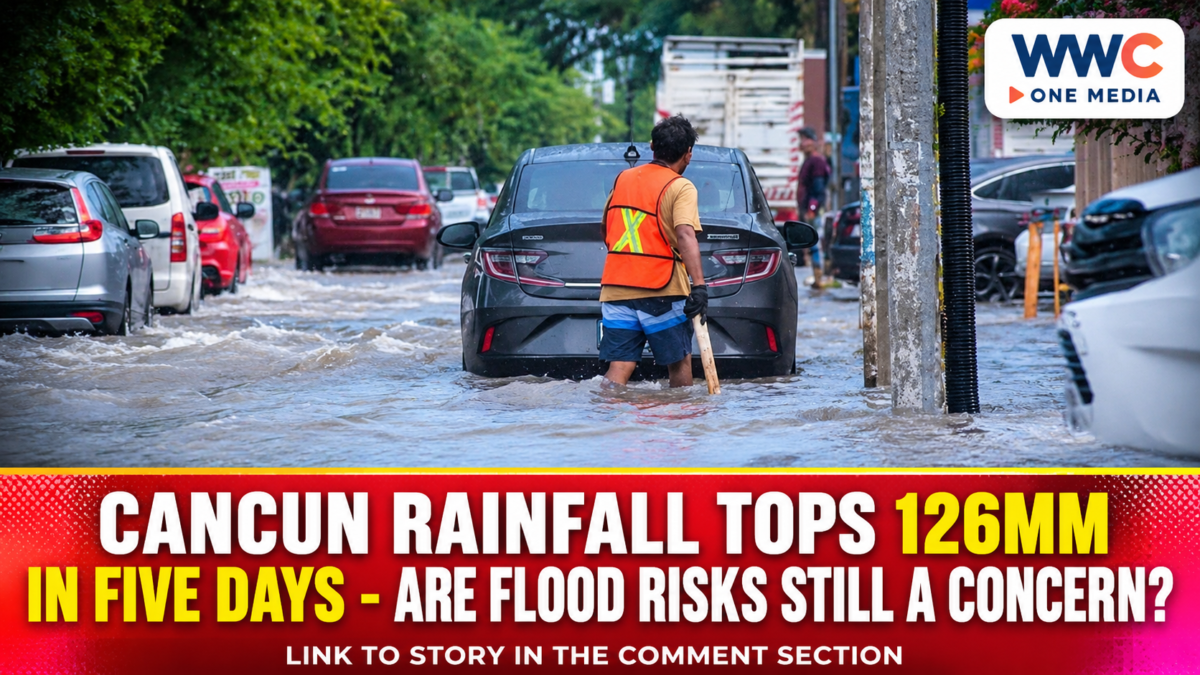
CANCUN, Mexico — November 26, 2026 — Heavy rainfall has put Cancun and other parts of Quintana Roo under renewed weather scrutiny, with Mexico’s National Meteorological Service recording 126.9 millimetres of accumulated rain at its Cancun radar station over the five-day period ending November 24.
The measurement highlights the volume of rain affecting the popular Caribbean destination as a weather system brought intense precipitation forecasts to the Yucatán Peninsula.
The figure is significant, but it needs context: 126.9 millimetres represents accumulated rainfall over five days, not the amount that fell in a single downpour or across every neighbourhood in Cancun.
The weather service also warned that intense rainfall could cause flooding in low-lying areas, increase water levels in rivers and streams, and create dangerous travel conditions.
For residents, workers and international visitors, the immediate concern is whether drainage systems and road networks can manage additional rainfall.
Cancun records more than 126 millimetres of accumulated rain
Mexico’s National Meteorological Service recorded 126.9 millimetres at the Cancun radar station between November 20 and November 24.
The same five-day report recorded 140.5 millimetres in Cozumel, also in Quintana Roo, while Playa del Carmen registered 81.6 millimetres.
These measurements show that substantial rainfall affected multiple locations across the state during the reporting period.
They do not mean every part of Cancun received the same amount. Rainfall can vary considerably between monitoring stations and neighbourhoods, particularly when showers and thunderstorms develop locally.
The distinction is important when interpreting flood reports. A regional rainfall measurement establishes that significant precipitation occurred, but it cannot independently establish the depth of water on a particular street or confirm damage to individual properties.
For more on how weather conditions affect Mexican coastal communities, WWC has examined the impact of cold fronts on Mexico’s fishing season and coastal livelihoods.
Cold Front No. 8 brought a wider weather threat
The rainfall occurred as Cold Front No. 8 interacted with other atmospheric systems over Mexico.
In its November 24 forecast, the National Meteorological Service warned of locally intense rainfall in Quintana Roo, alongside heavy to intense precipitation in other parts of southeastern Mexico.
The forecast identified a stationary frontal system over the Gulf of Mexico interacting with a low-pressure channel in southeastern Mexico and the subtropical jet stream.
These interacting systems can support the development of widespread rain and thunderstorms.
The weather service warned that heavy to intense rainfall could be accompanied by lightning, strong wind gusts and hail. It also identified the potential for rising river and stream levels, landslides, water accumulation and flooding in low-lying locations.
That warning matters in an urban destination such as Cancun, where road access, drainage capacity and the movement of residents and tourists can be affected when rainfall accumulates faster than water can drain.
Why flooding matters beyond Cancun’s residential neighbourhoods
Cancun’s economy depends heavily on tourism, hospitality, transportation and other services connected to international visitors.
The Hotel Zone is a major centre for resorts, restaurants, entertainment venues and visitor activities. Heavy rain can complicate movement between hotels, the city centre and transport facilities, even when tourist businesses remain operational.
The effects can also reach workers who commute between residential areas and the tourism corridor.
However, rainfall alone does not establish that hotels have closed, flights have been cancelled or tourism operations have stopped. Those developments require separate confirmation from the relevant operators and authorities.
WWC has previously examined how flooding can disrupt communities and essential services in the Philippines. The wider issue is that flooding can affect more than property: it can interrupt mobility, access to work and the delivery of basic services.
What the rainfall figures do not tell us
The official rainfall report provides a useful measurement of the weather conditions, but it does not establish the full extent of flooding in individual Cancun neighbourhoods.
Local news coverage published on November 24 and 25 described water accumulation and difficult road conditions in areas including Villas Otoch Paraíso, Villas del Mar, Región 201 and the Hotel Zone.
Those reports provide leads about possible local impacts. However, the primary municipal incident records or an official damage assessment confirming those specific locations were not available in the records reviewed for this report.
The distinction is especially important when reporting on public safety. A photograph or account of water on a road can show a local problem, but it does not establish the number of affected households, the depth of flooding across an entire district or the extent of infrastructure damage.
The same caution applies to reports about road closures. A separate notice concerning the Nichupté Bridge on November 24 described temporary traffic interruptions for an international filming operation. That notice does not establish that the bridge was closed because of flooding.
WWC has also examined how prolonged flooding can threaten electricity and essential services, underscoring why verified information about infrastructure and public safety matters during severe weather.
What happens next?
The priority is continued monitoring of rainfall, drainage conditions and any official advisories issued by Mexico’s National Meteorological Service and Quintana Roo’s civil protection authorities.
Residents and visitors should avoid driving or walking through floodwater, particularly where the depth or condition of the road surface cannot be determined. Water can conceal open drains, damaged pavement and other hazards.
Travellers should also check directly with airlines, hotels and transport operators for operational changes rather than assume that every reported weather disruption affects all services.
The National Meteorological Service’s November 26 outlook projected only isolated rainfall of 0.1 to 5 millimetres for Quintana Roo that day. That is a forecast, not a guarantee that every location would remain dry or that all accumulated water would immediately disappear.
The more important question is how quickly affected areas can drain and whether additional rainfall will create fresh problems.
For Cancun, the five-day rainfall total is a reminder that even a destination known for its beaches and year-round tourism remains exposed to intense weather. The challenge is not simply getting through one rainy day, but ensuring that roads, drainage infrastructure and public-safety systems can withstand repeated downpours.
Frequently asked questions
How much rain did Cancun receive in November 2026?
Mexico’s National Meteorological Service recorded 126.9 millimetres at its Cancun radar station over the five-day period ending November 24, 2026.
Which other areas in Quintana Roo recorded heavy rainfall?
The same five-day report recorded 140.5 millimetres in Cozumel and 81.6 millimetres in Playa del Carmen.
What weather system affected Cancun?
Cold Front No. 8 interacted with other atmospheric systems over the Gulf of Mexico and southeastern Mexico, contributing to the forecast of intense rainfall in Quintana Roo.
Does the 126.9-millimetre figure mean every Cancun neighbourhood received that much rain?
No. It is a measurement from the Cancun radar station. Rainfall amounts can differ between locations.
Are Cancun hotels and flights operating normally?
The rainfall measurement does not establish the operating status of individual hotels or flights. Travellers should confirm their arrangements directly with airlines, accommodation providers and transport operators.