
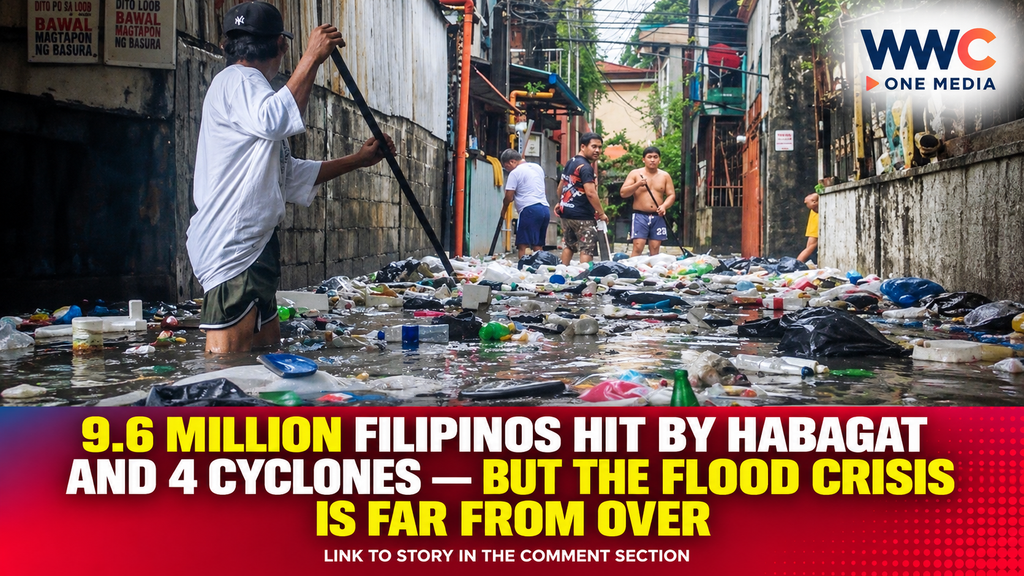
More than 9.6 million people across the Philippines have been affected by the combined effects of the enhanced Southwest Monsoon (Habagat) and four tropical cyclones, as flooding, landslides and other weather-related incidents continue to batter communities.
The latest figure from the National Disaster Risk Reduction and Management Council (NDRRMC) covers the impacts of Tropical Cyclones Luis, Maymay, Neneng and Pilandok, together with the enhanced Habagat.
According to the NDRRMC’s Situational Report No. 37, 9,614,020 people—or 2,781,245 families— had been affected across 10 regions, 39 provinces, 468 cities and municipalities, and 6,551 barangays.
The scale of the disaster has continued to shift as authorities update their assessments.
More than 162,000 people displaced
Of those affected, 162,057 people were displaced and staying in 820 evacuation centers, underscoring the continuing pressure on communities forced from their homes by flooding and other hazards.
The NDRRMC recorded 1,830 flooded areas, covering parts of Regions I, III, CALABARZON, MIMAROPA, VI and IX, as well as Metro Manila.
Authorities also recorded 79 other incidents, including rain-induced landslides, collapsed structures and tornadoes or destructive winds.
Death toll continues to change
The casualty figures have also evolved as government agencies validate reports.
The NDRRMC’s report cited by GMA recorded 12 confirmed deaths, with another 32 deaths still undergoing validation, along with 12 confirmed injuries and six additional injuries pending validation.
However, a later NDRRMC update reported by Radyo Pilipinas on September 9 placed the reported death toll at 44, with 18 injured and five people still missing. That later figure illustrates why casualty numbers should be treated as provisional while authorities continue validation.
Thousands of homes damaged
The prolonged rains have also caused significant damage to homes and public infrastructure.
The NDRRMC recorded 4,361 damaged houses, including 3,758 partially damaged and 603 totally damaged.
Infrastructure damage was estimated at approximately P8.30 billion, involving 1,383 facilities, including roads, bridges, schools, government buildings and flood-control structures.
The agricultural sector has likewise suffered heavy losses.
Agriculture takes another major hit
Separate Department of Agriculture figures released on September 8 put agricultural damage and losses from Habagat and the four cyclones at P4.38 billion.
The DA said 99,663 farmers and fisherfolk were affected, while approximately 81,511 hectares of agricultural areas were damaged. Production losses were estimated at 102,791 metric tons.
Rice accounted for the largest portion of agricultural losses at about P2.05 billion, followed by high-value crops at P1.38 billion. Fisheries and aquatic resources also suffered approximately P647.79 million in losses.
The government said affected farmers could receive agricultural inputs and access loans of up to P25,000 under the Survival and Recovery (SURE) Loan Program.
The danger isn’t over
Although some floodwaters have begun to recede in certain areas, the threat remains significant.
A September 7 report from BusinessMirror said 552 areas remained flooded, while about 18,100 families, or 62,300 people, were still staying in evacuation centers at that point. It also reported infrastructure damage of about P7.79 billion and crop damage of approximately P4.4 billion based on the then-current NDRRMC figures.
The continuing rainfall is particularly dangerous in areas already saturated by weeks of rain because additional downpours can quickly trigger flash floods and landslides, especially in low-lying and mountainous communities.
The Philippine Information Agency previously reported that government agencies had deployed extensive relief and response resources, including food packs, ready-to-eat meals, hygiene kits, water filtration equipment and medical services for affected communities.
A disaster that has stretched for weeks
This latest crisis is not the result of a single weather event.
The enhanced Habagat has repeatedly interacted with tropical cyclones, producing prolonged rainfall across large portions of Luzon and parts of the Visayas.
Earlier NDRRMC/OCD updates showed how rapidly the number of affected Filipinos climbed—from millions affected in August to more than 9.6 million in the latest assessment.
The continuing situation highlights a major challenge for disaster authorities: even when a tropical cyclone moves away, its effects can persist because the southwest monsoon can continue producing heavy rainfall and keeping already-flooded areas vulnerable.
For millions of Filipinos, the immediate concern is no longer simply whether another storm will arrive—but whether communities already battered by weeks of rain will have enough time to recover before the next round of severe weather.




Leave a Reply