
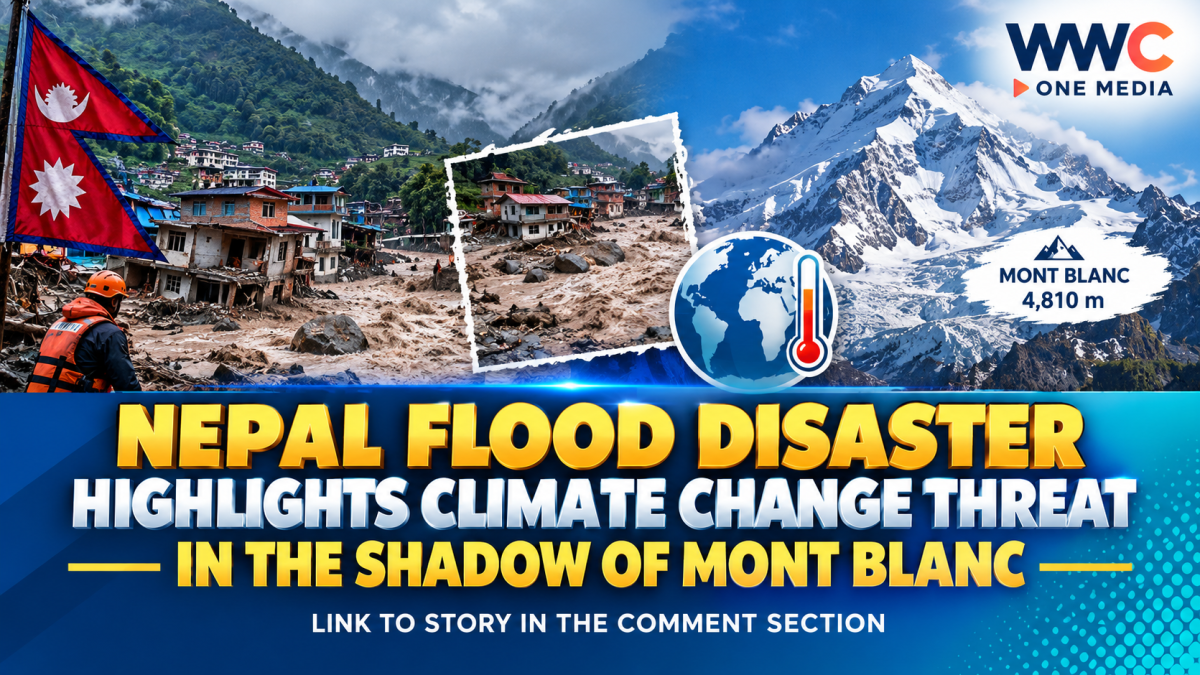
CHAMONIX-MONT-BLANC, France — As Nepal continues to deal with the devastating aftermath of catastrophic floods, communities beneath Europe’s highest mountain are confronting their own growing fears about climate change.
The glaciers, snowfields and rocky slopes surrounding Mont Blanc have long appeared permanent to the communities living beneath them.
But record heat and rising temperatures are rapidly changing the Alpine landscape, causing glaciers to retreat, permafrost to thaw and rock falls to become increasingly common.
The changes unfolding in the Alps have drawn fresh attention following the devastating disaster in the Himalayas, where a collapse involving bedrock and glacier ice triggered catastrophic flooding across parts of Nepal and China’s Tibet.
A summer of unprecedented heat
Mont Blanc, which rises between France and Italy, has experienced dramatic changes this summer as extreme heat affected high-altitude areas.
Permafrost — permanently frozen ground and ice that helps hold mountain rock together — has been weakened by rising temperatures.
As the frozen material thaws, cliffs and steep rock faces become less stable.
Officials and mountain experts in the Chamonix-Mont-Blanc area said rock falls increased significantly from mid-July, while glacier retreat and melting snow made some areas more difficult and dangerous to access.
At the Aiguille du Midi, a peak in the Mont Blanc range, average temperatures in July reached a record high, according to France’s national weather service.
Nepal disaster brings warning closer to home
The destruction in Nepal has become a stark reminder that mountain regions around the world are increasingly vulnerable to the effects of a warming climate.
The Aug 26 disaster near the Nepal-China border was triggered when bedrock and glacier ice collapsed, sending huge amounts of debris and water through Himalayan valleys and rivers.
The resulting floods caused widespread devastation, destroying homes, roads and major infrastructure while leaving thousands dead or missing.
Scientists and officials have warned that climate change is increasing the risks facing high mountain regions as warming destabilises glaciers, ice and frozen slopes.
Mont Blanc faces growing rockfall danger
Researchers studying Mont Blanc say the number of major rock collapses has surged dramatically.
Ludovic Ravanel, a researcher specialising in the effects of climate change on mountain environments, said warming temperatures have weakened the permafrost that has helped stabilise Alpine rock faces for thousands of years.
A major collapse is classified as involving more than 100 cubic metres of rock.
Ravanel expects the number of major collapses in the Mont Blanc massif to reach around 400 this year — roughly 10 times the number seen about two decades ago.
The scale of the activity has made 2026 one of the most challenging summers for the region’s mountain environment.
Glaciers are retreating rapidly
The effects of climate change are also becoming increasingly visible on the glaciers themselves.
In Italy’s Lombardy region, Alpine glaciers have lost more than 40 per cent of their surface area since 1991, according to the regional glacier service.
Scientists say rising temperatures are changing precipitation patterns as well.
At high altitudes where snow was once common, rain is increasingly falling instead.
This can further accelerate melting and affect the stability of mountain terrain.
Communities that have lived alongside glaciers for generations are now having to reconsider the risks posed by the changing landscape.
Mountain guides forced to change plans
The changing conditions are also affecting climbers and tourism.
Mountain guide Stuart MacDonald said the rapid retreat of glaciers and increased danger from falling rocks have made climbing routes increasingly unpredictable.
Some routes that were previously accessible during the summer have become too dangerous.
MacDonald was forced to cancel plans to lead a group to the summit of Mont Blanc because of unsafe conditions.
He said falling rocks are particularly alarming because they are now occurring in places and along routes that climbers previously considered accessible during this time of year.
Communities prepare for new dangers
Authorities in Chamonix are now considering more serious scenarios as glaciers and mountain slopes become increasingly unstable.
Officials are concerned that large pieces of ice, rock or mountain could eventually threaten populated areas.
The challenge is no longer simply preserving a famous landscape.
Communities must also prepare for potential disasters caused by rapidly changing mountain conditions.
Similar concerns are being raised in mountain regions around the world, from the European Alps to the Himalayas.
Climate change is reshaping the world’s mountains
The disasters and environmental changes in Nepal and Mont Blanc may be separated by thousands of kilometres, but scientists say they are part of a broader pattern.
Rising global temperatures are accelerating glacier retreat and weakening frozen mountain landscapes.
The consequences can include:
- More frequent rock falls and landslides
- Unstable glaciers and mountain slopes
- Sudden floods
- Changing river systems
- Greater risks to communities and infrastructure
- Dangerous conditions for climbers and tourists
Mountain regions are particularly sensitive to warming because even relatively small temperature increases can dramatically affect ice, snow and permafrost.
The bottom line
The devastating floods in Nepal and the rapidly changing landscape around Mont Blanc are highlighting the growing dangers climate change poses to mountain communities around the world.
In the Alps, record heat is melting glaciers, weakening permafrost and triggering a sharp increase in dangerous rock falls.
In the Himalayas, a catastrophic collapse involving glacier ice and bedrock unleashed devastating floods that destroyed communities and infrastructure.
From Nepal to the French Alps, mountains once seen as permanent and unchanging are being transformed — forcing communities to confront a future where the risks from a warming climate are becoming increasingly difficult to ignore.
WWC ONE MEDIA J.M.D




Leave a Reply