
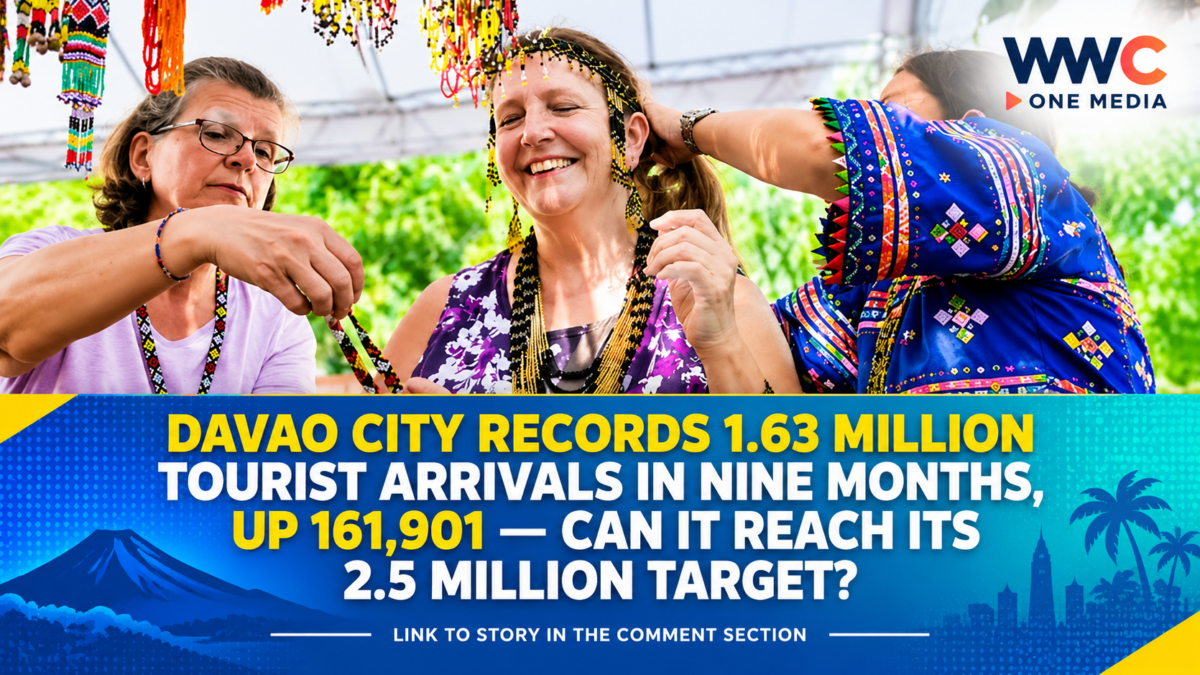
DAVAO CITY, Philippines, October 30, 2026 — Davao City welcomed more than 1.63 million tourist arrivals from January to September 2026, recording an increase of nearly 162,000 visitors compared with the same period last year.
The City Tourism Operations Office (CTOO) reported 1,632,597 arrivals, up by 161,901 or approximately 11 percent from the 1,470,696 recorded during the first nine months of 2025.
CTOO officer-in-charge Willenito Tormis Jr. presented the figures before the Davao City Council during its regular session on October 27, describing the performance as the city’s highest since 2019.
The increase reflects continued tourism activity in the city, supported by domestic travel, international visitors, cultural celebrations and business-related events.
However, the latest figures also reveal a challenge: Davao’s official visitor count may not capture a significant portion of travellers staying in unaccredited short-term rental properties. SunStar Publishing Inc.+1
Domestic Tourists Still Account for Most Arrivals
Domestic travellers continued to dominate Davao City’s tourism market during the January-to-September period.
According to the CTOO breakdown:
- Domestic tourists: 1,541,884, up 10.7 percent.
- Foreign visitors: 71,188, up 14.5 percent.
- Overseas Filipinos: 19,525, up 27.7 percent.
The figures show that domestic tourism remains the backbone of Davao’s visitor economy, even as foreign arrivals grow at a faster rate.
The increase in overseas Filipino visitors is also notable, suggesting stronger travel activity among Filipinos living abroad who return to the country and visit Davao.
For hotels, restaurants, tour operators and local retailers, the growing number of visitors could translate into additional business opportunities. SunStar Publishing Inc.+1
Kadayawan Month Records the Highest Visitor Arrivals
August emerged as Davao City’s busiest month, recording 226,785 tourist arrivals during the period.
The month coincided with the Kadayawan Festival, one of the city’s major annual celebrations showcasing indigenous culture, local traditions, food and community activities.
February, meanwhile, recorded the fastest year-on-year growth at 22.06 percent. May registered the slowest increase at 3.38 percent.
The figures suggest that major festivals and seasonal events remain important contributors to Davao’s tourism performance.
The city’s earlier tourism results also point to the value of extending celebrations beyond a single event. Araw ng Dabaw activities helped support arrivals during the first quarter, while Kadayawan provided another major attraction in August. SunStar Publishing Inc.+2
Davao Targets 2.5 Million Tourist Arrivals in 2026
With three months remaining in the year, the CTOO is aiming to reach 2.5 million tourist arrivals by December 2026.
That would exceed the approximately two million arrivals recorded in 2025.
However, Tormis acknowledged that the city’s current projection is more conservative, estimating that Davao could finish the year with between 2.2 million and 2.4 million arrivals.
The gap between the official target and the latest projection highlights the challenge of sustaining growth through the final quarter.
Reaching 2.5 million would require a strong final stretch, particularly as the city enters the Christmas and year-end travel season.
The target also makes the reliability of visitor statistics important: tourism planning, infrastructure spending and promotional campaigns depend on knowing how many people are actually visiting. SunStar Publishing Inc.+1
Airbnb Stays Raise Questions About Davao’s Tourism Numbers
One of the most significant issues raised during the City Council presentation involved how the CTOO counts tourists.
Tormis explained that the city primarily relies on monthly reports submitted by hotels and inns, which are required under the local tourism code.
Davao City has approximately 7,100 hotel rooms, according to the tourism official.
The CTOO does not simply use airport passenger figures because those numbers cannot distinguish visitors from Dabawenyos who are travelling out of or returning to the city.
But the hotel-based system has limitations.
Tormis said that most Airbnb guests are not included in the official figures because only short-term rental units accredited with the CTOO submit reports.
He also relayed complaints from hotels about condominium units being offered as Airbnb accommodation without declaring their operations or securing city accreditation.
The issue involves more than visitor counting. It also raises questions about whether different accommodation providers are operating under comparable reporting and regulatory requirements.
The CTOO is working with Councilor Myrna Dalodo-Ortiz on proposed revisions to the city’s tourism code that would require Airbnb operators to report their guest numbers.
If implemented effectively, the changes could give the city a more complete picture of its accommodation market and visitor activity. SunStar Publishing Inc.
City Council Considers Arrival Cards and a Tourism App
Davao City officials are also considering new ways to improve visitor tracking and tourism services.
Second District Councilor Diosdado Angelo Junior Mahipus proposed requiring visitors entering the city to complete arrival cards collected at checkpoints.
The proposed system would help build a database of people travelling into Davao from other locations.
Mahipus also suggested developing a tourism application and asked the CTOO to coordinate with the city’s security cluster on monitoring extended hotel stays.
He further raised the possibility of providing free shuttle services for tourists travelling from the airport.
Tormis said the proposed tourism-code revisions include measures intended to improve the reliability of visitor data.
The city is also developing a tourism website with a traveller database, although it does not yet have a dedicated tourism application.
A more comprehensive visitor database could help the local government identify travel patterns, understand accommodation demand and improve tourism planning. SunStar Publishing Inc.
Tourism Development Must Reach More Than the City Centre
The growth in visitor arrivals also raises questions about how Davao can spread tourism opportunities across its wider territory.
During the council session, Finance Committee chairman Councilor Danilo Dayanghirang requested a tourism development plan for the Marilog and Paquibato districts.
Tormis responded that a proposed community-based tourism ordinance remained at second reading.
The initiative could be important for communities outside the city’s more established commercial and tourism areas.
Developing community-based attractions can create opportunities for local guides, accommodation operators, food businesses, transport providers and small enterprises.
It also supports the broader goal of encouraging visitors to explore more than the city’s familiar destinations.
The proposal is consistent with wider efforts to connect destinations across Mindanao. WWC ONE MEDIA previously reported on the Mindanao Tourism Circuit Framework discussions, which aim to develop connected routes and encourage more coordinated tourism investment across the island.
Japan has also expressed interest in strengthening tourism and investment cooperation with Mindanao, including opportunities to attract more Japanese visitors to Davao. Read WWC ONE MEDIA’s report on Japan’s proposed deeper partnership with Mindanao.
At the national level, the Philippines is also pursuing improvements in tourism connectivity and investment readiness. These developments form part of the wider effort to make more destinations accessible to international travellers. SunStar Publishing Inc.+3
What Davao’s Tourism Growth Means for Local Businesses
More tourist arrivals can create opportunities for businesses throughout the city.
Hotels and inns may benefit from higher occupancy, while restaurants, transport operators, tour providers and retailers can potentially gain from increased visitor spending.
But higher arrival numbers do not automatically guarantee that local communities receive a proportional economic benefit.
The distribution of visitors, their length of stay, spending habits and choice of accommodation all influence how much tourism contributes to the local economy.
This is why the proposed tourism-code revisions and better visitor data matter.
If the city can account for more accommodation providers and identify emerging destinations, it may be better positioned to direct investment and promotional support where they are needed.
Davao’s performance also contributes to the wider Philippine tourism picture. WWC ONE MEDIA previously examined the country’s international visitor figures in the Philippines’ race to reach seven million international visitors in 2026.
The national and city-level figures measure different visitor populations, but both underline the importance of improving tourism data and strengthening the country’s destinations.
Can Davao Reach 2.5 Million Visitors Before 2027?
Davao City has already recorded more than 1.63 million arrivals in the first nine months of 2026, putting it ahead of the same period last year.
But the final quarter will determine how close the city gets to its ambitious 2.5-million target.
The current projection of 2.2 million to 2.4 million suggests that tourism officials see continued growth, although reaching the higher target remains uncertain.
The bigger challenge may be ensuring that the increase translates into sustainable economic opportunities for local communities.
Improving accommodation reporting, developing community-based destinations and building more reliable visitor databases could help the city move beyond simply counting arrivals.
Davao’s tourism numbers are rising, but can the city turn that growth into a more inclusive tourism economy — and reach 2.5 million visitors before the year ends?










