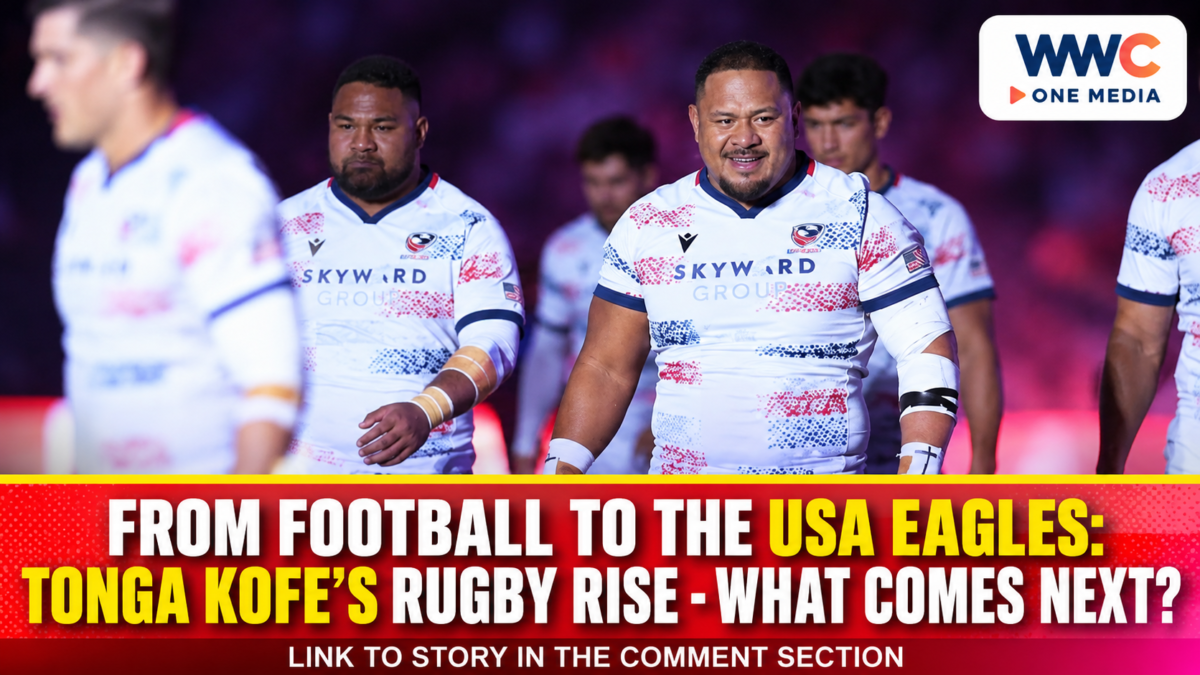
IRVINE, California — November 26, 2026 — Tonga Kofe did not follow the traditional route to professional rugby. Before becoming a powerful presence in the United States national team’s front row, the Oregon-born athlete built his sporting foundation through American football and wrestling.
Now, after earning recognition in Major League Rugby (MLR) for a second consecutive season, the California Legion prop is becoming one of the players to watch as the USA Eagles prepare for the 2027 Rugby World Cup in Australia.
Kofe’s progression is remarkable not simply because of his physical attributes, but because of how quickly he has developed in a sport that demands technical precision, tactical awareness and specialised front-row skills.
The 30-year-old stands at 6 feet 2 inches and weighs approximately 315 pounds, according to his MLR player profile. His size makes him a formidable presence, but his growing reputation rests on more than power.
His next challenge is to turn individual recognition into sustained international impact.
Tonga Kofe: From the gridiron to the rugby scrum
Kofe’s athletic background began outside rugby.
His official California Legion profile identifies him as an Oregon native who played football and competed in wrestling before concentrating on rugby. He attended Portland State University, where he continued his football career.
Those sports provided a foundation for the physical demands of rugby. Football develops explosive movement and contact skills, while wrestling requires balance, leverage and the ability to control an opponent.
However, succeeding as a rugby prop requires a different set of abilities.
The scrum, one of rugby union’s most technical contests, demands coordinated force, body positioning and precise timing. A powerful player cannot rely on strength alone. Technique and teamwork determine whether a front row can maintain stability and secure possession.
Kofe’s development illustrates how athletes from other sports can transition into rugby, provided they are prepared to learn its specialised demands.
Back-to-back All-MLR honours put Kofe in the spotlight
Kofe’s progress has been recognised at league level.
Major League Rugby named him to the 2025 All-MLR Second XV while he was with the Utah Warriors. He earned another selection in the 2026 All-MLR Second XV, this time representing California Legion.
The consecutive selections are particularly significant because the 2026 awards were determined using regular-season performance and statistics. The league selected its First XV, Second XV and Honorable Mention groups from the leading performers across the competition.
Kofe’s recognition places him among the league’s standout tighthead props and reflects his ability to maintain a high level of performance across different club environments.
His 2026 season also helped California Legion reach the MLR Championship Final. The club’s official announcement identified Kofe among eight Legion players recognised across the league’s All-MLR teams.
That achievement gives his development a stronger foundation than a single impressive performance. He has now received league-wide recognition in consecutive seasons.
WWC previously examined how Major League Rugby is building its international audience ahead of the 2027 World Cup, highlighting the growing importance of professional sports development and international visibility in the United States. Rugby’s challenge is to turn that growing attention into a stronger player pathway.
California Legion and the USA Eagles connection
Kofe’s club career has become closely connected to his international development.
California Legion included him in its 2026 roster and confirmed his selection for the USA Eagles’ World Rugby Nations Cup campaign.
The club named six of its players in the United States squad for the competition, including Kofe, captain Jason Damm, Ma’ake Muti, Lance Williams, Cassh Maluia and Joe Mano.
That connection matters because professional club rugby provides the regular competition needed to develop international players. Training, match experience and consistent exposure to high-level opponents help players refine their skills before returning to national-team duty.
Kofe also appeared in the USA’s November Nations Cup matchday squad against Georgia. He was named at tighthead prop for the contest at Mikheil Meskhi Stadium in Tbilisi on November 21.
The match was a demanding test against one of Europe’s strongest emerging rugby nations.
USA Eagles lose to Georgia, but finish as Nations Cup pool champions
The USA’s final Nations Cup match ended in a 38–10 defeat against Georgia.
The result ended the Eagles’ unbeaten run in the competition, but it did not erase their achievement in securing the Americas and Pacific pool title.
The inaugural 2026 World Rugby Nations Cup featured two pools, with the United States and Georgia finishing at the top of their respective groups. Both sides had already secured their pool championships before meeting in Tbilisi.
Georgia ultimately claimed the final match and completed its campaign with six victories from six games.
For the USA, the defeat offered a demanding final examination before the next phase of its preparation for the 2027 Rugby World Cup.
The Eagles have reason to take encouragement from their wider campaign, but the Georgia result also highlighted the level of physicality and execution required against established international opposition.
Kofe’s involvement in the match placed him in a front-row contest against a team that finished the tournament unbeaten.
The USA’s challenge now is to use the experience to improve its set piece, contact work and consistency against the world’s stronger rugby nations.
The 2027 Rugby World Cup is the bigger target
The next major milestone for Kofe and the USA Eagles is the men’s Rugby World Cup in Australia in 2027.
The tournament will bring together 24 national teams, giving the United States an opportunity to measure its development against the world’s leading rugby programmes.
The USA’s international ambitions are also part of a broader effort to strengthen the sport domestically. Professional clubs such as California Legion provide a platform for players to develop, while international competitions give those athletes experience against different rugby styles.
Kofe’s journey is an example of that pathway in action: an athlete with a background in American football and wrestling who developed into an MLR standout and an international prop.
WWC has also followed the wider preparations for the tournament, including South Africa and Fiji’s planned 2027 Rugby World Cup warm-up. The competition will demand depth, physical resilience and tactical discipline from every participating nation.
For the United States, building a competitive front row will be essential. Props are central to the scrum and contribute to the physical contest that can determine possession, territory and attacking opportunities.
Kofe’s continued development could therefore become an important part of the Eagles’ preparations.
What comes next for Tonga Kofe?
Kofe’s immediate priority is to keep improving at club level and remain part of the USA’s international plans.
California Legion’s 2026 roster lists him as a prop, while his consecutive All-MLR Second XV selections provide evidence of his standing in the domestic competition.
His future could also attract attention from clubs outside the United States. However, interest from overseas teams should not be confused with a confirmed transfer or contract announcement.
The more important question is whether Kofe can translate his club performances into consistent international success.
The USA Eagles have made progress, but the Georgia defeat showed that there is still work to do before they can challenge the strongest teams over a full international campaign.
For Kofe, the transition from football player to professional rugby prop has already produced significant milestones. Back-to-back All-MLR recognition and involvement in the USA’s Nations Cup campaign have established him as a player worth watching.
The next test will be bigger: helping the Eagles turn their growing potential into results on the world’s biggest rugby stage.