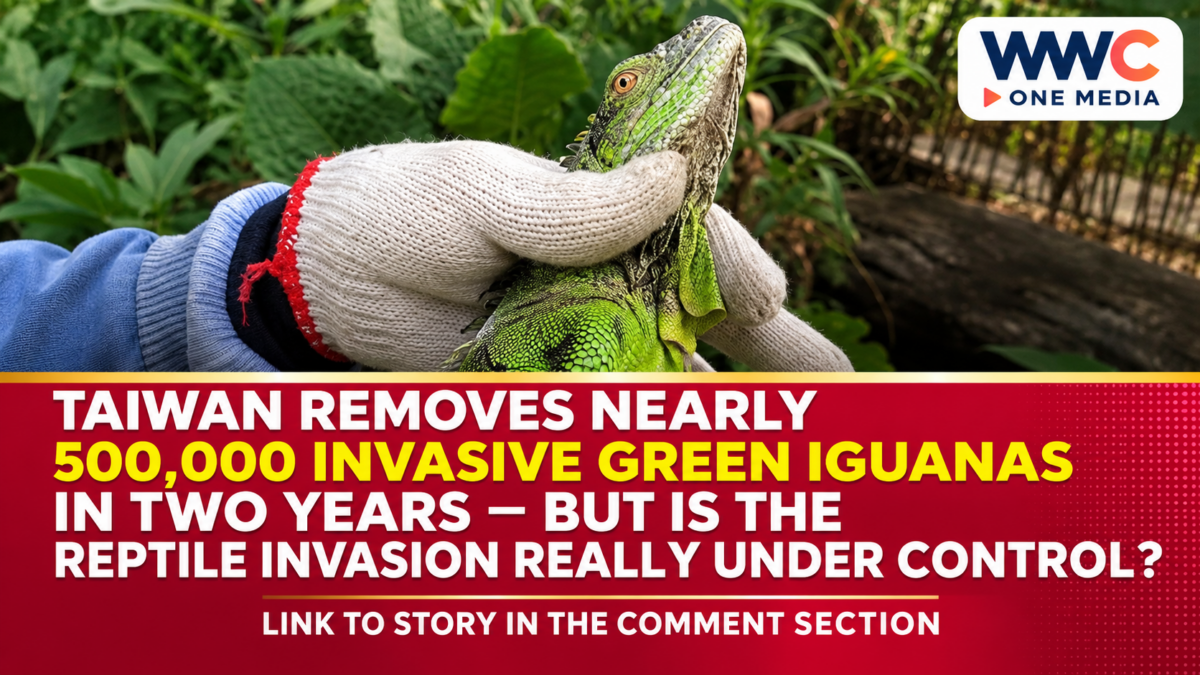
TAIPEI, TAIWAN | November 26, 2026 — Taiwan’s green iguana invasion is showing early signs of containment in several southern communities after authorities removed nearly half a million invasive reptiles over two years, marking significant progress in a nationwide effort to protect agricultural land and biodiversity.
Taiwan removed more than 260,000 green iguanas in 2025, followed by another 230,595 through early November 2026.
Despite the scale of the operation, the environmental challenge is far from resolved.
Selected monitoring locations in Tainan, Kaohsiung and Pingtung have recorded declining average sightings. However, emerging invasion zones and the possibility of further northward expansion remain significant concerns.
The next challenge is not simply removing more reptiles. It is determining whether the programme can suppress reproduction, prevent new populations from becoming established and reduce agricultural damage.
Taiwan Green Iguana Invasion: How an Exotic Pet Became an Environmental Problem
The green iguana, scientifically known as Iguana iguana, is native to tropical environments in Central and South America.
Its introduction to Taiwan was associated with the exotic pet trade.
As some animals grew larger and became increasingly difficult to maintain, owners abandoned them. Releases into the wild contributed to the establishment of breeding populations.
The consequences of irresponsible exotic animal ownership extend beyond the original owners.
Similar regulatory and environmental questions were explored in WWC ONE MEDIA’s coverage of the rescue of a 14-foot Burmese python previously kept as an exotic pet.
In Taiwan, the establishment of wild green iguana populations eventually required organised government intervention.
What began as a private pet ownership issue developed into a public environmental management challenge.
The financial consequences of managing an invasive species can therefore extend well beyond the original cost of importing or purchasing the animal.
Why Green Iguana Reproduction Makes Population Control Difficult
Removing large numbers of invasive animals does not automatically guarantee a sustained decline in their population.
Taiwan’s 2025 removal programme revealed a particularly important finding: 84% of the captured green iguanas were classified as immature based on a snout-to-vent length of less than 30 centimetres.
This raised concerns that the programme was removing substantial numbers of younger reptiles without sufficiently reducing the population of breeding adults.
Consequently, Taiwan adjusted its removal strategy to place greater emphasis on reproductively mature animals.
From an environmental management perspective, targeting reproductive capacity could potentially deliver longer-lasting results than relying on capture totals alone.
An operation that removes thousands of immature animals may appear successful numerically. However, if enough breeding adults remain, new generations could continue replenishing the wild population.
Evaluating the campaign therefore requires an understanding of population structure rather than simply counting captured reptiles.
Taiwan Deploys 14 Removal Teams and 420 Monitoring Sites
Taiwan’s response has evolved into a coordinated operation involving central and local authorities, researchers and community organisations.
Fourteen removal teams have been established to strengthen operational capacity.
The programme also uses contracts spanning different calendar years to reduce interruptions in removal activities.
Meanwhile, monitoring efforts provide information that capture statistics alone cannot establish.
The nationwide monitoring network comprises 420 sites, including:
- Pingtung County: 106 sites.
- Kaohsiung City: 99 sites.
- Tainan City: 86 sites.
- Chiayi County: 32 sites.
The remaining monitoring locations cover other areas included in the national programme.
The geographical distribution of these sites reflects the importance of maintaining surveillance across both established invasion zones and areas where populations could expand.
A comparable challenge involving early detection and sustained monitoring has emerged in Sydney’s response to invasive fire ants.
Although the species and environmental conditions differ, the central management question is similar: can authorities prevent an invasive population from spreading beyond the areas where it has already been detected?
Southern Taiwan Shows Encouraging Signs, but New Areas Remain Vulnerable
The latest assessments compared observations from the 2025 and 2026 egg-laying seasons.
Several locations in southern Taiwan recorded downward trends in average green iguana sightings.
However, these findings apply to selected monitoring locations rather than every affected community.
Areas requiring continued surveillance include the Wu River basin around the boundaries of Taichung, Nantou and Changhua, as well as parts of Yunlin and Chiayi.
Miaoli County is considered to be in an early invasion stage.
This distinction is particularly important when evaluating the effectiveness of the programme.
A reduction in sightings in one location does not establish that populations elsewhere are also declining.
Furthermore, fewer recorded sightings should not automatically be interpreted as an equivalent percentage reduction in the total wild population.
Taiwan’s authorities are therefore maintaining different strategies for established invasion hotspots and areas facing emerging risks.
The Economic Stakes for Agriculture and Biodiversity
The environmental consequences of invasive species can also become agricultural and economic concerns.
Green iguanas have caused crop damage in central and southern Taiwan, creating an additional challenge for agricultural communities.
However, the severity of agricultural damage varies between locations.
Taiwan plans to combine wildlife population monitoring with assessments of crop damage to establish where intervention is most urgently needed.
This could help identify areas where large reptile populations coincide with significant agricultural losses.
From a public spending perspective, that information could support more targeted allocation of personnel and financial resources.
Taiwan’s environmental priorities also include protecting biological resources with potential agricultural and cultural value, as illustrated by efforts to restore the nearly extinct Saisiyat citrus and develop sustainable agricultural applications.
The green iguana programme addresses a different aspect of biodiversity management: controlling a non-native species rather than restoring a threatened plant.
Both situations require long-term evaluation to determine whether environmental intervention is achieving its intended objectives.
Why Nearly 500,000 Removals Do Not Mean the Invasion Is Over
The headline removal figure demonstrates the scale of Taiwan’s intervention, but it does not establish the number of green iguanas remaining in the wild.
Seasonal activity and the reptiles’ ability to conceal themselves complicate population assessments.
This makes it difficult to establish a complete and reliable population count.
Three indicators will be particularly important when evaluating future progress: changes in monitored sightings, the geographical distribution of breeding populations and documented agricultural damage.
If these indicators improve together, they could provide stronger evidence of effective containment.
Conversely, continuing geographical expansion could reveal weaknesses that removal totals alone would not capture.
The challenge is to determine whether the operation is producing lasting ecological improvements rather than simply maintaining a high volume of annual removals.
What Happens Next?
Taiwan will continue its coordinated green iguana management programme in 2027.
Operations in heavily affected areas will prioritise breeding-capable reptiles, while newly threatened communities will receive greater attention through early reporting, verification and intervention.
Residents who encounter green iguanas are encouraged to report their location through local government channels, including the 1999 hotline when calling from a landline, and provide photographs when possible.
Reports should be made from a safe distance.
The nearly half-million removals represent an important operational milestone. Nevertheless, the ultimate measure of success will be whether Taiwan can prevent established populations from expanding and protect agricultural communities from continuing damage.
The invasion has not been declared over.
Frequently Asked Questions
How many green iguanas has Taiwan removed?
Taiwan removed more than 260,000 green iguanas in 2025 and another 230,595 through early November 2026, bringing the combined total close to 500,000.
Are green iguanas native to Taiwan?
No. Green iguanas originate from Central and South America. Their introduction to Taiwan was associated with the exotic pet trade.
Where are invasive green iguanas found in Taiwan?
Established invasion hotspots include areas of Tainan, Kaohsiung and Pingtung. Authorities are also monitoring other central and western regions, including emerging invasion areas in Miaoli.
Why is Taiwan removing green iguanas?
The programme seeks to limit their reproduction and spread, reduce agricultural damage and protect native ecosystems.
Has Taiwan successfully eradicated invasive green iguanas?
No. Selected monitoring locations show encouraging trends, but the available evidence does not establish nationwide eradication or complete population control.