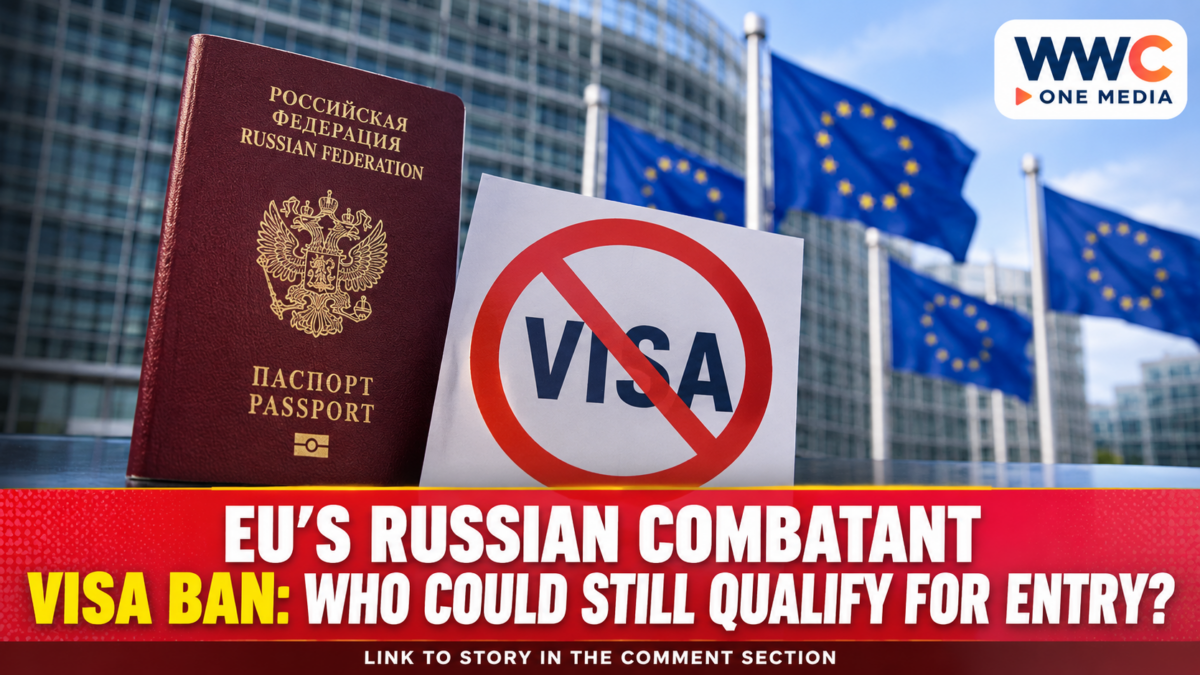
The European Commission presented its 22nd package of sanctions against Russia on November 23, 2026, alongside new steps to prepare restrictions on entry for people who have fought in Russia’s war against Ukraine. The proposed Russian combatant visa ban is aimed at current and former fighters, but its application depends on individual participation in combat and a further decision by EU member states.
The distinction is important for travellers, consular authorities and European governments: the proposal is not a blanket prohibition on every Russian citizen, nor does the Commission’s announcement mean the new visa restriction has already taken effect across the bloc.
The measure builds on a legal framework established in the EU’s 21st sanctions package in July. The latest Commission action provides additional guidance and documentation for identifying applicants who fall within the targeted group. Press release+1
What the Russian combatant visa ban would cover
The Commission’s November 23 statement says enhanced checks should focus on people who have served in the Russian armed forces or associated armed groups since February 24, 2022, and who directly participated in combat operations in the war against Ukraine.
The proposed restriction is not limited to Russian nationals. The Commission says combatants of other nationalities who served in the Russian Armed Forces and meet the stated criteria are also covered.
The updated guidance identifies possible documents that national authorities may use to assess applications. These include a questionnaire about military service, a self-declaration and, where requested, supporting records such as a military booklet. The guidance also refers to interviews and systematic fingerprint checks through the Schengen Information System.
That approach makes the applicant’s service history and participation in combat central to the assessment. It is more specific than treating nationality alone as proof that someone falls within the targeted category. Press release+1
The ban is not yet automatically in force
The legal sequence matters.
In July, the Council adopted the EU’s 21st sanctions package, which established the basis for a comprehensive visa restriction targeting combatants and former combatants of the Russian armed forces and associated groups involved in the war.
The July measure did not itself activate the ban. It stated that the Council would decide when it entered into force after the necessary implementation steps had been completed. Consilium+1
On November 23, the Commission adopted revised guidelines and an updated list of supporting documents. The Commission also said the High Representative had put forward a proposal to begin applying the visa restriction.
The next formal decision rests with the Council. Until that decision is taken, it would be inaccurate to describe the combatant visa ban as fully operational across all EU member states.
This distinction is more than legal wording. It tells travellers and visa applicants whether a political announcement has become an enforceable entry rule.
Humanitarian and political safeguards remain part of the framework
The official legal text contains exceptions that are important to the measure’s scope.
The framework provides that the restriction should not apply where a member state considers entry or transit necessary for humanitarian purposes, national interests or international obligations. It also provides an exception for applicants who present conclusive evidence that they are dissidents of, or defectors from, the Russian armed forces or covered armed groups. In those circumstances, a visa with limited territorial validity may be issued. EUR-Lex+1
The Commission’s updated guidance separately says enhanced scrutiny should not prevent entry by people with a legitimate interest in leaving Russia, including human rights defenders, dissidents and independent journalists. It also refers to humanitarian considerations for Ukrainians who were forcibly granted Russian nationality and can prove their previous Ukrainian citizenship. Press release
These safeguards matter because the policy is intended to address security risks linked to participation in combat, not to make every person with Russian citizenship automatically ineligible for travel.
For consular officials, the challenge will be applying the rules consistently while assessing individual circumstances and respecting the exceptions written into the legal framework.
The wider sanctions package reaches beyond travel
The visa proposal is only one part of the Commission’s 22nd sanctions package.
In her November 23 statement, Commission President Ursula von der Leyen described measures targeting financial channels, energy services, shipping and Russia’s participation in European sporting and cultural events.
The package proposes extending transaction restrictions to around 60 Russian banks and removing those banks from SWIFT. It also proposes additional restrictions on crypto and payment networks, including attention to third countries that help Russia evade sanctions.
In the energy sector, the Commission proposed expanding the ban on services that European companies can provide to Russian energy infrastructure, including refineries. The proposal also addresses electricity services and additional vessels associated with Russia’s shadow fleet. Statement
The wider approach reflects the EU’s use of financial, commercial and mobility restrictions as separate instruments of pressure. For businesses, sanctions can affect payment channels, shipping services, insurance and the ability to maintain commercial relationships. WWC has examined how Japanese companies are reassessing their Russian operations as restrictions and uncertainty complicate corporate decisions.
The EU’s latest measures also arrive as diplomatic efforts over Ukraine continue. But sanctions policy and peace negotiations are separate processes: a new restriction does not itself establish that negotiations have advanced or that a settlement is near. WWC’s report on the changing US sanctions approach and Ukraine peace discussions examines how economic pressure and diplomacy can operate at the same time.
What happens next
The Council must decide when the combatant visa restriction enters into force. The Commission says it will work with member states to support consistent application of the revised guidelines and supporting-document list. Press release
The practical test will be how national authorities identify relevant military service, evaluate evidence and apply the humanitarian and dissident exceptions. The process will also need to distinguish applicants who directly participated in combat from people whose circumstances do not meet the legal criteria.
For the wider sanctions package, the proposals must proceed through the EU’s decision-making process before they can be treated as adopted restrictions. Until the relevant decisions are made, the announced measures should be described as proposals or implementation preparations where applicable.
For travellers, the immediate message is to avoid assuming that the November 23 announcement created an instant, universal ban. The legal text, the Council’s next decision and individual visa assessments will determine how the policy applies.
Frequently asked questions
Has the EU already banned all former Russian soldiers from entering Europe?
No. The measure targets current or former combatants who directly participated in combat operations in Russia’s war against Ukraine. The Council must still decide when the visa restriction enters into force.
Does the proposed visa ban apply only to Russian citizens?
No. The Commission’s guidance also covers combatants of other nationalities who served in the Russian Armed Forces and meet the stated criteria.
When did the EU announce the latest sanctions package?
The European Commission presented its 22nd sanctions package on November 23, 2026.
Are there exceptions to the Russian combatant visa restriction?
Yes. The legal framework provides exceptions for certain humanitarian, national-interest and international-obligation cases, as well as applicants who can establish that they are dissidents or defectors.
Can Russian tourists still apply for Schengen visas?
The Commission’s revised guidance recommends a stricter approach to tourist visa applications from Russian nationals and stronger individual checks. That is separate from the targeted combatant restriction.
A third relevant WWC link is included in the article’s diplomacy context: Europe’s position on the conditions for a Ukraine settlement. The three WWC pages were opened and their article content was visible; the browsing results did not expose exact HTTP response codes, so I cannot certify HTTP 200.
Add this sentence to the “The wider sanctions package reaches beyond travel” section, after the paragraph discussing diplomacy:
The wider European debate over the terms of a settlement is also relevant: WWC has reported on European governments’ concerns about security arrangements while the war continues.