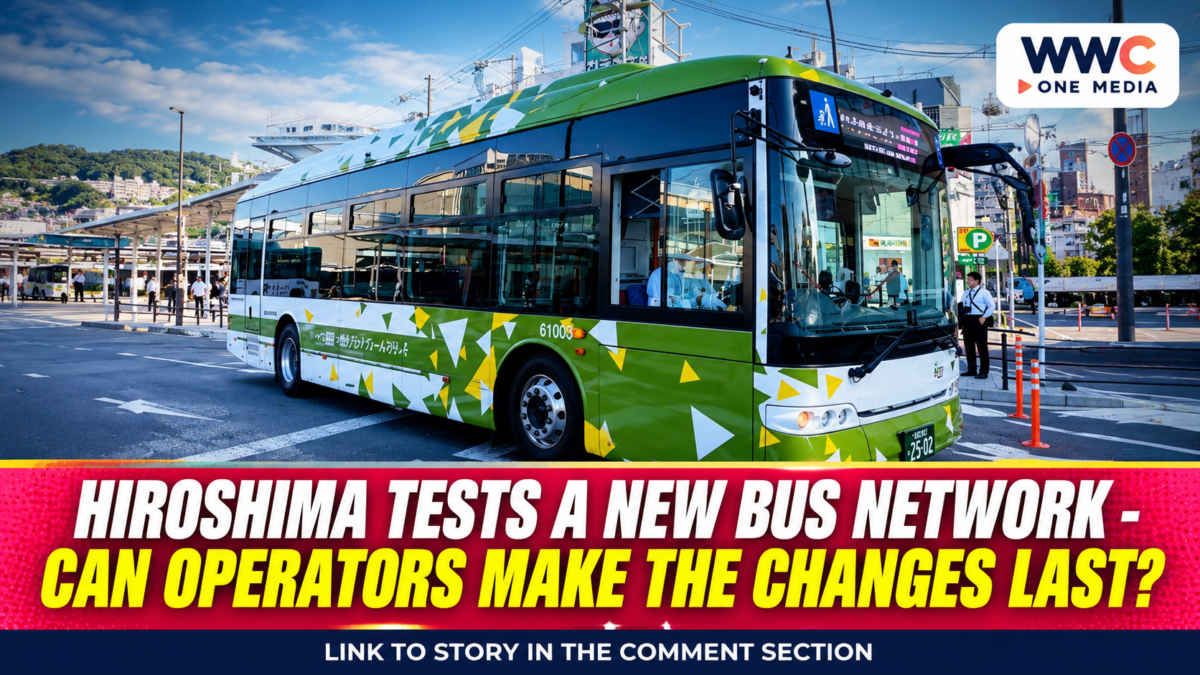
HIROSHIMA, Japan — November 24, 2026. Hiroshima is testing a different way to organise local bus services, with three operators jointly running a new route between Nishi-Hiroshima Station and Miyuki Bridge under a trial scheduled to end on December 30. The Koi-Miyuki Line is part of a wider city-backed effort to coordinate bus services, improve connections and make the network more sustainable.
The experiment matters because the problem facing Hiroshima is not simply where buses travel. The city says operators are under pressure from driver shortages, changing travel patterns and worsening business conditions, making it harder for individual companies to maintain services independently. Its approach is to coordinate planning and resources rather than leave every route decision to separate operators. 広島市公式ウェブサイト+1
The new route offers a practical test of that approach. It links neighbourhoods that have needed better east-west connections, provides transfers to other services and introduces a common fare structure across participating companies. Whether it becomes permanent will depend on the evaluation after the trial.
Hiroshima Bus Network Reform Starts With Shared Operations
The Koi-Miyuki Line began operating on October 1 and is scheduled to run daily through December 30. Hiroshima Bus, Hiroshima Electric Railway and Hiroshima Kotsu are the three operators named in the service announcement. The companies are working with the Bus Cooperation and Co-Creation Platform Hiroshima, an organisation established to coordinate the city’s wider bus restructuring effort. hirobus.co.jp+2
The trial route runs from Nishi-Hiroshima Station through areas including Kannon, Funairi and Yoshijima, serving the vicinity of the Japanese Red Cross Hiroshima Hospital before reaching Miyuki Bridge. It is designed to strengthen east-west travel across the city’s delta area.
Four new stops were introduced: Minami-Kannon 2-chome, Funairi High School North, Hiroshima Prison North and Red Cross Hospital South. The route also adds service at three existing stops, including Asahibashi Iriguchi. hirobus.co.jp+1
The published operating windows are from the 6 a.m. hour to the 6 p.m. hour on weekdays, and from the 7 a.m. hour to the 7 p.m. hour on weekends and public holidays. Hiroshima Electric Railway lists 21 departures per day for both weekday and weekend schedules. hirobus.co.jp+1
One Route, Three Operators and a Common Fare
The trial’s practical appeal lies in how it combines services. The adult fare is a flat ¥240, while children and eligible passengers using disability discounts pay half the adult fare. Certain commuter passes can be used across all three operators, while other pass products are accepted only on services operated by specific companies. hirobus.co.jp+1
Passengers using the MOBIRY DAYS or ICOCA payment systems may qualify for discounts of up to 10%, subject to the service and payment conditions. A transfer discount also reduces the second ride by ¥20 when the required payment method is used. Some ICOCA discounts are limited to Hiroshima Bus and Hiroshima Kotsu services. hiroden.co.jp
These details matter because a route can look useful on a map but still be inconvenient if passengers face confusing fares or incompatible tickets. A coordinated service needs to work as a journey, not merely as a collection of buses operated by different companies.
The connection at Red Cross Hospital is intended to make transfers to the Machinowa Loop bus and Hiroshima Electric Railway’s city tram network possible. That could extend the usefulness of the route beyond the neighbourhoods directly served by the new line. hiroden.co.jp
The Bigger Issue Is Keeping Regional Bus Services Running
Hiroshima’s official explanation of its shared operating system points to several pressures on the sector: population decline, an ageing population, greater reliance on private cars, changes in travel behaviour after the pandemic and a serious shortage of bus drivers. The city says those factors have weakened the financial position of operators and made it difficult for companies to secure stable services through independent efforts alone. 広島市公式ウェブサイト
The city and eight bus operators signed a memorandum on March 22, 2024, to establish a joint operating system aimed at improving sustainability and convenience. The platform’s membership includes Hiroshima Electric Railway, Hiroshima Bus, Hiroshima Kotsu, Geiyo Bus, Bihoku Kotsu, Chugoku JR Bus, HD Nishi Hiroshima and Forble, alongside the city. 広島市公式ウェブサイト+1
This is not the same as merging the companies into one bus operator. The model is a framework for coordination, with the city participating in planning and the companies cooperating on network improvements.
The challenge is familiar across Japan’s regional transport sector. WWC’s report on JR Hokkaido’s struggle to sustain loss-making railway lines shows how shrinking populations and operating costs can place pressure on essential transport services. Hiroshima’s bus initiative is a different model, but it faces the same broad question: how can a public network remain useful when the economics of running it become harder?
The Trial Also Tests Whether Better Connections Can Shift Travel
The operators say the new line is intended to improve access between residential districts, schools, the hospital area and transport connections. The service announcement also identifies the construction of the Nishi-Hiroshima Bypass urban extension as a reason for encouraging public transport use, with the new service expected to help ease traffic congestion associated with the project. hirobus.co.jp+1
That is an important distinction. A new bus route does not automatically reduce road congestion. Its effect depends on whether it attracts enough passengers who might otherwise use private vehicles, whether the timetable fits their travel needs and whether transfers are convenient.
For the trial to be judged successful, passenger numbers alone may not be enough. Reliability, operating costs, driver availability, transfer patterns and the ability to maintain the timetable will also matter. Those are reasonable measures to watch, although the public notices reviewed do not provide a complete set of performance targets or results.
Japan’s transport adjustments also offer useful comparisons for Philippine readers. WWC has covered the arrival of another North-South Commuter Railway trainset in the Philippines, a project that highlights the importance of connecting major transport infrastructure with dependable passenger services. Hiroshima’s bus trial is smaller in scale, but the underlying issue is similar: transport systems are only as useful as the links between their parts.
What Happens Next
The Koi-Miyuki Line’s current trial period ends on December 30, 2026. Hiroshima’s operator notices say the timing and conditions for moving to permanent operation remain under consideration. That means the route should not yet be described as a permanent addition to the city’s bus network. hirobus.co.jp+1
The broader city plan points toward continued route optimisation, improved transfer facilities, better passenger information, shared use of resources and measures to secure drivers. The city has also identified the need to use passenger data more effectively when planning and reviewing services. 広島市公式ウェブサイト+1
The next decision will show whether the trial’s connections and operating arrangements justify a longer-term service. If the model works, Hiroshima could use the experience to inform further network changes. If it does not, the city and operators will need to identify what must change before the approach can be expanded.
Frequently Asked Questions
1. What is the Koi-Miyuki Line in Hiroshima?
It is a trial bus route linking Nishi-Hiroshima Station and Miyuki Bridge through areas including Kannon, Funairi, Yoshijima and the Red Cross Hospital area.
2. Which companies operate the Koi-Miyuki Line?
Hiroshima Bus, Hiroshima Electric Railway and Hiroshima Kotsu operate the service as part of a coordinated trial.
3. How long will the Hiroshima bus trial run?
The published trial period is October 1 to December 30, 2026. Permanent operation has not yet been confirmed.
4. How much is the fare?
The published adult fare is a flat ¥240. Children and eligible passengers using disability discounts pay half the adult fare. Certain payment methods and transfers have additional discounts.
5. Why is Hiroshima restructuring its bus network?
The city identifies driver shortages, population decline, changing travel patterns and financial pressures on operators as reasons to coordinate services and improve the long-term sustainability of public transport.