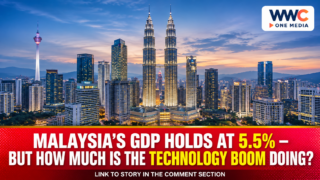
KUALA LUMPUR — Malaysia’s economy grew 5.5% year on year in the third quarter of 2026, the Department of Statistics Malaysia confirmed on Nov. 18, exceeding its earlier advance estimate of 5.3%. The revised Malaysia GDP growth reading highlights a manufacturing sector benefiting from worldwide demand for electronics and artificial intelligence equipment, even as policymakers caution against assuming those orders will remain strong indefinitely.
The stronger result gives Malaysia a favourable starting point for 2027, but it is not evidence that every data-centre project or chip producer is profitable. Official accounts show both rising technology production and a domestic economy that continues to depend on consumer spending, investment and external market conditions.
Malaysia GDP Growth Exceeds the First Estimate
The final third-quarter reading of 5.5% compared with 6.0% annual growth in the second quarter. Output increased 1.5% from the previous quarter on a seasonally adjusted basis, slower than the 2.5% quarterly increase in April–June.
Malaysia’s gross domestic product reached RM467.4 billion at constant 2015 prices and RM578.7 billion at current prices. The distinction matters: the first measure removes price changes to track real output, while the second records the market value at current prices.
Growth over the first nine months reached 5.6%, compared with 4.8% in the corresponding 2025 period. The preliminary October estimate had put third-quarter annual growth at 5.3%, illustrating why advance figures should not be treated as final.
WWC previously examined Malaysia’s 5.3% advance estimate and interest-rate outlook. The Nov. 18 final release supersedes that preliminary growth figure; it does not mean the earlier calculation was a separate quarter of economic activity.
Electronics Manufacturing Is the Standout Performer
Manufacturing expanded 7.7% from a year earlier, accelerating from 7.3% in the second quarter. Within that sector, electrical, electronic and optical products grew 16.5%, compared with 14.4% previously.
Bank Negara Malaysia identified strong global demand for AI-related technology products as an important driver of manufacturing activity and exports. This is a sector-level explanation, not a calculation showing how many percentage points of Malaysia’s total GDP came specifically from AI.
The wider services sector expanded 5.8%, supported by positive results across its subdivisions. Information and communication activity grew 8.7%, while finance and insurance increased 5.1%.
Analysis: Semiconductor and electronics orders can benefit Malaysian manufacturers even when finished AI systems are deployed overseas. But concentrated exposure to technology spending also creates a risk if customers postpone orders, switch suppliers or change their investment plans.
Domestic Demand Helps Offset External Uncertainty
Malaysia’s economy is not solely an export story. Private final consumption rose 4.3%, with spending supported by restaurants and hotels, transport, and food and non-alcoholic beverages. Growth in private consumption nevertheless slowed from 4.8% in the preceding quarter.
Gross fixed capital formation—a broad measure of investment in fixed assets—accelerated to 8.1% from 4.6%. Machinery and equipment investment increased 12.7%, while investment in structures rose 5.5%.
Construction expanded 5.9%, including a 16.7% increase in non-residential buildings. These statistics capture construction activity across the economy and should not be represented as data-centre construction alone.
The mining and quarrying sector contracted 6.1%, reflecting weaker oil and natural-gas production. That counterweight is a reminder that Malaysia’s sectors do not all move together.
Data-Centre Expansion Adds an Energy and Policy Test
Technology-sector growth has encouraged attention to electricity requirements and infrastructure investment. But approval for a data-centre project, a reservation of electrical capacity and an operating site producing revenue are three different milestones.
WWC has explored Malaysia’s proposals for a separate electricity market serving major data-centre users. The issue is relevant to the GDP outlook because reliable power and construction costs affect whether investment commitments become usable computing capacity.
Analysis: Strong electronics exports offer an immediate boost, while data-centre investments may generate construction and longer-term service activity. The benefits can differ by sector, and neither approved power capacity nor projected spending should be counted as completed economic output.
Global AI Demand Is a Strength—and a Risk
Bank Negara kept its overnight policy rate at 2.75% on Nov. 5. It said technology-related exports and domestic spending supported growth, while prolonged geopolitical tensions, weaker commodity output and tighter global financial conditions remained possible downside risks.
Its Nov. 18 assessment again linked stronger manufacturing to global AI demand and expected annual growth above 5% in 2026. The bank did not announce that AI orders had fallen or provide a precise forecast for a future collapse in spending.
Malaysia also faces regulatory uncertainty affecting advanced computing equipment. WWC’s report on new US AI-chip rules for Southeast Asian data centres explains the distinction between shipments subject to additional licensing and a blanket trade ban.
Analysis: The economy could remain resilient even if AI spending becomes less rapid, but that would depend on household demand, other export industries and the pace of investment. No official GDP release can establish how a hypothetical future slowdown would translate into employment or company profits.
What Happens Next
The next scheduled quarterly GDP report covers the fourth quarter of 2026 and is due on Feb. 12, 2027. Bank Negara’s next scheduled monetary-policy decision is Jan. 21, 2027.
For investors and businesses, the useful indicators will be subsequent electronics production, export performance, private investment and the central bank’s risk assessment. The revised 5.5% GDP result is a verified achievement; the durability of an AI-led expansion is still an open economic question.
Frequently Asked Questions
How fast did Malaysia’s economy grow in the third quarter of 2026?
Real GDP grew 5.5% year on year, compared with the earlier advance estimate of 5.3% and second-quarter growth of 6.0%.
How did Malaysia’s electronics industry perform?
Electrical, electronic and optical manufacturing output expanded 16.5% year on year, helping manufacturing grow 7.7% overall.
Has Malaysia’s central bank warned that AI demand is collapsing?
No. Its official statements identify strong AI-related demand as a growth driver while warning that external risks could affect the outlook.
What is Malaysia’s benchmark interest rate?
Bank Negara Malaysia maintained its overnight policy rate at 2.75% on Nov. 5, 2026.
When is Malaysia’s next quarterly GDP report?
The statistics department schedules its fourth-quarter 2026 GDP release for Feb. 12, 2027.