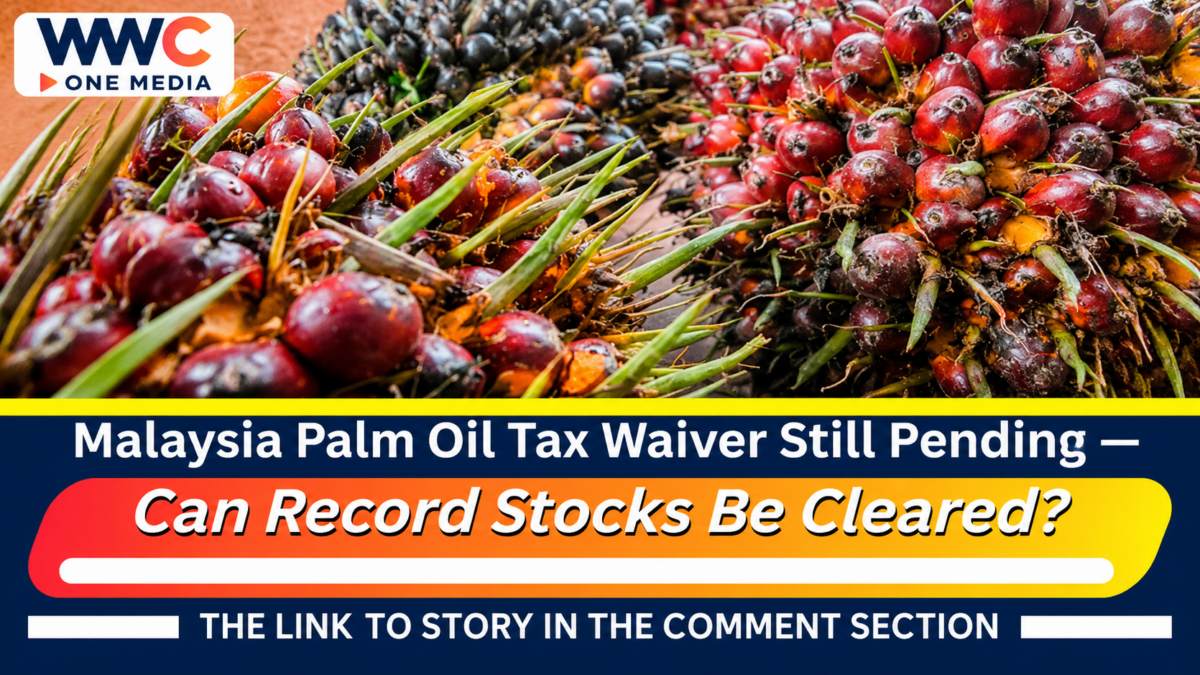
KUALA LUMPUR — Malaysia’s proposal to suspend crude palm oil export duties remains a policy question as of Nov. 17, 2026, after the government consulted industry representatives over potential tax relief. Official October figures show why the palm oil tax waiver debate matters: national palm oil inventories climbed to 3,621,164 tonnes, despite a sharp rebound in shipments.
The decision involves more than helping exporters sell excess oil. A waiver would also change the economics facing domestic refiners, growers and the government, making the timing and precise terms as important as the announcement itself.
Palm Oil Tax Waiver: Who Has the Final Say?
Malaysia’s parliamentary record for Oct. 29 confirms that the Ministry of Plantation and Commodities consulted palm-oil businesses on Oct. 20 over a temporary export-duty exemption. Finance Ministry representatives joined the consultation, which also involved plantation companies, industry associations and logistics operators.
Plantation and Commodities Minister Noraini Ahmad told lawmakers that approval of an exemption or postponement rests with the Ministry of Finance. The discussion therefore established an active proposal, not an approved waiver.
That distinction remains essential. No subsequently issued finance-ministry waiver instrument was established in the official documents reviewed for this article. Exporters should not treat a request made during industry discussions as an automatic change to the duty payable on a shipment.
The customs gazette for November still publishes an official reference value for crude palm oil under the existing duty framework. Its published value is RM4,323.78 per tonne for Nov. 1–30, 2026.
October Data Show Why Storage Has Become the Issue
The Malaysian Palm Oil Board’s preliminary October release puts closing palm oil stocks at 3,621,164 tonnes, up 3.15% from September’s revised 3,510,555 tonnes. Crude palm oil output increased to 2,153,701 tonnes, compared with 2,116,950 tonnes in September.
Exports improved substantially. Palm oil shipments reached 1,708,670 tonnes in October, compared with 1,097,074 tonnes in September — a 55.75% monthly increase. Yet stocks still rose, showing that stronger exports did not fully remove the accumulated supply during the month.
Those stock figures cover palm oil overall, including crude and processed categories. They should not be presented as an inventory count of crude oil alone. In October, the board reported 2,324,211 tonnes of crude palm oil stock and 1,296,953 tonnes of processed palm oil stock.
The data also distinguish two different issues: a monthly recovery in sales abroad and the continuing volume sitting in the domestic system. A temporary tax change could affect the second problem, but no official record guarantees how quickly buyers would respond.
What a Duty Suspension Could Change
Crude palm oil export duty raises the cost of shipping unrefined oil out of Malaysia. Suspending that duty could allow exporters to offer more attractive prices or retain more of the proceeds, depending on commercial negotiations.
For plantation operators and independent mills, easier crude-oil exports could create an additional outlet for production. This matters because fresh fruit must be processed promptly after harvesting, while processing and storage depend on available mill and tank capacity.
There is another side. Domestic refiners purchase crude palm oil as an input. If exporting unrefined oil becomes more financially attractive, local refiners could face stronger competition for feedstock. A policy favouring one stage of the supply chain may impose costs on another.
The parliamentary record explicitly recognises that Malaysia’s palm oil economy includes several tax instruments with different purposes, among them export duties, the windfall profit levy, state sales taxes and the Malaysian Palm Oil Board cess. Exempting one duty should not be confused with eliminating every tax or levy affecting the industry.
Why Philippine Importers Should Follow Malaysia’s Decision
Malaysia is part of the regional palm-oil supply network that supplies food manufacturers, processors and other buyers. For the Philippines, policy shifts in producing countries matter because imported raw materials feed through local supply chains, even when the final retail price also depends on freight, exchange rates and processing.
WWC has separately examined Philippine dependence on imported palm oil, including the country’s plans to develop more domestic supply. Malaysia’s pending tax decision is relevant to that dependence, but it cannot alone establish how much Philippine cooking oil or processed-food prices will change.
Regional production conditions also vary. WWC’s report on Indonesia’s palm-oil transport problems during El Niño describes a separate type of supply-chain constraint: moving product from plantations and mills to buyers. A tax waiver addresses selling incentives; it does not remove every transport or logistics bottleneck.
The Philippines is also considering longer-term responses, including plans to expand oil-palm cultivation. Those initiatives concern future domestic output, not an immediate substitute for supplies already moving through Southeast Asian trade.
What This Could Mean for Malaysia’s Industry
Analysis: The government faces a real policy trade-off. Keeping the export duty protects a source of public revenue and can support domestic refining economics. A temporary suspension may help clear inventories and improve cash flow for producers seeking overseas buyers.
It would nevertheless be misleading to assume all exported tonnes would increase immediately, or that an exemption would flow fully through to customers. Global demand, competing suppliers, prices, currency movements, shipping capacity and contractual terms affect the outcome.
The October numbers complicate a simplistic crisis narrative: exports surged, but the stockpile still edged higher. That combination gives policymakers reason to examine not just the total inventory but also where oil is stored, which products are accumulating and whether buyers want the available grades.
What Happens Next
The decisive next record would be a formal Finance Ministry or customs announcement spelling out the exemption’s legal basis, products, effective dates and conditions. Until such an instrument is issued and verified, the proposal should remain described as pending.
Subsequent Malaysian Palm Oil Board monthly releases will show whether the October export recovery continues and whether stocks finally decline. Those figures will provide a better way to judge the need for relief than treating an industry request as proof that a waiver has already begun.
Frequently Asked Questions
Has Malaysia approved a palm oil export tax waiver?
The official records reviewed confirm consultations and ministerial consideration, but not an enacted new waiver as of Nov. 17, 2026.
How large are Malaysia’s palm oil stockpiles?
The Malaysian Palm Oil Board reported preliminary October closing stocks of 3,621,164 tonnes, up 3.15% from September.
Did Malaysia’s palm oil exports increase in October?
Yes. Official exports rose to 1,708,670 tonnes, from 1,097,074 tonnes in September.
Who decides whether crude palm oil export duty is suspended?
Malaysia’s plantation minister told Parliament that the final decision on such an exemption or postponement rests with the Ministry of Finance.
Will a waiver automatically make Philippine cooking oil cheaper?
No. Any retail effect would depend on buyers’ contracts, international prices, freight, exchange rates and domestic distribution as well as the tax change itself.