
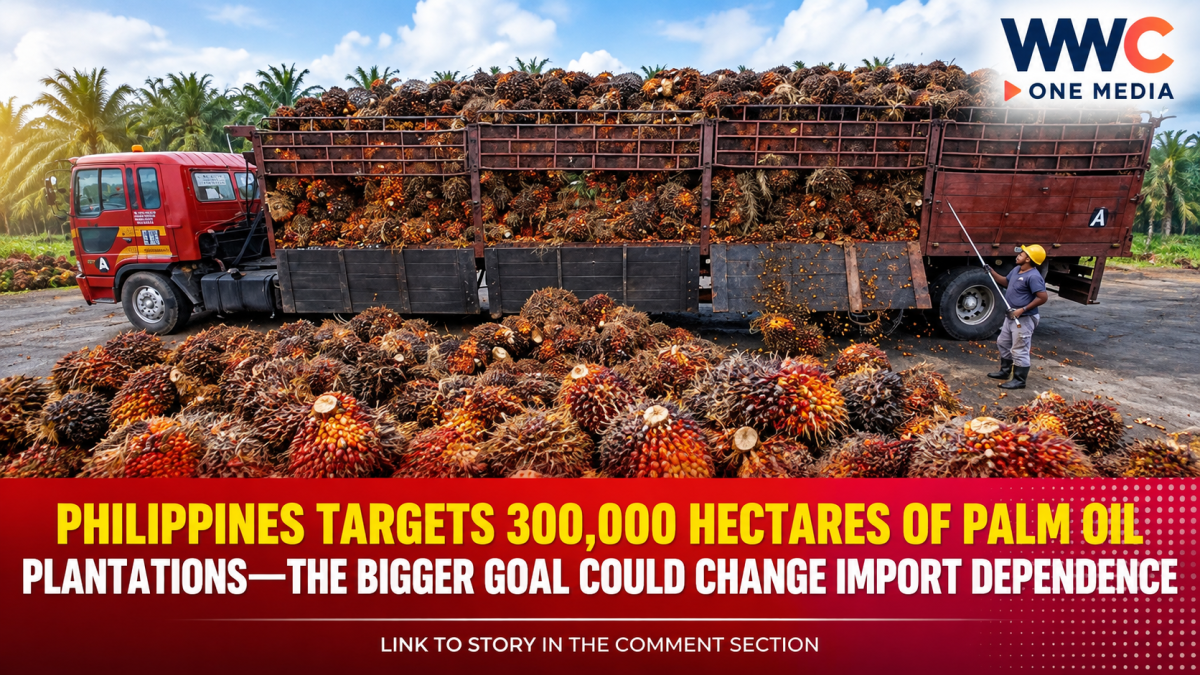
MANILA — The Philippine government is preparing a major expansion of the country’s palm oil industry, with the Department of Agriculture (DA) targeting as much as 300,000 hectares of oil palm plantations in a bid to reduce the country’s heavy dependence on imported palm oil.
The plan comes as the Philippines continues to source nearly 90% of its palm oil requirements from abroad, leaving a large portion of domestic demand exposed to international prices, supply disruptions and foreign exchange movements. The DA says expanding local production could turn that dependence into an opportunity for Filipino farmers, businesses and investors.
Agriculture Secretary Francisco Tiu Laurel Jr. said the government has already developed a roadmap for expanding the industry. While the long-term goal is to reach 300,000 hectares, he said reaching 100,000 hectares by the end of 2028 would already represent significant progress.
The DA is seeking at least ₱300 million for palm oil development in the proposed 2027 budget. The department has also discussed a much larger funding program of up to ₱1 billion annually for five years, provided legislation supporting the industry is enacted.
The government’s push is particularly significant for Mindanao, where much of the country’s existing oil palm production is concentrated.
The Board of Investments recently highlighted opportunities throughout the palm oil value chain, including plantation development, nurseries, milling, refining, logistics, research and development, biomass utilization and the production of higher-value palm-based products.
Why palm oil matters to the Philippines
The Philippines already has an estimated 100,000 hectares planted with oil palm, but domestic production accounts for only about 10% of national demand, according to the Board of Investments.
That gap represents a potentially significant domestic market.
Earlier industry estimates cited by the Philippine business press put Philippine palm oil consumption at around 1.1 million metric tons annually, with local production accounting for only a small portion of demand. The remaining supply has to be imported.
For the DA, increasing local production could therefore provide multiple benefits: more opportunities for farmers, additional agricultural investments, greater domestic processing capacity and less exposure to imported supply.
Government also sees potential for cleaner fuels
The palm oil expansion is not being framed solely as a food and agriculture initiative.
The DA said expanded domestic palm production could eventually provide raw material for cleaner fuels and other industrial applications. This gives the industry a potential role in both agricultural development and the country’s broader energy strategy.
The development of a stronger domestic supply chain could also create opportunities beyond simply growing oil palm. Processing, milling, refining, transportation and manufacturing of palm-based products could generate additional economic activity.
DA wants stronger government structure for palm oil
Tiu Laurel has also proposed strengthening the institutional structure overseeing the industry.
The DA is considering changes involving the Philippine Coconut Authority (PCA), including the possibility of establishing a dedicated deputy administrator and specialized teams focused on palm oil and coconut development. The agriculture chief said a clearer structure could help accelerate government programs for the sector.
The DA has likewise expressed support for the proposed Palm Oil Bill and said it would recommend that the measure be certified as urgent, according to the department.
A major opportunity—but expansion will take time
The government’s 300,000-hectare ambition is significant, but it will not happen overnight.
Expanding the industry will require substantial investment in planting materials, nurseries, farm development, processing facilities, roads, logistics and technical support. The government also needs to ensure that expansion benefits farmers and does not simply create additional raw-material supply without sufficient domestic processing and markets.
For now, however, the DA’s message is clear: the Philippines wants to build a much larger domestic palm oil industry and gradually reduce its dependence on foreign supply.
If the country can move from importing nearly 90% of its palm oil requirements toward significantly higher domestic production, the shift could create a new agricultural growth area—particularly across Mindanao and other areas suited to oil palm cultivation.
The real test will be whether the government’s ambitious plantation targets can translate into sustained production, higher farmer incomes and a competitive local palm oil value chain.
And with 300,000 hectares now on the government’s roadmap, the next question is how quickly the Philippines can turn that target into actual farms, jobs and locally produced palm oil.




Leave a Reply