
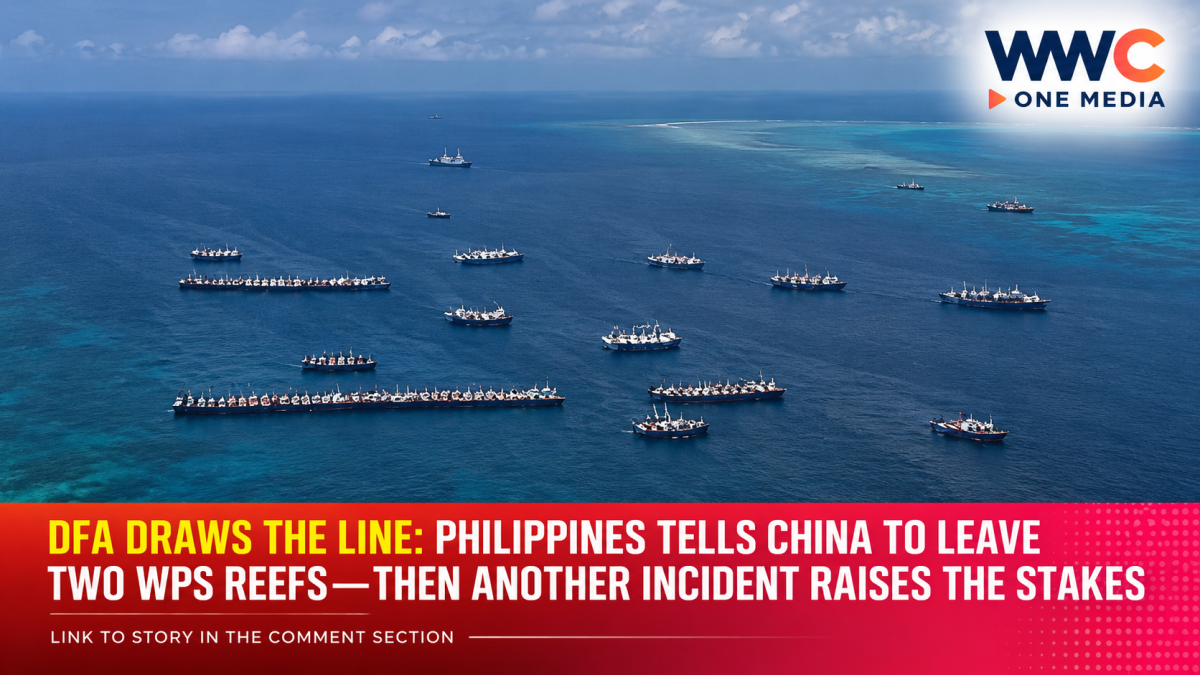
MANILA — The Philippines has issued a fresh and unusually direct warning to China, calling on Beijing to immediately cease what Manila describes as the “illegal occupation” and activities at Panganiban Reef (Mischief Reef) and Zamora Reef (Subi Reef) in the West Philippine Sea.
The Department of Foreign Affairs (DFA) reiterated on Friday, September 11, that the two features are within the Philippines’ exclusive economic zone (EEZ) and continental shelf, and said China’s construction and activities there do not alter their legal status under international law.
The latest confrontation comes just days after the Philippine Coast Guard (PCG) reported that Chinese forces released multiple flares near an unarmed Philippine Coast Guard aircraft conducting a routine maritime-domain-awareness flight over the Kalayaan Island Group.
According to the PCG, the aircraft was challenged over the radio by Chinese forces occupying Zamora Reef before the aircraft landed at Pag-asa Island on September 7. Chinese forces associated with Panganiban Reef reportedly carried out similar actions.
DFA invokes Philippine law and UNCLOS
DFA spokesperson for maritime affairs Rogelio Villanueva Jr. said China’s island-building activities at Panganiban and Zamora reefs violate the Philippine Maritime Zones Act (Republic Act No. 12064) and the United Nations Convention on the Law of the Sea (UNCLOS).
The DFA also pointed to the 2016 South China Sea arbitral award, which Manila continues to regard as final and binding.
The department stressed that China’s construction of artificial islands does not change the legal character of the features in question.
The Philippines therefore called on China to “cease its illegal occupation and activities” in the two areas and comply with the 2016 arbitral ruling.
The flare incident that triggered the latest warning
The DFA’s statement followed the PCG’s disclosure that Chinese forces fired flares at a Philippine aircraft during a surveillance flight.
The PCG said the aircraft was conducting a legitimate maritime-domain-awareness mission and was unarmed.
The reported incident adds another layer to already tense encounters between Philippine and Chinese maritime forces in the West Philippine Sea.
The Armed Forces of the Philippines separately reported that it monitored 27 Chinese vessels from September 1 to 7 across several contested features, including Ayungin Shoal, Bajo de Masinloc, Escoda Shoal and areas near the Pag-asa Islands.
The vessels included ships from the People’s Liberation Army Navy (PLAN) and the China Coast Guard (CCG).
Manila says diplomacy and international law remain the answer
Despite the increasingly tense encounters, the Philippine government continues to emphasize diplomacy and international law as its principal approach.
Foreign Affairs Secretary Ma. Theresa Lazaro recently said the Philippines would continue responding to China’s actions through a clear legal framework, particularly UNCLOS and the 2016 arbitral award.
She also stressed that Manila remains open to meaningful dialogue with Beijing while maintaining its position on Philippine sovereignty and jurisdiction.
The DFA has also continued filing diplomatic protests against China’s activities in the West Philippine Sea.
Earlier this month, the department said it had lodged 39 diplomatic protests against Chinese actions in the WPS in 2026, bringing the total number of protests filed since 2022 to 296.
Tensions are high—but some areas have seen fewer confrontations
The latest dispute comes as the Philippines and China attempt to manage tensions in other parts of the West Philippine Sea.
The DFA previously reported that a provisional arrangement covering Philippine resupply missions to Ayungin Shoal had contributed to fewer confrontations in that area.
That does not mean tensions have disappeared.
The reported flare incident, the continuing presence of Chinese maritime vessels and the latest dispute over Panganiban and Zamora reefs demonstrate that significant friction remains in other parts of the West Philippine Sea.
China and Philippines remain far apart
China claims sovereignty over much of the South China Sea and has consistently rejected the 2016 arbitral ruling, while the Philippines maintains that the ruling supports its maritime rights under international law.
The disagreement has persisted despite diplomatic efforts to prevent encounters from escalating.
For Manila, the latest issue is not simply about the presence of Chinese vessels. It also concerns island-building, maritime activities, access, and the legal status of features inside waters where the Philippines asserts sovereign rights and jurisdiction.
The DFA’s latest message therefore carries a broader warning: the Philippines says China’s physical presence and construction activities cannot, by themselves, change the legal framework governing the disputed waters.
And with another reported encounter involving a Philippine aircraft now added to the growing list of WPS incidents, attention is turning to what happens next—and whether the latest diplomatic warning will lead to restraint or another confrontation at sea.



Leave a Reply