
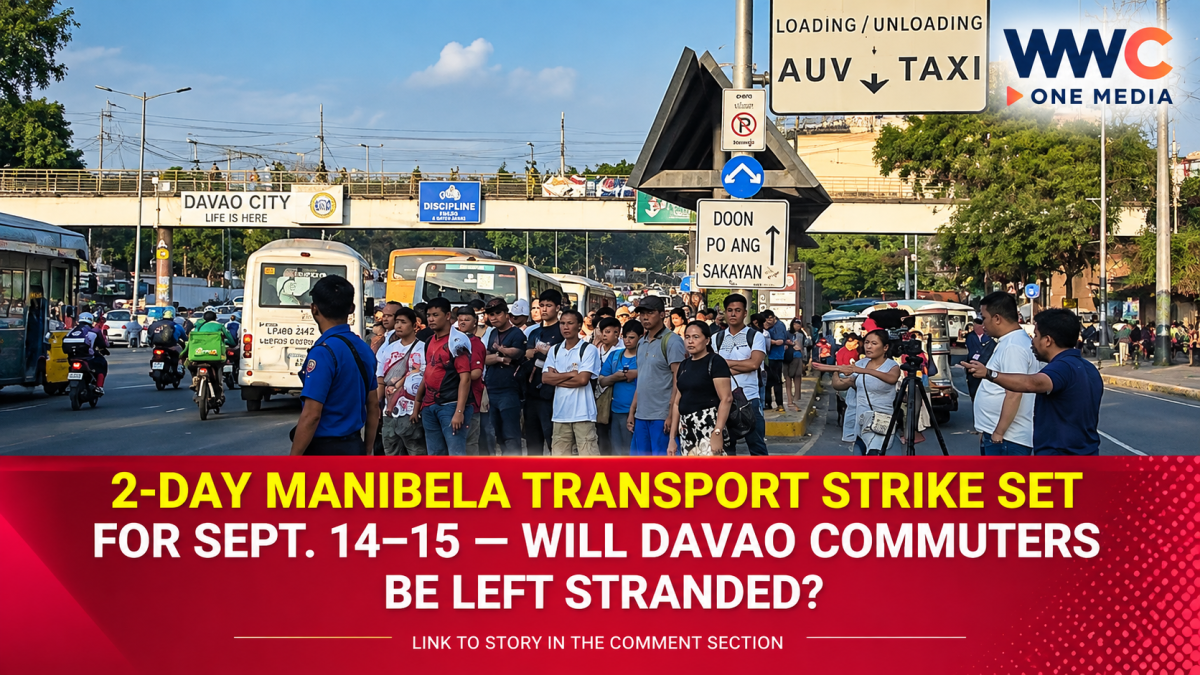
DAVAO CITY, Philippines — Commuters across Davao and other parts of the country could face transportation disruptions as transport group MANIBELA confirmed a two-day nationwide tigil-pasada on September 14 and 15 to protest continued increases in fuel prices.
MANIBELA President Mar Valbuena confirmed the planned strike, saying the action is intended to pressure the government to address the impact of soaring gasoline and diesel prices on public utility vehicle drivers and operators.
The announcement comes as fuel prices have again climbed sharply.
Oil companies implemented increases of ₱4.69 per liter for gasoline, ₱5.18 for diesel and ₱5.58 for kerosene during the latest adjustment. The Department of Energy attributed the increases partly to continuing tensions involving the United States and Iran, as well as the weakening of the Philippine peso against the US dollar.
MANIBELA has criticized the government’s response, particularly its fuel subsidy program. Valbuena questioned whether the assistance is reaching drivers effectively and raised concerns about problems involving participating fuel stations.
Davao commuters could feel the impact
The strike is particularly significant for Davao, where thousands of residents rely daily on jeepneys, buses, tricycles and other public transportation to reach workplaces, schools, markets and government offices.
However, the extent of participation specifically in Davao City should not be overstated. The Bombo Radyo Davao report confirms MANIBELA’s two-day strike announcement but does not provide a definitive number of Davao drivers or routes that will stop operating.
That distinction is important because participation in previous transport strikes has varied significantly by locality.
For commuters, the safest assumption is that some routes may experience reduced service, while other drivers may continue operating.
Government prepares alternative transportation
The government is also preparing measures to help commuters affected by the two-day stoppage.
Radyo Pilipinas reported that government agencies and some local governments are preparing free-ride services to help workers and students reach their destinations during the strike.
Davao already has government-supported public transport assistance through programs such as the Love Bus, which provides free rides to commuters in the city. The Philippine Information Agency reported that the program had served about 1.89 million passengers as of January 2026, with the government continuing the service.
The Department of Labor and Employment in Davao has also previously implemented assistance aimed at keeping drivers on the road during the fuel crisis. Its TUPAD TULOY PASADA program was designed to provide cash-for-work assistance to transportation-sector workers while they continue operating their designated routes.
Why are drivers protesting?
For MANIBELA, the central issue is the growing cost of fuel and its effect on drivers’ daily income.
Transport groups argue that higher diesel and gasoline prices increase operating costs at a time when drivers are already struggling with household expenses.
MANIBELA has also questioned the government’s fuel subsidy system, saying some drivers have encountered difficulties accessing the assistance. GMA News reported that transport leaders cited concerns involving drivers who were allegedly not included in beneficiary lists, encountered system cutoffs or faced problems involving participating fuel stations.
The group is also pressing government agencies over the long-standing issue of public transport fares, although the immediate trigger for the September strike is the continued rise in petroleum prices.
Fuel prices remain the pressure point
The timing of the strike comes as international developments continue to affect Philippine fuel prices.
The DOE has pointed to geopolitical tensions and movements in global oil markets as major factors behind the increases, while the weaker peso has added pressure because petroleum products are largely priced in US dollars.
MANIBELA, however, says government intervention needs to be stronger and more effective.
The group is hoping other transport organizations will join the action, potentially increasing the number of vehicles pulled off the roads on September 14 and 15. Bombo Radyo Davao reported that MANIBELA was calling on other transport groups to support the protest.
What commuters should do
With the strike scheduled for Monday and Tuesday, September 14–15, commuters should prepare for possible delays and reduced public transportation availability.
Those who need to travel should consider leaving earlier, checking local government transportation advisories and identifying alternative routes or free-ride services before heading out.
Importantly, a nationwide strike announcement does not automatically mean that every jeepney or public utility vehicle in Davao will stop operating. Actual participation can differ from one route or transport organization to another.
For now, the biggest question is how widespread the stoppage will be—and whether the government’s response will be enough to prevent commuters from bearing the brunt of another transport-sector confrontation.
The two-day strike is scheduled to begin Monday, September 14, and continue through Tuesday, September 15.

Leave a Reply