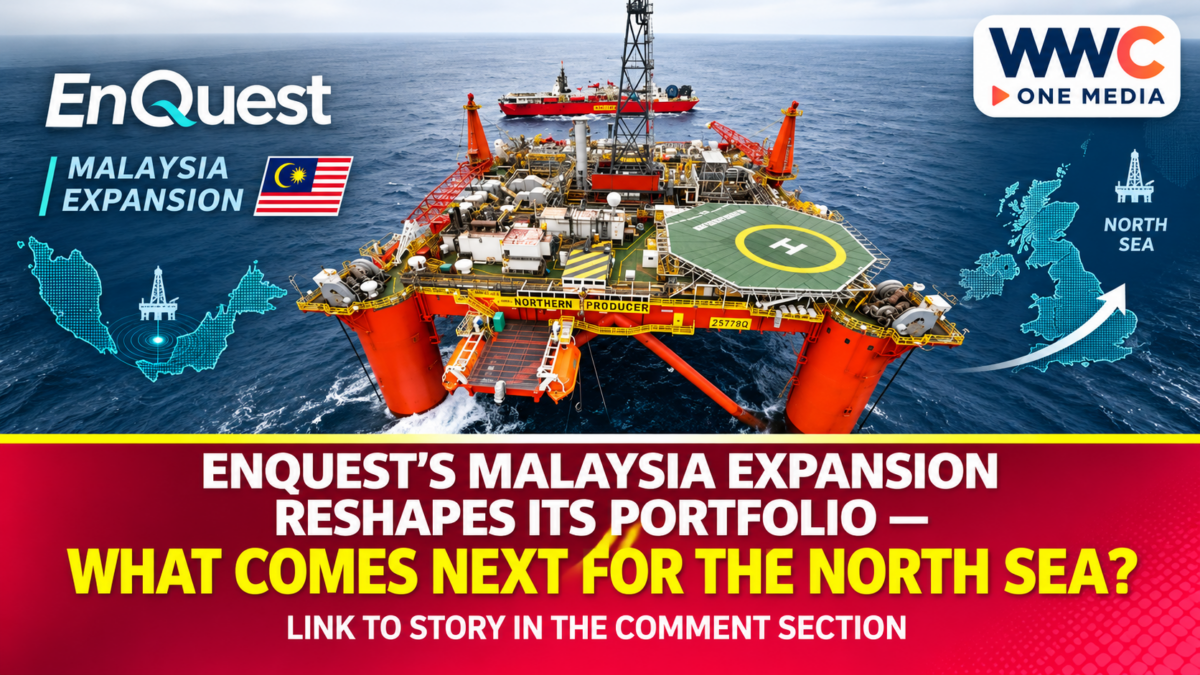
EnQuest entered November 2026 preparing for a major expansion in Southeast Asia, after securing shareholder approval and satisfying the stated conditions for acquisitions of offshore Malaysian production interests. Its published interim results show a business still operating in the UK North Sea while committing substantial capital to a larger Asian portfolio.
The strategic question is how those investments will change EnQuest’s production mix, costs and exposure to mature UK oilfields. A separately reported disposal of its UK upstream business requires examination of the Nov. 18 regulatory announcement before its price, buyer and completion terms can be treated as established facts.
EnQuest Malaysia expansion: what the filings establish
On June 10, EnQuest announced a proposed acquisition of interests in four production-sharing contracts offshore Malaysia from PETRONAS Carigali. Its company documents set maximum total consideration at US$833 million, with completion subject to conditions and the transaction structured in separate packages.
EnQuest published a combined prospectus and shareholder circular on July 24. Shareholders subsequently approved the acquisition resolution at a general meeting on Aug. 11, with 996,741,676 votes in favour and 301,437 against, excluding votes withheld. Those figures document approval of the Malaysian deal, not approval of a later UK disposal.
An Aug. 12 company announcement said the conditions precedent for the Malaysian acquisitions had been satisfied. Management continued to expect completion on Dec. 31, 2026, with an economic effective date of Jan. 1, 2027. Expected completion is not the same as a transaction that has already closed.
Why it matters: These regulatory milestones provide evidence of a concrete expansion strategy. They do not establish the outcome of any separate proposed sale of North Sea assets.
North Sea assets remain significant in published accounts
In its September half-year report, EnQuest recorded average production of 41,544 barrels of oil equivalent per day for the six months to June 30, up from 38,257 a year earlier. The operating figures included production in the UK, Malaysia and Vietnam.
The company’s Magnus field experienced an interruption associated with third-party infrastructure, which curtailed output by approximately 4,100 barrels of oil equivalent per day. EnQuest also reported investments and operating activity in its UK portfolio during the half.
These records explain why a potential UK exit would be a material change in the group’s direction. Oilfields come with ongoing operating costs, infrastructure obligations and eventual decommissioning requirements. Their financial significance cannot be assessed from an indicative headline transaction value alone.
For wider energy-market context, WWC has examined the outlook for global oil supply in 2027. Such market forecasts help explain commodity-price risks, but do not determine the value of a particular North Sea portfolio.
The financial position before the proposed reshaping
EnQuest reported US$529.9 million in revenue and other operating income for the first half of 2026, compared with US$549.1 million a year earlier. Adjusted EBITDA was US$273.0 million, while the statutory after-tax result was a US$39.9 million loss.
Those measures are different. Adjusted EBITDA excludes certain costs and accounting effects; it cannot be presented as statutory profit. The company reported US$517.0 million in net debt at June 30 and US$758.6 million in cash and available facilities.
EnQuest said it had refinanced its bonds and reserve-based lending facility, while paying a deposit related to the Malaysia acquisition. That backdrop is relevant when assessing future financing flexibility, but no verified disposal proceeds have been incorporated into these historical figures.
Analysis: A sale of producing assets could release cash and reduce exposure to a mature basin, yet it could also remove operating cash flow. Net benefit depends on transaction costs, liabilities transferred, contingent payments and how proceeds are used.
Why Southeast Asia is central to the plan
EnQuest’s June acquisition document estimated that Southeast Asia would account for 69% of production in the enlarged group, based on 2025 working-interest output, with the UK North Sea contributing 31%. This was a pro forma comparison for the planned acquisitions, not an observed 2027 production result.
The company has also highlighted operations in Vietnam and Malaysia as sources of production growth. Its stated rationale for the Malaysian purchases includes longer-life reserves, operational control and a wider range of development opportunities.
A different regional energy agreement covered by WWC, the long-term gas partnership between PETRONAS and Thailand’s PTT, illustrates the importance of cross-border energy relationships in Southeast Asia. That agreement is distinct from EnQuest’s transaction and should not be confused with it.
Analysis: Geographic diversification changes a company’s exposure to fiscal regimes, asset maturity and contract structures. It does not remove commodity-price volatility or the need to fund development and abandonment obligations.
What a UK disposal would require investors to verify
For any announced sale of EnQuest’s UK upstream operations, the crucial documents are a signed transaction announcement, the detailed consideration structure, approvals required, obligations retained and the expected closing date. Where payments depend on oil prices or taxation, the highest potential amount is not necessarily the cash received on completion.
Investors must also distinguish between selling shares in an operating subsidiary and selling individual licences, because the transfer of employees, contracts, tax attributes and decommissioning obligations can differ. The public regulatory document should resolve those questions before a definitive accounting conclusion is drawn.
UK fields remain part of a broader international energy market. WWC’s report on global oil supplies despite tanker disruptions provides commodity-market context but does not establish EnQuest’s future cash flows.
What happens next
The immediate editorial and investor milestone is the authenticated announcement detailing any proposed UK disposal, followed by required approvals and completion updates. The separate Malaysian acquisitions were still expected to complete on Dec. 31 under EnQuest’s latest accessible company statement.
EnQuest’s official financial reports document a genuine portfolio expansion towards Southeast Asia. Until the November disposal filing is independently available, claims that an entire North Sea business has been sold for a particular price should remain outside a primary-record-only news report.
FAQ
What Malaysian acquisition has EnQuest announced?
EnQuest agreed to acquire interests in four offshore Malaysian production-sharing contracts from PETRONAS Carigali for maximum consideration of US$833 million, subject to the disclosed transaction terms.
Has the Malaysian acquisition closed?
The last authenticated company update reviewed expected completion on Dec. 31, 2026. It did not establish that the acquisition had already completed by Nov. 18.
What were EnQuest’s first-half 2026 financial results?
The company reported US$529.9 million in revenue and other operating income, US$273.0 million in adjusted EBITDA and a US$39.9 million statutory after-tax loss.
Has the reported US$960 million UK disposal been verified?
Not against a directly accessible Nov. 18 company regulatory announcement in this review. Its buyer, payment terms and completion conditions must be checked against that primary record before publication as confirmed facts.