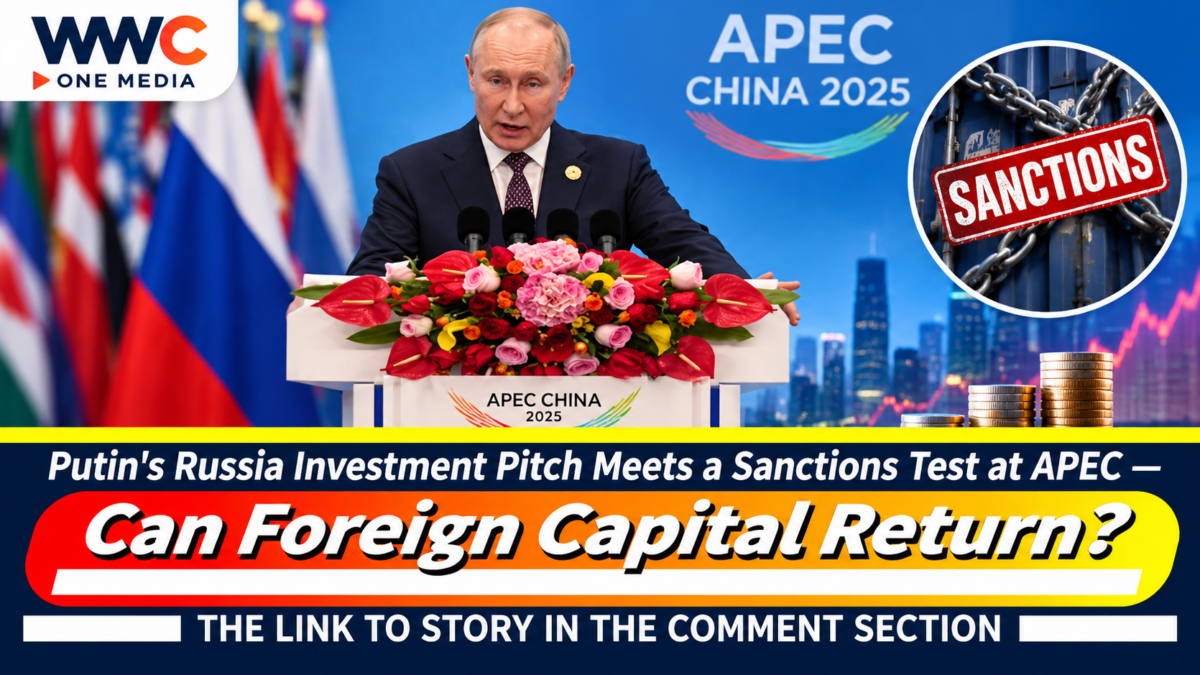
Russian President Vladimir Putin joined Chinese President Xi Jinping in Shenzhen on Nov. 18, 2026, as the Asia-Pacific Economic Cooperation (APEC) meetings placed trade and investment at the centre of regional diplomacy. Russia’s effort to attract international capital faces a measurable obstacle: US sanctions still restrict certain investments and transactions, while its own central bank maintains a 14% policy interest rate.
That contrast matters more to potential investors than the presentation of an investment opportunity. A political invitation does not remove legal prohibitions, lower borrowing costs or guarantee that a company can move money across borders.
Russia investment pitch meets the APEC agenda
The Chinese government’s Nov. 18 account confirms that Xi met Putin in Shenzhen. China also identified the APEC CEO Summit on Nov. 17–18 and the economic leaders’ gathering on Nov. 18–19 as distinct parts of the week’s programme.
APEC’s official agenda addresses trade integration, business connectivity, artificial intelligence and measures intended to make regional commerce easier. Its senior officials reviewed proposals involving paperless trade, digital documentation and future economic cooperation before the leaders’ meetings.
Those ambitions offer Russia a platform for economic engagement, but participation in the gathering is not itself a foreign investment agreement. APEC discussions can encourage dialogue without cancelling national regulations or sanctions imposed by individual members.
The publicly accessible official records reviewed here confirm the Shenzhen meetings and policy setting. They do not provide an authenticated full transcript of Putin’s Nov. 18 investment remarks, so no specific economic claim or quotation from that address is presented as verified.
Sanctions make a difference to actual transactions
The US Treasury’s Russia-related sanctions framework continues to list Executive Order 14071, which prohibits new investment in Russia by US persons, alongside other relevant restrictions. Treasury guidance also emphasises that Russia is not under an identical blanket prohibition covering every possible transaction with every country or company.
This distinction is critical. Whether an investor can proceed depends on the people involved, the nature of the transaction, the applicable jurisdiction, any designated counterparties and available exemptions or licences.
Treasury’s published list includes authorisations for specific activities, including some energy-related transactions. A targeted authorisation is not a general invitation for all US persons to finance Russian projects.
WWC previously examined limits of the latest US sanctions waiver. The wider lesson is that changes to one legal measure do not necessarily cancel restrictions imposed under other authorities.
Why it matters: A prospective investor needs more than a positive forecast. Banks, legal advisers and counterparties must determine whether a particular payment, ownership interest or service is permitted before a transaction can proceed.
Russia’s 14% interest rate raises financing questions
Russia’s central bank published a key interest rate of 14.00% for Nov. 17, 2026. It also listed its next policy-rate decision for Dec. 18, making the cost of domestic finance a relevant issue alongside foreign investment rules.
The key rate is not identical to the interest rate on every business loan. Individual borrowing costs depend on lender assessments, collateral, maturity, currency and credit risk. Nevertheless, an elevated benchmark can make expansion harder to finance when projects have long development periods.
A factory or logistics facility may require significant spending before generating revenue. A company considering such an investment must examine expected returns against financing expenses and uncertainty about future operations.
Analysis: Russia’s investment case cannot be evaluated only through the size of its market or the resources it can offer. Capital availability, legal access and the ability to repatriate earnings can be just as decisive. The central bank rate is one publicly verifiable indicator, rather than a forecast of any individual project’s success.
China ties do not remove every banking obstacle
Xi and Putin’s confirmed meeting places the bilateral relationship within the wider Asia-Pacific economic calendar. China has advocated open trade and investment during this year’s APEC programme, while the forum’s official work has focused on practical barriers to cross-border activity.
Yet a diplomatic relationship between governments should not be confused with commercial approval from every bank or company. Firms operating internationally may face compliance requirements in more than one jurisdiction, particularly where payments involve restricted persons or activities.
WWC’s earlier report on Russia’s yuan-based trade and banking challenges examines that commercial complexity. The issue for investors is not merely which currency is used, but whether an institution can lawfully and reliably complete a transaction.
No newly signed bilateral investment package, binding funding amount or relaxation of sanctions can be inferred from the confirmation that Xi and Putin met.
Why the Philippines should watch investment rules
The Philippines is among APEC’s 21 member economies. The organisation’s November programme covers regional supply chains, connectivity and digital trade, all relevant to companies selling goods or services across borders.
For Philippine businesses, developments in Russia’s relationships with major economies may affect commercial choices indirectly. However, it would be unsupported to claim that Putin’s appearance in Shenzhen has already changed Philippine investment rules, prices or trade flows.
WWC has also covered the planned three-way summit in Shenzhen. That diplomatic process is separate from the question examined here: whether applicable financial rules permit an actual project to be financed and completed.
Analysis: Regional cooperation is most valuable to businesses when announcements translate into predictable processes. Investors can assess published licences, bank requirements, ownership structures and signed agreements; diplomatic language alone is not a substitute.
What happens next
The next evidence to watch is not simply another statement supporting investment. It is whether governments publish legally effective changes to restrictions, companies disclose completed financing and investors identify projects with confirmed commitments.
Russia’s next scheduled central bank rate meeting on Dec. 18 provides another measurable point for assessing domestic funding conditions. Any outcome from separate diplomatic meetings should be judged on its own published terms rather than assumed to alter sanctions automatically.
As of Nov. 18, the official record establishes Putin’s presence in Shenzhen, the APEC economic agenda, a substantial Russian policy interest rate and continuing US restrictions. It does not establish that an influx of foreign capital has followed the investment appeal.
FAQ
Is Russia open to foreign investment in 2026?
The answer depends on the investor, transaction and relevant laws. US sanctions prohibit certain new investments and other dealings, while some activities may be permitted or specifically authorised.
What did Putin do at APEC in November 2026?
China’s government confirmed that Putin met Xi in Shenzhen on Nov. 18 during APEC leaders’ week. The reviewed primary records did not independently establish the full wording of his investment speech.
What is Russia’s current central bank interest rate?
The Bank of Russia listed its key rate at 14.00% on Nov. 17, 2026, with its next scheduled decision on Dec. 18.
Can the APEC summit remove sanctions on Russia?
No. APEC meetings do not automatically repeal national sanctions laws, executive orders or regulations. Those require action by the relevant authorities.