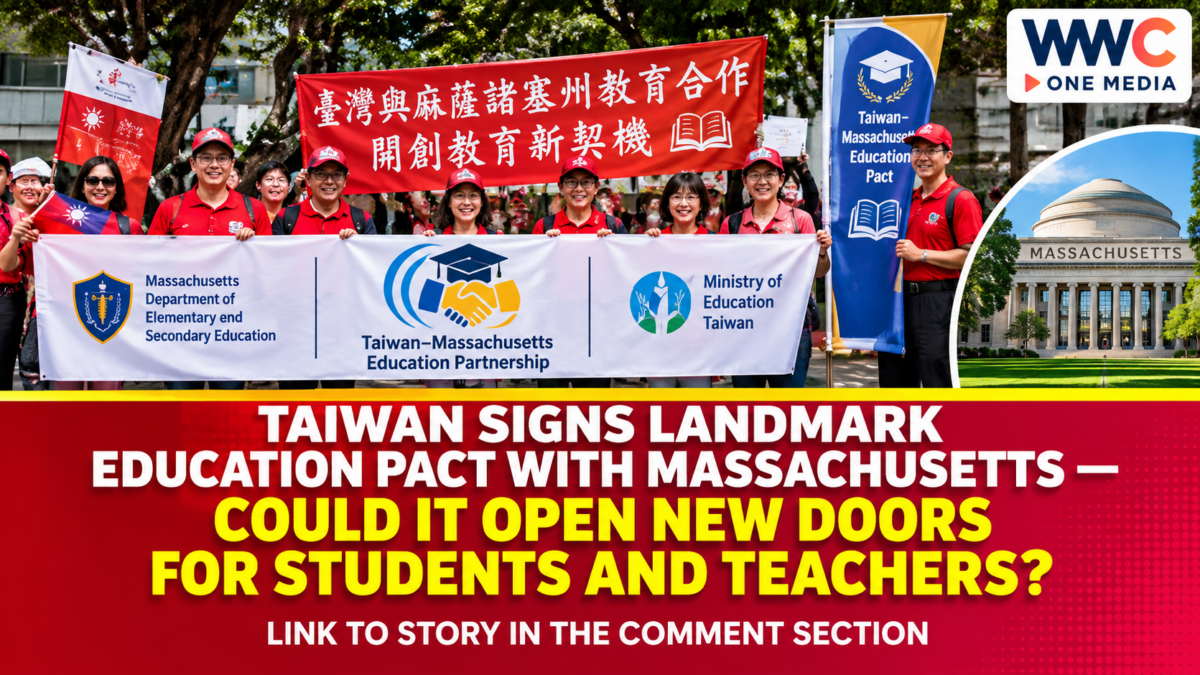
TAIPEI, Taiwan — November 28, 2026 — Taiwan and the US state of Massachusetts have established a new education partnership designed to expand international learning opportunities, strengthen bilingual education and encourage closer cooperation between elementary and secondary schools.
The Taiwan Massachusetts education pact was signed on November 27, 2026, marking the first education cooperation memorandum between Taiwan’s Ministry of Education and the Massachusetts Department of Elementary and Secondary Education.
The agreement represents another step in the expansion of Taiwan’s educational relationships with American states, with particular attention to Mandarin and English-language instruction, professional development and international classroom collaboration.
For students and educators, the next significant development will be how these commitments translate into accessible learning programmes.
Taiwan Massachusetts Education Pact Opens a New Chapter
The agreement was signed by Massachusetts Department of Elementary and Secondary Education Commissioner Pedro Martinez and Taiwan’s Department of International and Cross-Strait Education Director-General Lee Yu-chuan.
Taiwan’s Deputy Minister of Education Liu Kuo-wei witnessed the signing.
The Massachusetts delegation, which included Chief of Staff Lauren Secatore, scheduled its Taiwan visit from November 22 to 28, 2026.
The partnership provides an institutional framework for educational collaboration, rather than establishing a single exchange programme with predetermined participant numbers.
Schools and education authorities will have opportunities to explore cooperative activities that reflect their respective teaching priorities.
The agreement focuses on K-12 education, which broadly covers schooling from kindergarten through the completion of secondary education.
Its potential benefits therefore extend to younger learners and schoolteachers, rather than being limited to university students and researchers.
Mandarin Education Creates Opportunities for American Students
Language education is an important component of the relationship between Taiwan and Massachusetts.
Massachusetts already recognises Taiwan’s Test of Chinese as a Foreign Language, commonly known as TOCFL, as an assessment option for its State Seal of Biliteracy programme.
This recognition provides eligible Mandarin learners with another pathway for demonstrating language proficiency.
The new agreement creates opportunities to build on that foundation through cooperation between schools and educators.
For readers interested in Taiwan’s international language education initiatives, WWC ONE MEDIA has also examined the expansion of Taiwan’s Chinese studies network through an academic centre in Naples, Italy.
Although the Italian initiative involves a different educational setting, language learning remains a common theme connecting these international partnerships.
A Partnership With Roots Dating Back to 2022
Educational cooperation between Massachusetts and Taiwan existed before the November 2026 agreement.
On March 1, 2022, the Cambridge School of Weston in Massachusetts established a partnership with National Magong High School in Taiwan.
The schools identified curriculum development, teaching methods, educational resources and professional development as areas for collaboration.
During the online signing ceremony, participating students introduced their schools in Mandarin and English, demonstrating how language education could support communication between international classrooms.
A separate agreement followed on April 18, 2022, between the Cambridge School of Weston and Taoyuan Municipal Wu-Ling Senior High School.
These earlier institutional partnerships demonstrate that educational cooperation did not begin with the latest memorandum.
The November 2026 agreement instead offers a broader framework through which further school-level collaboration can be explored.
Teachers Could Become Central to the Partnership
The agreement creates a basis for cooperation among education professionals, including possible exchanges involving language teachers and teaching assistants.
Such arrangements could enable educators to experience different classroom environments and explore alternative instructional approaches.
Digital learning may also provide a way for participating institutions to cooperate without requiring every educational activity to involve international travel.
For schools, this could mean exploring joint learning activities, professional discussions and collaborative approaches to lesson development.
These opportunities remain subject to implementation arrangements between the participating authorities and institutions.
The memorandum does not automatically guarantee overseas employment, funded travel or participation in a particular exchange programme.
Educators’ working conditions also remain an important consideration in Taiwan’s domestic education policies, as explored in WWC ONE MEDIA’s coverage of Taiwan’s revised parental leave rules for education personnel.
Taiwan Expands Its Education Relationships Across the United States
Massachusetts is not the only American state developing closer educational relationships with Taiwan.
On November 26, 2026, Taiwan’s Ministry of Education announced the renewal of education cooperation memorandums with Idaho and Oklahoma, alongside further work to implement its partnership with North Carolina.
The Idaho renewal was completed on November 16 during a visit to Taiwan by Governor Brad Little and his delegation.
Taiwan and North Carolina had previously signed an education memorandum on March 11, 2026.
These developments demonstrate how educational cooperation can be pursued through individual state authorities, creating multiple institutional channels for international academic engagement.
The Massachusetts agreement is particularly relevant to school-level language education, while other partnerships may reflect different educational priorities.
WWC ONE MEDIA has previously examined another dimension of international institutional learning in its coverage of the US–Taiwan fellowship programme for American government employees.
The fellowship and Massachusetts education memorandum are separate initiatives, with different participants and institutional objectives.
What Happens Next for Students and Schools?
The signing of an education memorandum establishes a starting point for cooperation, but the practical details will determine its eventual reach.
Schools interested in participating will need information about available activities, institutional eligibility and programme schedules.
Teachers considering international exchanges will also require clarification regarding application procedures, professional requirements and financial arrangements.
For students and families, important questions include whether particular activities will involve physical travel, digital participation or a combination of both.
The agreement does not establish an automatic scholarship entitlement, guarantee admission to an American school or create a new immigration pathway.
For education systems across the Asia-Pacific, international partnerships offer opportunities to explore language learning and cross-cultural communication through cooperation between institutions.
The next test for the Taiwan Massachusetts education pact is whether its framework leads to sustained participation by schools, educators and students.
Frequently Asked Questions
What is the Taiwan Massachusetts education pact?
It is a memorandum of understanding establishing educational cooperation between Taiwan’s Ministry of Education and the Massachusetts Department of Elementary and Secondary Education.
When was the agreement signed?
The agreement was signed on November 27, 2026.
Who signed the education agreement?
Massachusetts education commissioner Pedro Martinez and Taiwan’s international education director-general Lee Yu-chuan signed the memorandum, witnessed by Deputy Minister Liu Kuo-wei.
Will the agreement provide automatic scholarships or exchange placements?
No. Specific participation opportunities, funding arrangements and eligibility requirements will depend on subsequent implementation.
Does Massachusetts recognise Taiwan’s Mandarin proficiency examination?
Yes. Massachusetts recognises the Test of Chinese as a Foreign Language as an assessment option for its State Seal of Biliteracy programme.