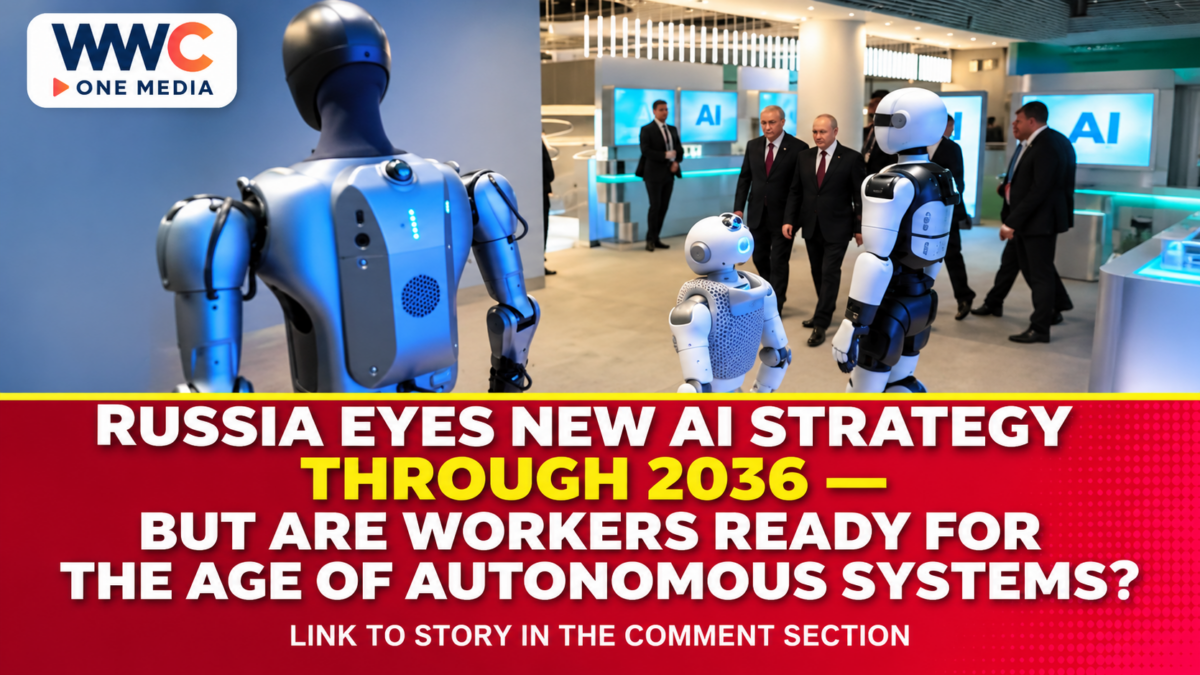
MOSCOW, RUSSIA — Russian President Vladimir Putin has proposed updating Russia’s national artificial intelligence strategy through 2036, placing greater emphasis on collaboration between people and autonomous technologies as the country seeks to expand AI adoption throughout its economy.
Speaking at the AI Journey 2026 international conference on Nov. 26, Putin emphasised that possessing advanced artificial intelligence technologies would not automatically guarantee technological leadership or sustainable economic development.
Instead, the Russian leader called for closer integration of human expertise and automated systems into economic activities, industrial operations, management processes and public services.
The proposed direction raises an important question for businesses, educational institutions and workers: how should people prepare for an economy in which AI systems can increasingly perform complex tasks?
Russia AI Strategy Shifts Focus Towards Human-Machine Collaboration
Putin’s proposed update reflects an approach that places considerable importance on the practical application of artificial intelligence.
Developing sophisticated AI models is one challenge. Integrating those technologies into existing organisations, production systems and public institutions presents another.
From a business perspective, purchasing AI software does not automatically improve productivity.
Companies must determine which activities are suitable for automation, establish measurable performance objectives and develop procedures for identifying errors.
Employees may also need to acquire additional skills to communicate effectively with AI systems and evaluate their outputs.
For example, a financial analyst using artificial intelligence to examine corporate records must still understand accounting principles and recognise potentially incorrect conclusions.
Similarly, an engineer using AI to develop technical designs must be able to evaluate whether the proposed solutions meet applicable requirements.
The importance of preserving human responsibility has also been examined in WWC ONE MEDIA’s coverage of Putin’s proposed AI-agent regulation and human oversight framework.
The challenge extends beyond learning how to operate a digital assistant. It involves understanding when an automated recommendation should be accepted, questioned or rejected.
AI Workforce Skills Could Become a Competitive Advantage
The growing integration of artificial intelligence into workplace activities raises important considerations for employers.
Rather than treating AI adoption solely as a technology procurement exercise, organisations could approach it as a broader workforce development initiative.
Employees using AI for research, customer service, administration or technical development may need to combine their existing professional expertise with additional digital capabilities.
These could include formulating clear objectives, breaking complicated assignments into manageable components, evaluating information and protecting confidential data.
For employers, effective training would need to reflect the responsibilities of individual workers.
A customer service employee, software developer and healthcare administrator are unlikely to require identical AI capabilities.
The issue is already attracting attention across Asia-Pacific, including within the Philippine IT-BPM industry’s efforts to develop talent as artificial intelligence reshapes business operations.
The economic value of AI-assisted work should ultimately be assessed through measurable improvements rather than simply counting how many employees use automated tools.
Kazakhstan Highlights AI Education and Industrial Applications
Kazakhstan President Kassym-Jomart Tokayev also participated in the Moscow conference, presenting artificial intelligence and digitalisation as priorities within his country’s economic development agenda.
Tokayev reported that more than 100,000 students were acquiring practical artificial intelligence skills through Kazakhstan’s AI-Sana programme.
He also highlighted the AI Challenge initiative, which seeks to connect technology developers with businesses requiring solutions to specific industrial problems.
The initiative illustrates how workforce development could be connected directly with commercial requirements.
Instead of concentrating exclusively on theoretical knowledge, educational programmes could provide opportunities for students to examine practical challenges encountered by businesses.
Tokayev also proposed joint educational projects for teachers and schoolchildren through the AI Journey Junior programme.
Such initiatives could help establish a foundation for responsible technology use while developing the skills required to participate in a more digitally intensive economy.
However, participation figures alone cannot establish the effectiveness of a training programme. Evaluating its outcomes would require evidence concerning skills development, employment and practical applications.
Education Systems Face Their Own AI Transition
Educational institutions face a particularly important challenge as artificial intelligence becomes more accessible.
The ability to produce an answer using AI does not necessarily demonstrate that a student understands the underlying subject.
Schools and universities may therefore need to reconsider how they assess knowledge, independent reasoning and problem-solving capabilities.
Effective AI education could combine technical instruction with information literacy, critical thinking and professional ethics.
The question is particularly relevant for students balancing education and employment, as examined in WWC ONE MEDIA’s coverage of AI adoption and unequal access to educational opportunities.
If access to effective training differs considerably between institutions and communities, existing educational inequalities could become more difficult to address.
For governments and educational organisations, introducing AI into classrooms should therefore involve consideration of teaching quality, accessibility and measurable learning outcomes.
AI Governance Remains Important as Technology Expands
During the November 26 conference, Putin and Tokayev visited exhibitions presenting artificial intelligence applications across sectors including education, healthcare, public administration, financial technology and transportation.
The diversity of these applications highlights why AI governance cannot be reduced to a single set of workplace instructions.
Systems used for administrative assistance may require different safeguards from those involved in healthcare, financial transactions or public-sector decisions.
Businesses considering AI adoption must evaluate the consequences of inaccurate outputs, inappropriate data handling and excessive delegation of authority.
These governance questions are also emerging in Southeast Asia, where ASEAN parliamentarians have been examining artificial intelligence governance and technology safeguards.
Clear responsibilities, appropriate oversight and reliable procedures for challenging automated decisions could become important components of successful AI implementation.
What Happens Next for Russia’s AI Strategy?
Putin has proposed updating Russia’s national artificial intelligence strategy through 2036 and adopting a national action plan.
The proposal establishes a policy direction, but it should not be interpreted as confirmation that the revised strategy has already been formally adopted or that mandatory AI training requirements have entered into force.
Future policy documents will be important for determining how Russia intends to implement its objectives.
For companies and educational institutions across APEC economies, the broader commercial question remains relevant regardless of individual national strategies.
The economic value of artificial intelligence will depend partly on how effectively people use it, how organisations manage its limitations and whether its deployment produces meaningful improvements.
The next phase of technological competition may therefore involve not only developing more powerful artificial intelligence but also developing the human expertise required to use it responsibly.
Frequently Asked Questions
What did Putin announce at AI Journey 2026?
Putin proposed updating Russia’s national artificial intelligence strategy through 2036 and adopting a national action plan that supports greater collaboration between people and autonomous systems.
Has Russia’s updated AI strategy already been adopted?
The November 26 announcement establishes a proposal to update the strategy. It does not independently establish that the revised document has already entered into force.
Why are advanced AI skills important for workers?
AI skills can help workers formulate complex assignments, evaluate automated outputs and apply technology within their professional responsibilities.
How many students are participating in Kazakhstan’s AI-Sana programme?
President Kassym-Jomart Tokayev reported that more than 100,000 students were acquiring practical AI skills through the programme.
Does human-AI collaboration mean replacing human decision-making?
Not necessarily. Effective collaboration can involve using AI to assist with complex activities while retaining appropriate human judgement, supervision and accountability.