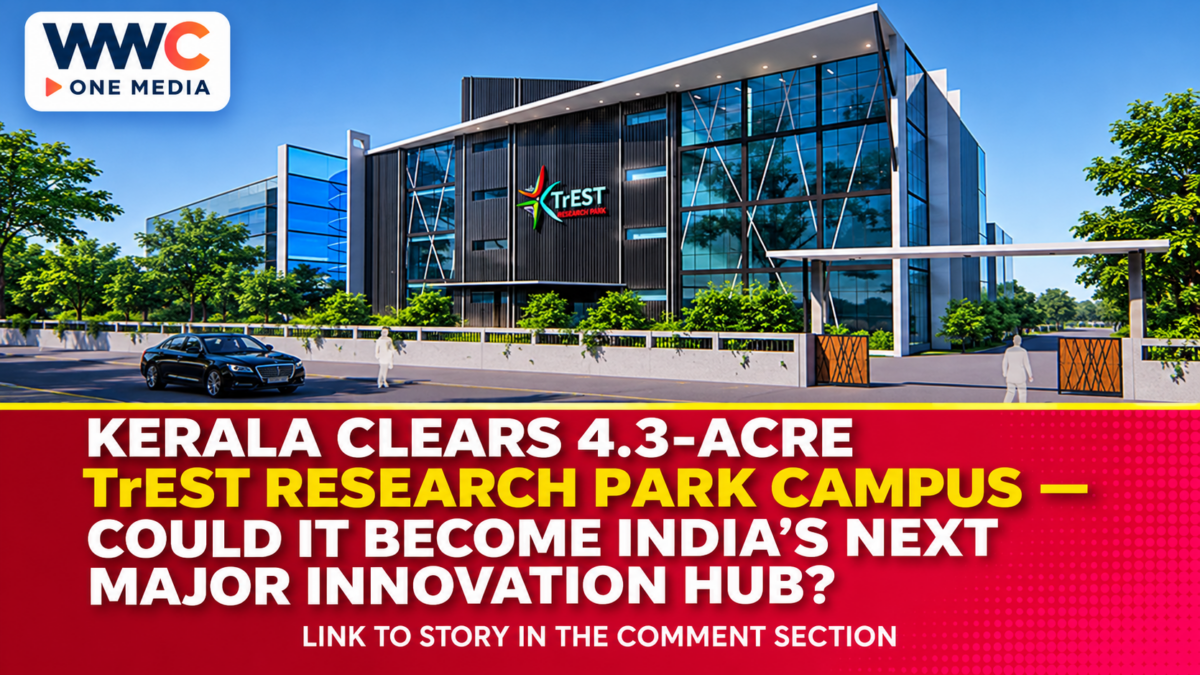
THIRUVANANTHAPURAM, INDIA — Kerala is moving towards expanding its technology research infrastructure after the state government granted permissive sanction for the construction of a permanent headquarters and associated facilities for the TrEST Research Park.
The development would occupy 4.3 acres within the College of Engineering Trivandrum (CET), bringing academic researchers, engineering students and industrial partners into closer collaboration.
The initiative represents an important step in Kerala’s ambition to build an economy supported by technological development, entrepreneurship and commercially applicable research.
However, the ultimate test will extend beyond constructing new buildings. Kerala must establish whether its investment in research infrastructure can generate competitive technologies, attract industrial partnerships and support sustainable businesses.
TrEST Research Park Moves Towards a Permanent Campus
The Trivandrum Engineering Science and Technology Research Park was established to strengthen cooperation between academic institutions and businesses engaged in technological research.
Kerala’s government initially consented to its formation in 2013. The organisation was subsequently incorporated on March 24, 2015, under Section 8 of India’s Companies Act 2013.
Its existing administrative address is at the GEM Building opposite the College of Engineering Trivandrum.
The planned headquarters within CET would provide a permanent institutional base for developing its research and industry engagement activities.
Locating research facilities within an engineering campus could help reduce the separation between academic work and commercial technology development.
Companies could benefit from closer interaction with researchers and engineering talent, while students could gain opportunities to work on practical industrial challenges.
The importance of establishing dedicated facilities for technological development is also reflected in Western Philippines University’s advanced manufacturing and 3D printing initiative in Palawan.
Both initiatives illustrate the potential of research infrastructure to support innovation beyond conventional academic instruction.
Kerala Wants to Connect Universities With Industry
TrEST’s operating model brings together three groups: academic researchers, students and industrial research personnel.
The organisation seeks to encourage companies to collaborate with educational institutions through sponsored research, consultancy, technology development and intellectual property creation.
Its services also include joint academic supervision and mechanisms for pursuing commercial applications of research.
This approach addresses a fundamental challenge in technology development: promising academic discoveries do not automatically become commercially successful products.
Researchers may develop technically innovative solutions, but businesses must also evaluate production costs, customer demand, reliability and market readiness.
A research park can provide an environment in which these commercial and technical considerations are examined together.
TrEST’s permanent campus could strengthen that process by providing a more stable institutional setting for long-term collaboration.
However, the government sanction does not independently establish how many companies will occupy the new facilities or how much private investment the development will attract.
Semiconductor Research Forms Part of TrEST’s Technology Ambitions
TrEST’s research activities extend into semiconductor design through its fabless technology programme.
One of its identified initiatives involves developing a processor based on the RISC-V architecture, together with associated development tools.
The programme is designed to bring CET researchers into collaboration with public research organisations and private companies.
RISC-V is an open instruction set architecture that provides a foundation for designing processors.
For engineering students and researchers, participating in processor development offers opportunities to gain experience in hardware design, verification and associated software development.
These capabilities could become increasingly valuable to businesses seeking specialised technical expertise.
Across Asia-Pacific, similar efforts to translate emerging technologies into practical applications are gaining attention, including Macau’s international AI competition for young innovators.
Semiconductor development and artificial intelligence represent different technical disciplines, but both require access to skilled researchers, specialised facilities and effective collaboration.
Importantly, TrEST’s processor research objective should not be interpreted as confirmation that a commercially manufactured semiconductor has already been produced.
Electric Mobility Creates Another Research Opportunity
TrEST has also pursued collaboration involving automotive technology and emerging mobility solutions.
Its NAVIGYAAN initiative, organised with ARAI-AMTIF and CET, brought students and industry specialists together to examine automotive design, innovation and future transportation technologies.
Such programmes provide opportunities for engineering students to understand practical industrial requirements beyond classroom instruction.
For automotive businesses, cooperation with research institutions could support the evaluation of components, technologies and potential engineering solutions.
A permanent research campus could provide an institutional foundation for expanding such partnerships.
However, the eventual scale of automotive research activities will depend on the facilities installed, the organisations participating and the resources available to support their work.
No independently verified manufacturing commitments or commercial automotive production targets have been established for the proposed campus.
Can Research Infrastructure Generate Commercial Growth?
TrEST identifies entrepreneurship, technology transfer and enterprise development among its institutional objectives.
Its stated ambition is to support the creation of technology companies and contribute to Kerala’s development as a knowledge-based economy.
Achieving these objectives requires more than physical infrastructure.
Research institutions need sustainable operating resources, qualified technical personnel, access to specialised equipment and businesses willing to pursue commercial applications of academic work.
Intellectual property arrangements and access to financing can also influence whether promising innovations progress beyond their development stage.
These considerations are relevant throughout Asia-Pacific, as examined in WWC ONE MEDIA’s coverage of science funding and technology commercialisation.
For Kerala, the permanent research campus could strengthen the institutional environment supporting these activities.
Nevertheless, its economic impact should ultimately be assessed through measurable outcomes such as completed research projects, industrial partnerships, commercially deployed technologies and sustainable enterprises.
What Happens Next for TrEST Research Park?
The government’s permissive sanction establishes an administrative milestone for the proposed headquarters and associated infrastructure.
The next important developments will involve detailed project planning, funding arrangements, construction procurement and the eventual establishment of operational research facilities.
A confirmed construction budget, contractor appointment and completion schedule have not been independently established for this report.
For Kerala’s academic community, the permanent campus represents an opportunity to deepen cooperation with technology businesses.
For industrial partners, it could provide another channel for accessing engineering expertise and pursuing research collaborations.
The project’s longer-term significance will depend on whether the infrastructure supports meaningful technological development and commercially viable innovations.
Kerala has taken an important step towards providing TrEST with a permanent home. The bigger challenge is transforming that space into an institution capable of producing lasting economic and technological value.
Frequently Asked Questions
What is TrEST Research Park?
TrEST is the Trivandrum Engineering Science and Technology Research Park, a Kerala government undertaking established to strengthen academic research, industrial collaboration and technology commercialisation.
Where will the permanent TrEST Research Park campus be located?
The proposed headquarters and associated facilities will occupy 4.3 acres within the College of Engineering Trivandrum campus in Kerala, India.
When was TrEST Research Park established?
Kerala’s government consented to its formation in 2013. The organisation was incorporated on March 24, 2015.
What technologies does TrEST Research Park focus on?
Its documented activities include semiconductor processor research, automotive technology, engineering research, consultancy and technology commercialisation.
When will the new TrEST Research Park campus open?
A definitive completion or opening date has not been independently verified. The government has granted permissive sanction for construction, but further implementation milestones remain necessary.