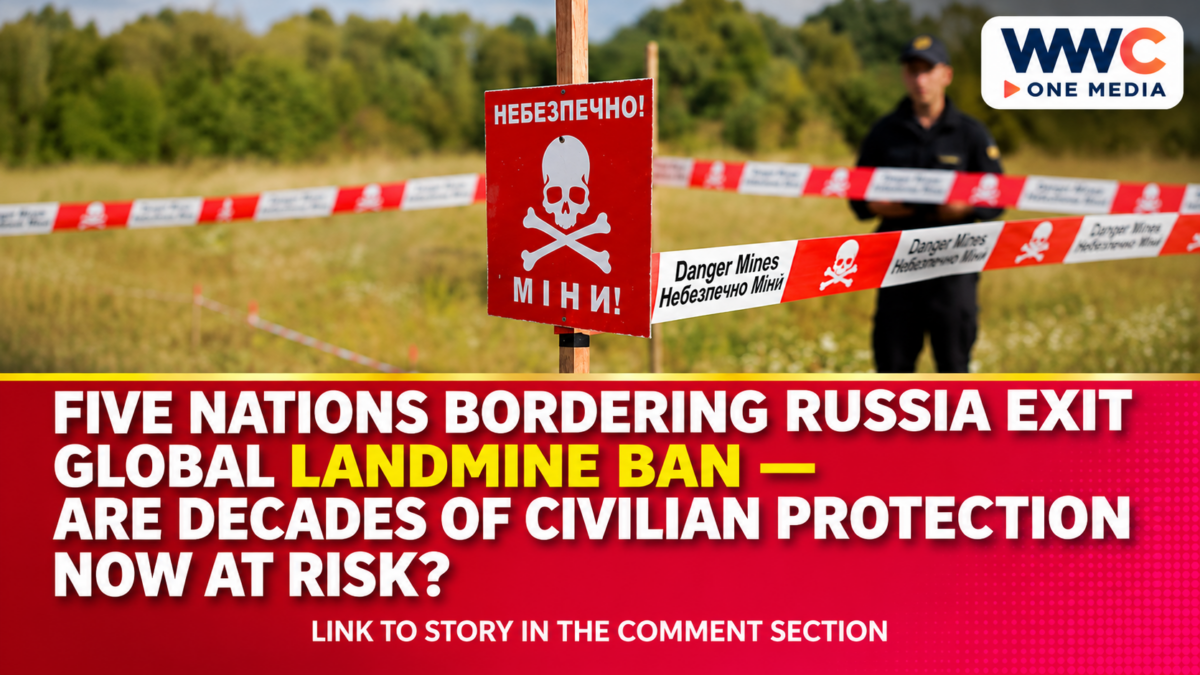
GENEVA, SWITZERLAND — Five European countries bordering Russia have withdrawn from the international treaty banning antipersonnel landmines, marking an unprecedented setback for a global humanitarian disarmament agreement that entered into force in 1999.
Estonia, Latvia, Lithuania, Finland and Poland completed their withdrawals between December 2025 and February 2026, following reassessments of national security prompted by Russia’s war against Ukraine.
The departures have returned to international attention following the release of Landmine Monitor 2026 on Nov. 24, which documented the highest annual number of landmine and explosive remnants of war casualties since 2020.
The developments expose a growing tension between national defence priorities and international efforts to protect civilians from weapons that can remain dangerous long after armed conflicts have ended.
Global Landmine Ban Loses Five European Members
The withdrawals represent the first effective departures from the Ottawa Convention since its adoption in 1997.
Estonia, Latvia and Lithuania formally left the agreement on Dec. 27, 2025, following the submission of their withdrawal notices to the United Nations six months earlier.
Finland’s departure became effective on Jan. 10, 2026, followed by Poland on Feb. 20.
The countries are consequently no longer bound by the specific prohibitions imposed through their former membership of the Ottawa Convention.
However, withdrawal does not eliminate their responsibilities under other applicable international humanitarian laws.
The distinction is particularly important amid wider debates over international arms control, including Russia’s involvement in United Nations negotiations concerning autonomous weapons.
Although the two issues involve different weapons and legal frameworks, both raise questions about maintaining humanitarian protections when governments reassess their national security requirements.
Why European Countries Reconsidered Their Treaty Commitments
The decisions followed growing concerns among European governments over the regional security environment.
On March 18, 2025, the defence ministers of Estonia, Latvia, Lithuania and Poland jointly recommended withdrawing from the convention.
Lithuania’s government subsequently explained that its assessment of national defence requirements had changed substantially because of the security threats facing countries along NATO’s eastern flank.
Finland similarly cited the deterioration of Europe’s security environment following Russia’s aggression against Ukraine.
Estonia’s foreign ministry identified national security considerations as the basis for its withdrawal decision.
These government positions demonstrate the importance that the withdrawing countries place on maintaining flexibility in their defence policies.
Nevertheless, their decisions have raised humanitarian concerns about whether expanding military options could weaken international efforts to reduce civilian exposure to landmines.
Finland and Estonia have maintained their commitments to international humanitarian law and humanitarian mine action despite leaving the agreement.
Landmine Casualties Reach Their Highest Level Since 2020
The departures coincide with a worsening global humanitarian situation.
At least 6,929 people were killed or injured by landmines and explosive remnants of war during 2025, representing a 10% increase from the previous year.
Civilians accounted for 84% of casualties whose civilian, military or demining status was identified.
Among civilian casualties for whom age information was available, half were children.
These statistics demonstrate the continuing consequences of explosive contamination for communities affected by armed conflict.
Importantly, the figures cover multiple categories of explosive hazards and incidents across different countries. They do not represent casualties caused exclusively by antipersonnel landmines or by the five European nations that withdrew from the treaty.
The humanitarian consequences also extend into Southeast Asia, as examined in Myanmar’s ongoing landmine crisis and the challenges confronting survivors.
For affected communities, the consequences can include permanent disability, displacement, restricted access to agricultural land and substantial rehabilitation needs.
What Leaving the Ottawa Convention Actually Means
The Ottawa Convention establishes an international prohibition on the use, production, acquisition, stockpiling and transfer of antipersonnel mines by its members, subject to the treaty’s limited exceptions.
Its humanitarian framework also addresses the destruction of existing stockpiles, the clearance of contaminated areas and assistance for survivors.
Article 20 establishes a formal withdrawal mechanism requiring notification to the relevant international parties and a six-month waiting period.
An additional provision prevents withdrawal from becoming effective while the withdrawing country is engaged in an armed conflict at the end of that period.
This provision is particularly relevant to the continuing controversy surrounding Ukraine’s treaty obligations.
Ukraine has attempted to suspend the operation of the agreement during its war with Russia, a development examined in the international dispute over Ukraine’s compliance with the global landmine ban.
Ukraine’s legal circumstances differ from those of the five European countries whose withdrawals have already taken effect.
Russia, meanwhile, has never joined the Ottawa Convention.
However, countries outside the agreement remain subject to other applicable international legal obligations concerning the conduct of hostilities and civilian protection.
Humanitarian Protection Extends Beyond the Battlefield
The consequences of explosive contamination are not limited to the period during which military operations take place.
Communities may face restrictions on returning to their homes, accessing farmland and rebuilding essential infrastructure until contaminated areas can be safely restored.
Survivors may also require long-term medical care, physical rehabilitation and assistance returning to education or employment.
On Nov. 13, 2026, the International Committee of the Red Cross reported that its teams had provided physical rehabilitation services to more than 25,000 people across 28 countries during the previous year for injuries associated with mines, cluster munitions and other explosive remnants of war.
The humanitarian organisation continues to oppose the use of antipersonnel mines by all parties.
For governments assessing national security policies, the long-term financial and social consequences of explosive contamination deserve consideration alongside immediate defence objectives.
What Happens Next for the Global Landmine Ban?
The international community now faces the challenge of maintaining support for humanitarian disarmament while responding to increasingly divergent national security assessments.
The departure of five members does not invalidate the Ottawa Convention or remove the obligations of countries that remain parties to it.
Nor does it establish that additional countries will necessarily withdraw.
However, the unprecedented departures create uncertainty over whether the international agreement can maintain its influence as security concerns intensify.
For governments across Europe, Asia-Pacific and the Americas, the central question is whether national defence objectives can be pursued without weakening the humanitarian protections established over nearly three decades.
The future credibility of the global landmine ban will depend not only on treaty membership but also on the continued commitment of governments to civilian safety, mine clearance and assistance for affected communities.
Frequently Asked Questions
Which five countries withdrew from the global landmine ban?
Estonia, Latvia, Lithuania, Finland and Poland completed their withdrawals between December 2025 and February 2026.
Why did these countries leave the Ottawa Convention?
Their governments cited changing national security requirements and concerns arising from Russia’s war against Ukraine.
Is Russia a member of the Ottawa Convention?
No. Russia has never become a party to the international antipersonnel mine ban treaty.
Does leaving the treaty remove all legal restrictions on landmines?
No. Former members remain subject to other applicable international humanitarian law obligations.
How many landmine-related casualties were recorded in 2025?
At least 6,929 people were killed or injured by landmines and explosive remnants of war worldwide during 2025, an increase of 10% from 2024.