
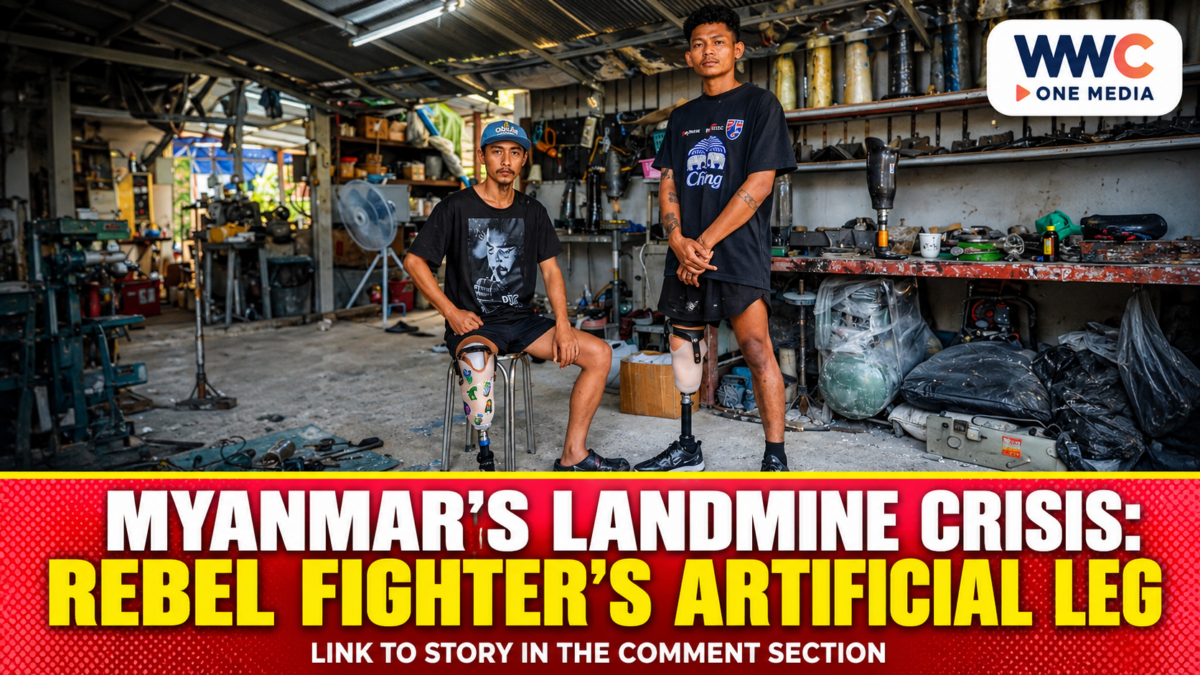
BAGO REGION, Myanmar — November 25, 2026 — A resistance fighter who lost his right lower leg in a landmine explosion is learning to walk again with an artificial limb near the Thailand-Myanmar border. But for Pee Litt, the 28-year-old platoon commander, recovery is not the end of his story. He wants to return to the front line.
His experience captures a growing humanitarian danger in Myanmar, where landmines and explosive remnants of war continue to injure civilians and combatants as the country’s conflict spreads across communities.
Myanmar recorded 1,891 mine and explosive-remnant casualties in 2025, the highest national total in the world for the third consecutive year. The figure includes people killed and injured, and places the country ahead of Syria, which recorded 1,602 casualties.
The toll is not confined to battlefields. Explosive devices can remain buried or hidden along routes, near settlements and around areas where people work, travel and gather food.
For survivors, escaping the initial explosion may be only the beginning of a long struggle involving surgery, rehabilitation, prosthetic equipment, transport and the difficult process of rebuilding everyday life.
A LANDMINE EXPLOSION CHANGED A RESISTANCE FIGHTER’S LIFE
Pee Litt was leading resistance fighters into a village in Myanmar’s central Bago Region in January 2026 when the group encountered an area littered with landmines.
Two explosions injured members of his unit before he stepped on a mine. The blast destroyed his right leg below the knee.
The platoon commander later travelled to a small prosthetics workshop near the Thailand-Myanmar border, where technicians measured and prepared an artificial limb for him.
The workshop provides a route to rehabilitation for people who struggle to reach established services inside Myanmar. Its location is not publicly disclosed, reflecting the security risks surrounding the work.
Pee Litt was able to practise walking with the prosthesis after it was fitted. The process required more than receiving an artificial limb: technicians had to assess its fit and allow time for him to adjust to using it.
His determination to return to his unit highlights a difficult reality in the conflict. Some survivors view rehabilitation not only as a way to regain mobility but also as a means of returning to the roles they held before being injured.
Yet the continued use of landmines creates the possibility that more people will suffer similar injuries.
A SMALL BORDER WORKSHOP IS FILLING A MAJOR REHABILITATION GAP
The workshop, known as i-walk, was established by former Myanmar nurse Ngu War War Hlaing.
Over its first two years, it made and fitted prosthetic limbs for 150 people wounded in the fighting in Myanmar. More than 90% of those treated were landmine victims, based on the workshop founder’s account.
The reported cost of Pee Litt’s artificial leg was approximately US$1,700, with the expense covered through online crowdfunding.
That figure illustrates one of the practical barriers facing survivors: access to a prosthesis depends not only on medical need but also on whether a person can reach a workshop, obtain funding and receive follow-up adjustments.
A prosthetic limb is not a one-time solution. It must fit the user’s body, support movement and be adjusted as necessary. Rehabilitation can also involve physiotherapy, mobility training and psychological support.
For people living in conflict-affected areas, the journey to obtain these services can be especially difficult.
THOUSANDS OF SURVIVORS NEED REHABILITATION
Myanmar already has an established physical rehabilitation network, but access is uneven.
The International Committee of the Red Cross has supported physical rehabilitation services in the country since 1986. Its programme supports three physical rehabilitation centres run by the Ministry of Health, located in Myitkyina, Kyaing Tong and Yangon, as well as the Orthopedic Rehabilitation Centre operated by the Myanmar Red Cross Society in Hpa-an.
From 2021 through August 2025, ICRC-supported centres recorded 5,730 service users who were landmine or explosive-remnant victims.
During the same period, the programme recorded 5,827 prostheses provided through its supported centres.
These are programme service figures, not a count of every survivor in Myanmar. They nevertheless show the scale of rehabilitation needs and the importance of maintaining access to artificial limbs and other mobility support.
The challenge is that established rehabilitation facilities are not equally accessible to everyone. Conflict, displacement, transport difficulties and insecurity can prevent injured people from reaching treatment.
For survivors who cannot safely travel to established centres, smaller community-based or cross-border facilities may become an essential alternative.
MYANMAR’S LANDMINE CASUALTIES ARE THE HIGHEST IN THE WORLD
The scale of the crisis extends far beyond individual stories.
The 2026 Landmine Monitor recorded 1,891 mine and explosive-remnant casualties in Myanmar during 2025. The country remained the world’s most affected for the third consecutive year.
The same report recorded at least 6,929 casualties worldwide in 2025, the highest annual total since 2020. Civilians accounted for 84% of recorded casualties where civilian, deminer or military status was known. Children represented half of civilian casualties where age was known.
Myanmar’s 2025 figure should not be confused with the separate civilian casualty monitoring released for the first half of 2026.
During January to June 2026, humanitarian monitoring recorded 327 landmine and other explosive-ordnance incidents in Myanmar, resulting in 487 civilian casualties. That total included 113 children.
Shan State recorded 109 civilian casualties, followed by Magway Region with 80 and Mandalay Region with 68.
The two sets of statistics measure different reporting periods and categories. The 2025 Landmine Monitor figure includes mine and explosive-remnant casualties across civilian and military categories, while the first-half 2026 monitoring figure covers civilian casualties only.
Together, they show that the danger remains widespread and that children are among those exposed.
LANDMINES ARE SPREADING THE DANGERS BEYOND FRONT LINES
Myanmar’s contamination problem is not limited to a handful of isolated locations.
The 2026 Landmine Monitor reported suspected mine and explosive-ordnance contamination in 211 townships as of October 2025, equivalent to 64% of the country’s townships.
The report also documented continuing antipersonnel mine use by Myanmar’s armed forces and non-state armed groups.
This matters because the consequences of explosive contamination can persist long after a military operation has moved elsewhere.
A farmer may encounter a device while working land. A family may face danger when returning to a home or village. A child may come across an explosive object while playing or travelling to school.
Even when fighting subsides in a particular area, contaminated land can remain unsafe until it has been properly assessed and cleared.
The impact extends beyond physical injuries. It can restrict access to farmland, water, healthcare, education and essential transport routes.
WWC ONE MEDIA has examined the wider international challenge in its report on the global landmine ban and the renewed use of antipersonnel mines.
CHILDREN AND DISPLACED FAMILIES FACE CONTINUING RISKS
The danger is particularly serious for children.
The 113 child casualties recorded in the first six months of 2026 represented 23.20% of the 487 civilian casualties monitored during that period.
Children can be exposed to explosive hazards while walking through communities, accompanying family members or returning to areas affected by fighting.
Displacement creates additional risks. Families forced to leave their homes may travel through unfamiliar areas, while people returning to their communities may encounter devices left behind during earlier fighting.
Humanitarian organisations have also warned that prolonged conflict is disrupting children’s access to education, healthcare and protection services.
The wider civilian protection problem has been examined in WWC ONE MEDIA’s coverage of ASEAN’s demands for stronger civilian protection in Myanmar.
The regional political response remains important, but diplomatic statements alone cannot make contaminated land safe. Communities need practical protection, access to medical treatment and sustained humanitarian assistance.
WHY CLEARING MINES IS SO DIFFICULT
Identifying and removing landmines in an active conflict environment is a complicated and dangerous task.
Front lines shift, armed groups control different territories and access for humanitarian organisations can be restricted. Survey teams need reliable information about contaminated areas, while clearance operations require trained personnel, specialised equipment and safe operating conditions.
The problem is made worse when mines are placed in areas used by civilians or when information about their location is unavailable.
The result is a long-term danger that can continue even after fighting has moved away.
Myanmar is not a party to the 1997 Mine Ban Treaty, which prohibits participating countries from using, producing, stockpiling and transferring antipersonnel mines. The treaty’s restrictions do not remove the need for all parties to an armed conflict to comply with applicable international humanitarian law, including rules protecting civilians.
The issue has also become part of the wider regional debate over the humanitarian consequences of Myanmar’s conflict. WWC ONE MEDIA has reported on ASEAN’s continuing political restrictions on Myanmar, including the challenge of translating diplomatic pressure into measurable improvements for people affected by the crisis.
RECOVERY REQUIRES MORE THAN AN ARTIFICIAL LEG
For a landmine survivor, receiving a prosthetic limb can restore mobility, but it does not automatically restore a normal life.
Long-term recovery may require repeated medical care, physiotherapy, psychological support, education assistance and help returning to work.
People who lose limbs in conflict may also face discrimination, reduced employment opportunities and financial pressure on their families.
The needs are especially difficult to meet when rehabilitation facilities are concentrated in a limited number of towns and cities, or when survivors cannot safely travel to them.
The work of the i-walk workshop shows how smaller rehabilitation initiatives can help fill gaps in access. But a workshop fitting 150 people over two years cannot meet the needs of a country recording thousands of mine and explosive-remnant casualties.
Myanmar’s landmine crisis therefore requires more than emergency treatment. It needs sustained survivor assistance, risk education, safe humanitarian access and credible efforts to prevent additional contamination.
Pee Litt is determined to return to his comrades. His artificial leg represents a personal step towards that goal.
For thousands of other people in Myanmar, however, the first challenge is simply reaching safety and obtaining the treatment they need.
The war may continue to shift across the country, but the danger left in the ground can remain long after the fighting has passed.










