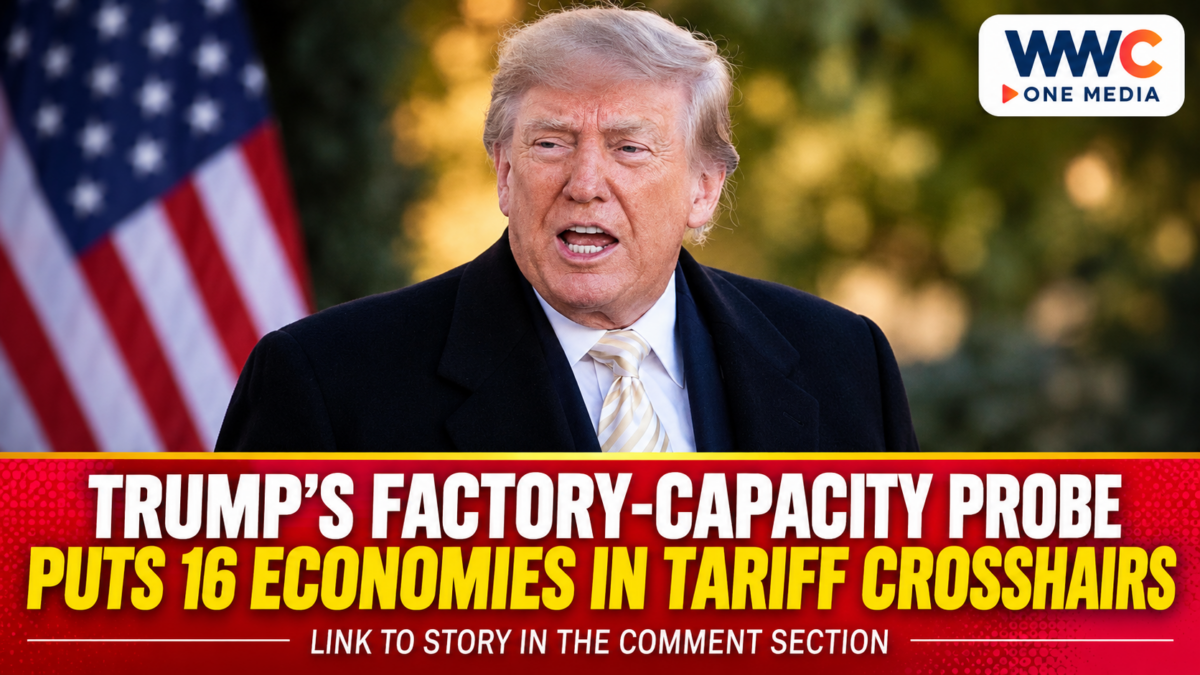
WASHINGTON, November 25, 2026 — President Donald Trump’s administration is moving deeper into a trade dispute over global manufacturing capacity, with 16 major trading partners facing a US investigation that could eventually lead to additional import duties.
The investigation, conducted under Section 301 of the Trade Act of 1974, examines whether manufacturing policies and production practices in economies including China, Japan, South Korea, India, Vietnam, Indonesia, Malaysia and Thailand create structural excess capacity that disadvantages American industries.
The European Union, Singapore, Switzerland, Norway, Cambodia, Taiwan, Bangladesh and Mexico are also included.
The investigation puts a wide range of international manufacturers and exporters under scrutiny. But one distinction matters for businesses and investors: the opening of a trade investigation is not the same as the imposition of a tariff.
As of November 25, the publicly available US trade records reviewed for this report establish that the investigation was launched, consultations were requested and public hearings were held. They do not establish a final tariff schedule or a new duty rate resulting from this particular investigation.
That leaves companies operating across Asia, Europe and North America facing a familiar problem: preparing for possible changes in market access without knowing which products, countries or tariff rates might ultimately be affected.
WHY WASHINGTON IS TARGETING EXCESS FACTORY CAPACITY
The Trump administration argues that some trading partners have built manufacturing capacity beyond what domestic and international demand can absorb.
In its March 2026 investigation notice, the Office of the United States Trade Representative described structural excess capacity as industrial production capacity maintained beyond market demand, including through government interventions and policies that encourage businesses to continue expanding or retaining underused facilities.
Washington argues that this can produce more goods than domestic markets can consume, leading manufacturers to depend heavily on exports.
The administration’s concerns include subsidies, subsidised lending, state-owned or state-controlled enterprises, market-access barriers and policies that encourage production and exports beyond normal market incentives.
These are the US government’s allegations and investigative criteria. They are not findings that every economy named in the investigation has violated international trade rules.
The distinction is important because manufacturing capacity is not automatically evidence of unfair trade. A country may produce more because it has competitive costs, specialised technology, established supply chains or stronger international demand.
The investigation is intended to examine whether particular government policies and practices create conditions that Washington considers unreasonable or discriminatory and that burden US commerce.
WHICH ECONOMIES ARE UNDER INVESTIGATION?
The US investigation covers 16 economies or trading jurisdictions:
- China
- European Union
- Singapore
- Switzerland
- Norway
- Indonesia
- Malaysia
- Cambodia
- Thailand
- Korea
- Vietnam
- Taiwan
- Bangladesh
- Mexico
- Japan
- India
The geographic reach is significant. It includes major industrial producers, advanced technology centres, export-oriented manufacturing economies and countries increasingly integrated into international supply chains.
For Asian manufacturers, the inclusion of China, Japan, South Korea, India and several Southeast Asian economies is particularly consequential.
The investigation also raises questions for businesses that manufacture components in one country, assemble products in another and export finished goods to the United States.
A company may have no direct factory in China, for example, but still rely on Chinese materials, components, machinery or intermediate products. Any future change in US import duties could therefore influence supply-chain decisions beyond the country directly targeted.
AUTOMOBILES, BATTERIES, STEEL AND SEMICONDUCTORS IN THE SPOTLIGHT
The investigation notice identifies a broad range of manufacturing sectors that could be examined.
These include:
- Automobiles and automotive components
- Batteries and energy-related products
- Steel and aluminium
- Semiconductors and electronics
- Solar modules
- Industrial machinery and machine tools
- Chemicals, plastics and non-ferrous metals
- Robotics and transportation equipment
- Ships and other industrial products
The sectors matter because they sit at the centre of modern industrial competition.
Automotive manufacturing, for example, increasingly depends on batteries, semiconductors, electronics and specialised materials. A tariff affecting one component can influence the cost of producing an entire vehicle.
The same applies to solar equipment, industrial machinery and electronics. Their supply chains often cross multiple borders before a finished product reaches its final market.
The US investigation therefore goes beyond a dispute over individual imported products. It examines how industrial policies, production decisions and export patterns interact across global manufacturing networks.
SECTION 301: HOW THE INVESTIGATION COULD LEAD TO TARIFFS
Section 301 gives the US Trade Representative authority to investigate foreign government practices that may be unreasonable, discriminatory or harmful to US commerce.
If the investigation produces the required determination, the law provides several possible responses. These can include additional duties, other import restrictions, suspension of trade concessions or negotiated arrangements intended to address the practices under investigation.
That does not mean the administration can simply announce a tariff rate without completing the relevant process.
The March 2026 notice initiated the investigation and invited public comments. The administration also requested consultations with the economies concerned.
Public hearings were scheduled for May 5 through May 8, 2026, giving interested parties an opportunity to present evidence and arguments.
The law also allows the United States to consider negotiated solutions rather than relying exclusively on tariffs.
For companies, this is the stage at which the details matter most. A final action would need to identify the relevant legal basis, affected economies or products, applicable rates and implementation timetable.
Until those details are published, businesses cannot reliably calculate the additional costs that might apply to specific shipments.
THE SUPREME COURT RULING ADDS ANOTHER LAYER TO TRUMP’S TARIFF STRATEGY
The Section 301 investigation is unfolding against a complicated legal background.
On February 20, 2026, the US Supreme Court ruled in Learning Resources, Inc. v. Trump that the International Emergency Economic Powers Act, or IEEPA, does not authorise the president to impose tariffs.
The ruling was significant because the administration had relied on IEEPA for broad tariff measures.
But the decision did not eliminate every legal authority available to the US government for imposing import duties.
Section 301 is a separate provision of the Trade Act of 1974. Other trade laws also provide specific authorities for certain import restrictions and duties.
That distinction helps explain why the administration is pursuing investigations under trade statutes with their own procedures and requirements.
It also means that any new duties resulting from this investigation would need to be assessed under the applicable legal authority rather than automatically treated as a continuation of the tariffs addressed by the Supreme Court.
CHINA IS CENTRAL TO THE DISPUTE — BUT THE INVESTIGATION IS MUCH WIDER
China occupies a central position in Washington’s concerns over global manufacturing capacity.
The US investigation notice identifies Chinese production and export patterns across sectors including electronics, machinery, automobiles, plastics, steel and other manufactured goods.
The administration argues that large production capacity, combined with weak domestic absorption and strong export activity, can place pressure on competing manufacturers in the United States and other markets.
Beijing has rejected accusations that its exports reflect unfair production practices, maintaining that its manufacturing strength is based on competitiveness.
The broader dispute is not limited to China. The inclusion of Japan, South Korea, India, Vietnam, Indonesia, Malaysia and other economies shows that Washington is examining manufacturing policies across a much wider group of trading partners.
That creates a delicate position for countries that maintain extensive commercial relationships with both the United States and China.
WWC has previously examined the continuing uncertainty surrounding the US-China trade agreement, critical minerals and agricultural commitments.
TRADE PARTNERS HAVE ALSO BEEN DISCUSSING A RESPONSE TO GLOBAL OVERCAPACITY
The dispute is taking place alongside a separate international effort to address concerns about excess manufacturing capacity.
On October 7, 2026, the United States Trade Representative announced that 14 economies had joined the United States in signing a joint ministerial statement addressing global excess capacity and production in key manufacturing sectors.
That development shows that concern about industrial overcapacity is not confined to Washington’s tariff investigation.
However, international cooperation on the issue should not be confused with agreement to impose US tariffs. The ministerial statement and the Section 301 investigation are separate policy processes.
The wider debate also intersects with the Asia-Pacific Economic Cooperation agenda, where leaders and businesses have continued discussing trade openness, supply-chain resilience and regional economic integration.
Chinese President Xi Jinping’s recent APEC remarks warning against protectionism provide another perspective on the competing approaches to international trade.
The challenge for regional economies is balancing industrial development and domestic manufacturing objectives with predictable access to international markets.
WHAT BUSINESSES SHOULD WATCH NEXT
For exporters, manufacturers and investors, the most important development will be the publication of an actual determination and any proposed or final trade action.
Several questions remain unanswered:
Which products could face additional duties? The investigation covers numerous manufacturing sectors, but a final product-level tariff schedule has not been established in the official records reviewed.
Will the administration set different rates for different economies? No final rates arising from this investigation have been confirmed in the reviewed public records.
Will existing trade arrangements affect the outcome? The investigation may interact with negotiated trade commitments, but companies should not assume that an existing agreement automatically guarantees an exemption from every future measure.
Will negotiations prevent additional tariffs? Section 301 provides options beyond import duties, including negotiated arrangements. Whether those options are used will depend on the administration’s eventual findings and decisions.
The ongoing Trump-Xi trade discussions show why businesses need to distinguish diplomatic commitments from enforceable customs rules.
A political announcement may signal a change in direction. Only the relevant legal instrument, published tariff schedule and effective date can establish what importers must actually pay.
For now, Trump’s manufacturing investigation has placed 16 major trading partners under scrutiny. Whether it becomes another round of tariff escalation will depend on what Washington formally determines — and whether the affected economies can negotiate a different outcome before new duties take effect.