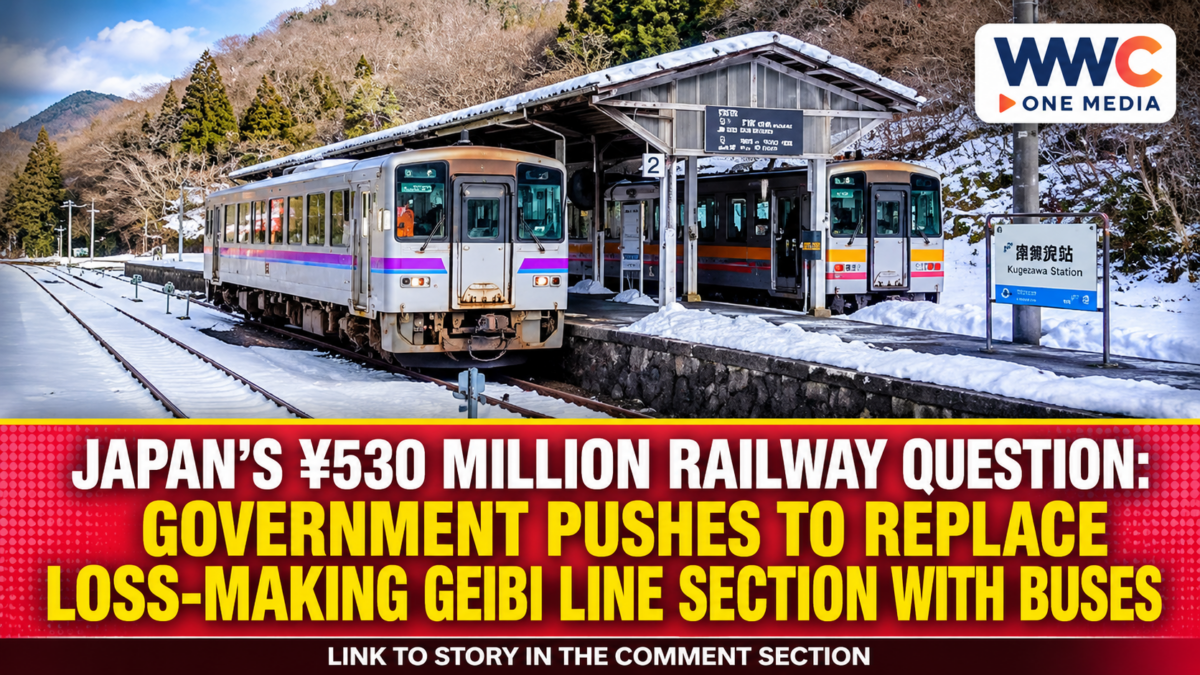
OKAYAMA / HIROSHIMA, Japan — November 25, 2026 — One of Japan’s most closely watched rural railway debates has reached a turning point after a government-led council proposed replacing a 68.5-kilometre section of the Geibi Line with a bus-centred transport network.
The proposal covers the section between Bitchu-Kojiro Station in Niimi City, Okayama Prefecture, and Bingo-Shobara Station in Shobara City, Hiroshima Prefecture. The line is operated by West Japan Railway Co., commonly known as JR West.
The financial argument is difficult to ignore.
A draft reconstruction policy presented on November 24 estimates that maintaining the railway-based option would require approximately ¥740 million in annual operating costs. A bus-based alternative is estimated to cost approximately ¥210 million annually.
That would create a projected annual operating-cost difference of approximately ¥530 million.
But the proposal is not yet a final closure decision. The document is a draft presented by the Chugoku District Transport Bureau, and it explicitly states that the participating members have not collectively agreed to its contents. Further discussions are expected before the council targets a final reconstruction policy in March 2027.
The debate now centres on a difficult question: can Japan preserve essential transport access in shrinking rural communities without continuing to spend heavily on railway infrastructure that carries relatively few passengers?
Why Japan is considering replacing part of the Geibi Line
The Geibi Line connects communities across Okayama and Hiroshima prefectures. The section under review covers approximately 68.5 kilometres between Bitchu-Kojiro and Bingo-Shobara.
JR West requested the establishment of a reconstruction council in October 2023. The Chugoku District Transport Bureau formally decided to establish the council in January 2024 after hearing from the local governments concerned.
The council brings together national and local authorities, JR West and other relevant participants to examine the future of the railway and the transport services needed by communities along the route.
The discussions have included railway improvements, bus trials, tourism initiatives and alternative transport arrangements.
Rather than making a decision based solely on the railway’s financial performance, the council has compared the two transport options using operating costs, passenger benefits, economic effects, community needs, staffing requirements and resilience during natural disasters.
The November 24 draft represents the clearest direction yet from the national government: a bus-based transport system should become the central option for the section.
The ¥530 million annual cost difference
The proposed financial comparison is one of the strongest arguments behind the recommendation.
Under the railway-based reconstruction scenario, the estimated requirements are:
- Initial investment: approximately ¥1.11 billion to ¥1.51 billion
- Annual operating costs: approximately ¥740 million
- Estimated local-government share of initial investment: approximately ¥370 million to ¥780 million
- Estimated annual local-government operating burden: approximately ¥500 million to ¥740 million
Under the bus-based reconstruction scenario, the estimates are:
- Initial investment: approximately ¥20 million
- Annual operating costs: approximately ¥210 million
- Estimated local-government share of initial investment: approximately ¥10 million
- Estimated annual local-government operating burden: approximately ¥150 million
The annual operating-cost difference is therefore approximately ¥530 million.
These are estimates for the proposed reconstruction scenarios, not confirmed future budget allocations or money already saved.
The comparison also illustrates why the issue is bigger than ticket revenue. Railways require tracks, stations, signalling and other infrastructure to be maintained even when passenger numbers are low. A bus system can use existing roads and adjust its routes and stops more flexibly.
For local authorities facing population decline and competing demands for public spending, the difference could influence decisions about the long-term structure of regional transport.
Passenger numbers show the scale of the challenge
JR West’s published passenger-density figures show how sharply demand varies across the Geibi Line.
For fiscal 2025, the average number of passengers per day per kilometre was:
- Bitchu-Kojiro to Tojo: 83
- Tojo to Bingo-Ochiai: 25
- Bingo-Ochiai to Bingo-Shobara: 89
The Tojo-to-Bingo-Ochiai section recorded the lowest figure, at just 25 passengers per day per kilometre.
This measure, known as average transport density, is not the total number of passengers travelling on the entire line. It represents the average number of passengers carried per kilometre each day.
The figure helps explain why the railway’s weakest sections have become difficult to sustain financially.
The government’s draft also describes a longer-term decline in demand. In 2023, average transport density across the 68.5-kilometre special section was 62 passengers per day per kilometre. The document says railway use had fallen by 84% between 1990 and 2023, while the population decline in the area over the same period was 38%.
That gap points to a transport network whose passenger demand has weakened faster than the communities it serves have lost residents.
The government says buses could protect everyday mobility
The proposed shift is not simply about removing trains and leaving residents without an alternative.
The draft envisions a more flexible transport network that would connect the main communities while providing additional services for students, older residents and people travelling to hospitals, shops and other essential destinations.
Buses could use routes closer to schools, medical facilities and commercial areas, reducing the need for some passengers to walk long distances from railway stations.
The proposed system also includes consideration of demand-responsive transport and shared taxis in areas where passenger demand is particularly low.
The objective is to create a network that can connect residents to major transport hubs while improving access to daily services.
A bus-based system could also be more flexible during severe weather. The draft notes that buses can sometimes use alternative roads when railway operations are disrupted by natural disasters.
However, the proposal depends on more than purchasing buses. Local authorities and transport operators would still need enough drivers, reliable schedules, suitable routes and connections to existing services.
The government’s assessment recognises that securing transport workers remains a serious challenge for both railway and bus operators.
The railway still has advantages that buses cannot easily replace
The draft does not conclude that buses are better in every category.
Its comparison identifies several areas where the railway performs better, particularly in economic and community value.
For estimated benefits to passengers, the railway option was calculated at approximately ¥48 million annually, compared with ¥50 million for the bus option. The two were considered broadly comparable.
But the railway performed better in several other assessments.
The estimated annual benefit from reducing the burden on people who drive passengers to transport services was ¥10 million for rail, compared with ¥6 million for buses.
The estimated economic effect from residents’ spending was ¥134 million for rail and ¥115 million for buses.
The largest difference in the visitor-spending assessment was ¥93 million for rail, compared with ¥31 million for buses.
The draft attributes the railway’s advantage in tourism partly to the appeal of its historic stations, rural scenery and the railway journey itself. Some visitors travel because of the train experience, rather than simply because they need to reach a destination.
That is a value that a conventional bus service may struggle to reproduce.
The railway also carries symbolic importance for communities that have grown around the stations and the route. Its history, scenery and role in local identity are recognised in the government’s assessment.
The policy challenge is therefore not to deny the railway’s value. It is to determine whether that value can justify the significantly higher projected costs of maintaining the rail-based system.
Population decline could make the decision harder
The communities along the Geibi Line face a demographic challenge that extends beyond transport.
The draft estimates that the combined population of Niimi and Shobara could decline from approximately 62,000 in 2020 to 50,000 in 2030 and 33,000 in 2050.
That would represent a projected decline of approximately 47% from the 2020 level by 2050.
An ageing population also increases the importance of transport services for people who cannot drive.
For students, older residents and people who need regular medical appointments, public transport can determine whether they can continue living independently in their communities.
This is why the proposed bus system must be assessed on its actual ability to serve residents, not simply on its lower operating cost.
A cheaper service that does not connect people to schools, hospitals and essential shopping areas would not necessarily solve the region’s transport problem.
The draft therefore calls for buses to be coordinated with local transport services, including demand-responsive vehicles and shared taxis, rather than treated as a simple one-for-one replacement for trains.
Japan is facing similar pressure on other rural railway networks
The Geibi Line debate reflects a wider issue facing regional transport operators in Japan.
JR Hokkaido, for example, has been trying to find ways to maintain eight loss-making railway sections while negotiating with local governments and the national government over who should bear infrastructure costs.
The difficulties are not identical, but the central question is familiar: how should Japan pay for railway networks when local passenger demand is no longer sufficient to support their maintenance?
WWC ONE MEDIA previously examined JR Hokkaido’s decision to withdraw its controversial cost-sharing proposal for eight loss-making railway sections. That case illustrates how difficult it can be to transfer railway infrastructure costs to local communities without a broader agreement.
Japan’s railway sector is also not a single business model. Major private railway groups such as Hankyu Hanshin combine passenger transport with property, hotels and other commercial activities. Their diversified businesses provide a different financial structure from rural routes that depend heavily on local passenger demand.
The wider commercial pressures facing Japan’s railway and property conglomerates show how much the economics of rail transport can differ between dense urban networks and less populated regions.
The debate also comes at a time when Japan continues to export railway technology and participate in major infrastructure projects elsewhere in Asia. The disagreement over technology and control in India’s Japan-backed bullet train project demonstrates another side of the railway industry: large-scale investment in high-speed rail can coexist with difficult decisions over the viability of local services.
What happens before the March 2027 decision?
The November 24 document is a draft policy outline, not the final reconstruction decision.
The document itself says that it reflects discussions and investigations through November, but that the participating members have not collectively agreed to it. It also says the draft does not determine the final direction of the policy.
Further discussions are expected to examine the details, including how the proposed bus-based network would operate and how local transport services would connect.
The target is to establish the reconstruction policy in March 2027.
If the bus-based direction is ultimately adopted, the next stage will involve determining the implementation arrangements, transport operators, service structure, funding and timing.
The draft also recognises that the transition must preserve cross-prefecture travel between Okayama and Hiroshima, including access to major transport hubs and regional destinations.
That means the final plan will need to address more than the railway itself. It will need to establish how people move between communities after any change in transport mode.
The real test is whether rural communities remain connected
Japan’s Geibi Line debate captures the difficult economics of maintaining public transport in regions where populations are shrinking and infrastructure costs remain high.
The projected ¥530 million annual operating-cost difference gives the bus proposal a powerful financial argument. The government’s assessment also finds that buses can provide comparable benefits for many everyday journeys while offering more flexibility in routes and disaster response.
But the same assessment recognises that the railway contributes to tourism, local spending, community identity and the region’s appeal to visitors.
The final decision will have consequences beyond the railway’s operating budget. It will shape how students reach school, how older residents access medical services, how tourists explore the area and how communities stay connected across the prefectural border.
The question is no longer simply whether the Geibi Line can continue operating in its present form.
It is whether Japan can build a transport system that costs less to maintain without stripping rural communities of the connections they need to survive.