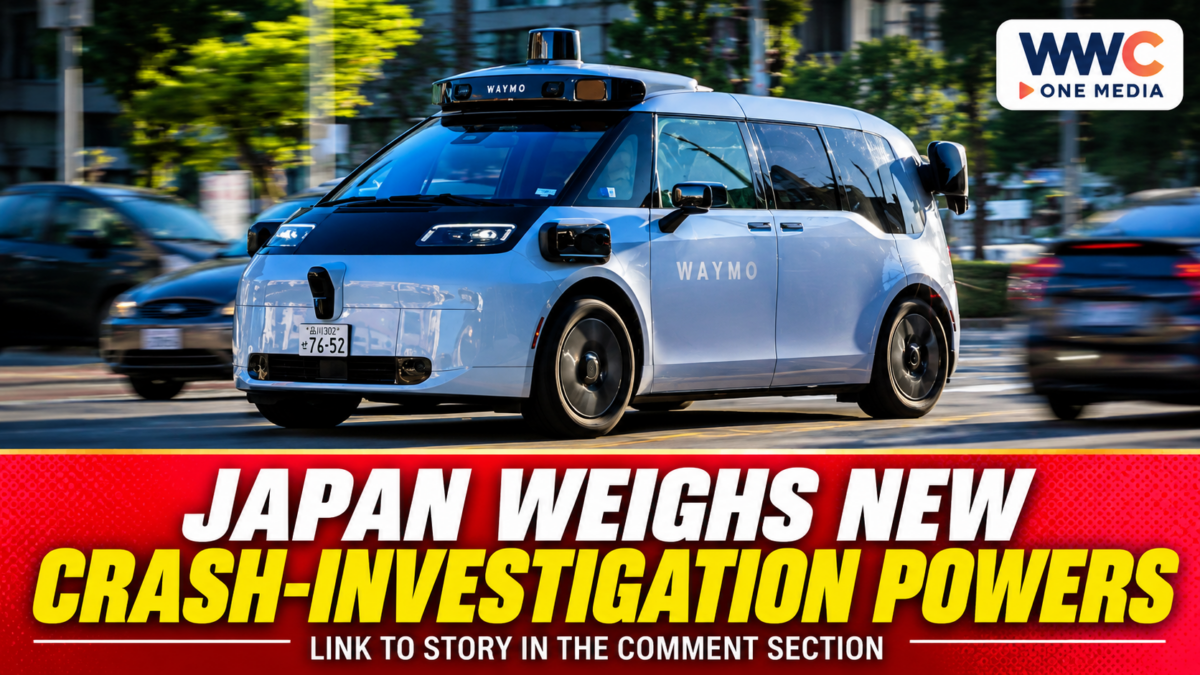
TOKYO, Japan — November 25, 2026 — Japan is considering giving its national transport accident investigation system a greater role in examining serious incidents involving self-driving vehicles, as the country prepares for the arrival of fully driverless commercial taxis.
The proposed reform would allow the Japan Transport Safety Board (JTSB) to investigate selected accidents and serious incidents involving Level 4 autonomous vehicles. It could give authorities a more specialised way to examine what went wrong when a vehicle operating without a human driver makes a dangerous manoeuvre, stops unexpectedly or becomes involved in a collision.
The timing is significant. Waymo, Japanese ride-hailing operator GO and taxi company Nihon Kotsu are preparing for a commercial Level 4 driverless taxi service in Tokyo in 2027.
However, the legal change is not yet an enacted law. Japan’s transport ministry has published a policy document outlining possible measures, while the government’s broader regulatory reform plan calls for further examination of the investigation framework and a conclusion within fiscal 2026.
The question now is whether Japan can strengthen accountability and accident prevention before driverless taxis become a more visible part of its transport network.
Japan’s transport safety board could gain a new role
The JTSB is an independent national body under the Ministry of Land, Infrastructure, Transport and Tourism. Under its existing legal mandate, it investigates accidents involving aircraft, railways and ships.
Road vehicle accidents are not currently listed among the categories covered by the JTSB’s establishing law.
That is the gap the proposed reform seeks to address.
A transport ministry policy document dated November 4 outlines a possible system in which operators of Level 4 autonomous vehicles would be required to report specified accidents and incidents to the ministry.
The ministry would review the reports and notify the JTSB about cases considered serious enough to require specialised investigation.
The proposed arrangement would not automatically send every minor traffic incident involving an autonomous vehicle to the board. Instead, it would create a process for identifying cases where an independent technical investigation could help prevent similar incidents.
The distinction matters because an autonomous vehicle accident may involve more than conventional driving errors. Investigators may need to examine the vehicle’s sensors, software, automated decision-making, system limitations, operating conditions and the actions of the company responsible for the service.
What kinds of driverless-car incidents could be investigated?
The ministry’s draft identifies several examples of incidents that could fall within a reporting framework.
These include:
- Collisions involving pedestrians or other vehicles
- Collisions involving trains
- Impacts with structures or other objects
- Vehicles falling or overturning
- Vehicle fires
- Unexpected shutdowns of automated driving systems
- Abnormally rapid acceleration
The document proposes that the vehicle operator, such as a taxi company, could be responsible for reporting relevant incidents to the Ministry of Land, Infrastructure, Transport and Tourism.
The ministry would then determine whether an incident requires further technical investigation and should be referred to the JTSB.
This approach is important because a driverless vehicle does not have a human driver who can provide a conventional account of what happened immediately before a crash. Investigators may need access to system records, vehicle data and technical information held by the operator or technology provider.
The proposed framework is intended to improve the collection of information, identify technical causes and support measures that could prevent similar incidents.
The precise reporting requirements and investigation procedures remain subject to further policy and legal development.
The proposal currently focuses on Level 4 vehicles
The distinction between different levels of driving automation is central to understanding the proposed changes.
Under Level 3 automation, the system can perform driving tasks under specified conditions, but a human driver must be ready to take control when the system requests intervention.
Level 4 is different. Within its designated operating conditions, the automated driving system performs the driving task without requiring a human driver to take over.
Japan already has a legal framework for Level 4 operations. Amendments to the Road Traffic Act established a permission system for specified automated operations, with the relevant provisions taking effect in April 2023.
The new proposal is therefore not Japan’s first attempt to regulate driverless vehicles. It is an effort to strengthen what happens after a serious incident.
One important qualification: the transport ministry’s November proposal specifically describes a reporting and investigation framework for Level 4 autonomous vehicles. It should not be presented as a final decision to place every Level 3 and Level 4 vehicle accident under JTSB investigation.
That scope may be reviewed as autonomous technology becomes more widely deployed.
Waymo, GO and Nihon Kotsu are preparing for Tokyo’s driverless taxi launch
The proposed investigation framework is emerging as Japan prepares for a major commercial test of autonomous transportation.
In September, Waymo, GO and Nihon Kotsu announced their intention to pursue Japan’s first commercial taxi service using Level 4 fully driverless operation in Tokyo during 2027.
The three companies have been preparing for the introduction of the service and discussing its commercialisation with Japan’s transport authorities.
Waymo brings autonomous-driving technology and operating experience from the United States. GO operates a major Japanese taxi-hailing platform, while Nihon Kotsu brings experience in the country’s taxi industry.
Japan’s transport ministry has described the initiative as an important step toward putting autonomous mobility into practical use.
The government has also set a target of introducing 10,000 autonomous service vehicles across buses, taxis and trucks by fiscal 2030.
That target reflects a wider policy objective: using automated transportation to address driver shortages, maintain local transport services and improve mobility in areas where conventional public transport is difficult to sustain.
But commercial expansion also raises a difficult question. If a vehicle operating without a human driver causes a serious accident, who has the technical authority and access needed to establish what happened?
Why independent investigations matter
A serious autonomous-vehicle incident can involve several layers of responsibility.
The vehicle manufacturer may be responsible for the underlying vehicle design. A technology provider may develop the automated driving system. A taxi operator may manage the vehicle’s daily service, maintenance and operating conditions.
An investigation may therefore need to examine whether the vehicle behaved as designed, whether its sensors correctly interpreted the road environment, whether the software responded appropriately and whether the operator followed required procedures.
The JTSB proposal could help establish a more specialised process for examining these technical questions.
It is also important to distinguish an accident investigation from a criminal investigation or a civil compensation dispute. The proposed JTSB role is focused on identifying causes and supporting the prevention of future incidents. It does not, by itself, settle every question about legal liability or who must compensate an injured person.
That distinction will become increasingly important as autonomous services involve more companies, software suppliers and vehicle operators.
The wider autonomous-driving industry is already confronting these questions. Singapore’s experience with a driverless vehicle near-miss involving a schoolgirl in Punggol illustrates why regulators need to examine how automated systems detect and respond to vulnerable road users.
Autonomous transport is expanding across Asia
Japan is not developing its driverless transport framework in isolation.
Singapore is expanding its autonomous mobility operations, with Grab preparing to increase its fleet as the country develops new services and operating models. Its plans show how quickly autonomous vehicles can move from controlled trials toward public transport applications.
The expansion also makes clear that deployment requires more than vehicles that can navigate roads. Regulators must consider passenger safety, road-user protection, operational supervision and procedures for dealing with unexpected events.
The experience of Grab’s planned expansion of its Singapore autonomous vehicle fleet offers another regional example of the growing scale of driverless transport.
Technology suppliers are also working to improve the sensors and data systems that help automated vehicles interpret their surroundings. LG Innotek’s autonomous-driving data collection vehicles in South Korea demonstrate how companies are using real-world driving conditions to develop and evaluate sensing technology.
Japan’s wider investment in robotics and automation, including the push to bring humanoid robots into factories and logistics operations, reflects the same industrial challenge: new automated systems must prove that they can operate reliably outside controlled demonstrations.
For autonomous vehicles, the consequences of failure can be especially serious because the technology shares public roads with pedestrians, cyclists, conventional vehicles and public transport.
What happens next?
The government’s regulatory reform plan calls for Japan to continue examining how the JTSB could investigate autonomous-vehicle accidents, with a conclusion targeted within fiscal 2026. It also says legislation should be submitted promptly if necessary.
The transport ministry’s November 4 document provides a more concrete outline of the possible framework, including operator reporting duties, ministry review and referral of serious incidents to the JTSB.
But the document presents proposed directions for further consideration, not a final law.
The coming legislative process will determine the final scope of the JTSB’s authority, which incidents must be reported, how investigations will be conducted and when any new requirements will take effect.
Japan’s planned 2027 Tokyo driverless taxi service gives the debate a practical deadline. The country is preparing to place more automated vehicles on public roads, but its investigation and safety systems must be ready to respond when technology does not perform as expected.
The central issue is no longer simply whether a car can drive without a human behind the wheel. It is whether authorities can independently establish why something went wrong—and use that evidence to make the next journey safer.