
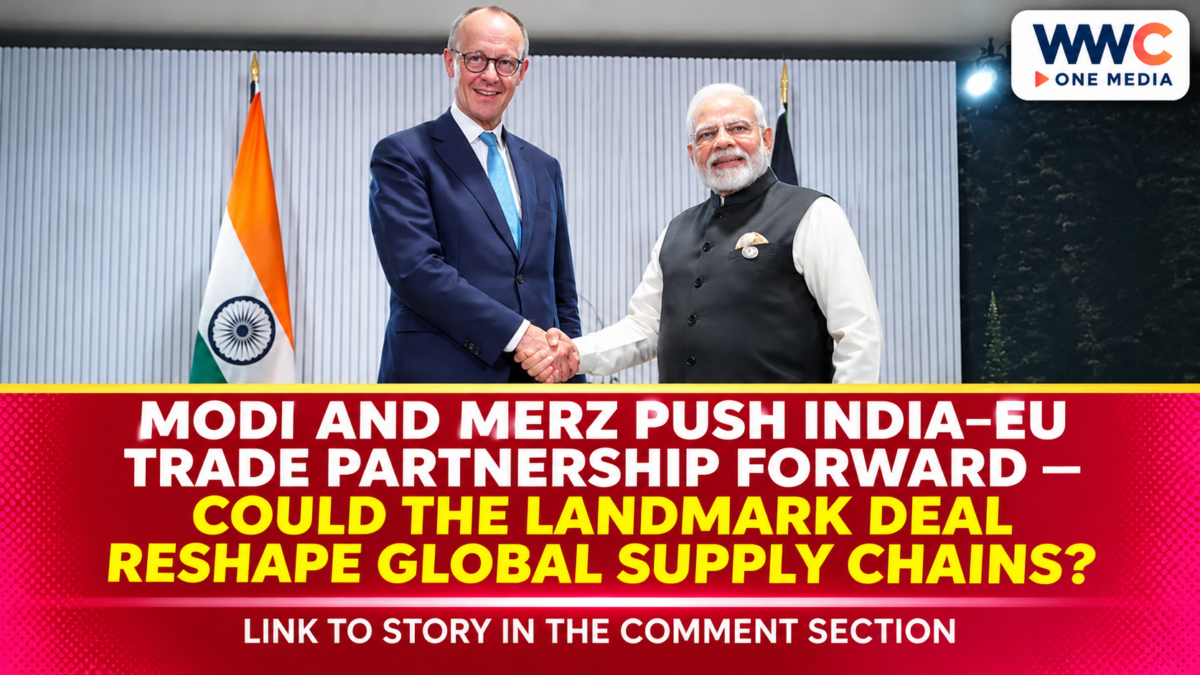
NEW DELHI, INDIA — India and Germany are strengthening their economic and strategic partnership as the proposed free trade agreement between India and the European Union moves towards its final approval stages, potentially opening significant commercial opportunities for manufacturers, exporters and investors.
Indian Prime Minister Narendra Modi and German Chancellor Friedrich Merz discussed the agreement during a telephone conversation on Nov. 24, 2026, alongside cooperation in defence, advanced technologies and international affairs.
The India–EU free trade agreement represents a significant development in an economic relationship that generated €118 billion in bilateral goods trade in 2025.
With trade negotiations already concluded on Jan. 27, 2026, attention is shifting towards formal approval and implementation.
For international businesses, the bigger question is whether the agreement could reshape manufacturing decisions, investment flows and global supply chains.
India–EU free trade agreement enters a decisive phase
India and the European Union have been pursuing a comprehensive trade agreement for nearly two decades.
Negotiations initially began in 2007, were suspended in 2013 and subsequently relaunched in 2022.
The conclusion of negotiations in January 2026 marked a substantial breakthrough in efforts to improve commercial access between the two economies.
On Sept. 11, 2026, the European Commission submitted proposals to the Council of the European Union seeking authorisation for the agreement’s signature and conclusion.
However, the completion of negotiations does not automatically introduce preferential tariffs.
The agreement must still undergo the necessary legal and institutional approval procedures before becoming enforceable.
For manufacturers and exporters, this distinction is particularly important. Businesses cannot assume that negotiated tariff concessions are already available when calculating import expenses or negotiating international contracts.
Similar implementation challenges feature in WWC ONE MEDIA’s coverage of India’s Scotch whisky tariff concessions and customs classification concerns.
The commercial value of a trade agreement ultimately depends on how its provisions are implemented.
A €118 billion trading relationship with room for expansion
India and the European Union already maintain a substantial economic relationship.
The latest published European trade statistics provide the following benchmarks:
| Economic indicator | Reported figure |
|---|---|
| Bilateral goods trade in 2025 | €118 billion |
| EU share of India’s total goods trade | 11.1% |
| India’s share of EU goods trade | 2.3% |
| Bilateral goods trade growth over the past decade | 83.7% |
| Bilateral services trade in 2024 | €67 billion |
| EU services exports to India in 2024 | €29 billion |
The European Union was India’s third-largest goods trading partner in 2025, while India ranked ninth among the EU’s goods trading partners.
This difference illustrates the potential for further expansion in bilateral economic activity.
India’s major exports to Europe include chemicals, machinery, textiles, mineral products and base metals.
European exports to India include industrial equipment, transport equipment, chemicals, medical instruments and optical products.
Lower trade barriers could strengthen commercial relationships across these industries, although actual growth will depend on market demand, production capacity and the final implementation of the agreement.
Why Germany could become an important beneficiary
Germany and India are commemorating 75 years of diplomatic relations in 2026.
During Chancellor Merz’s official visit to India in January, the two governments reaffirmed their support for the proposed India–EU trade agreement and stronger economic cooperation.
Their latest telephone conversation reinforces the importance of those objectives.
Germany’s commercial interests in India extend across manufacturing, technology and industrial development.
Improved market access could provide German businesses with opportunities to expand exports, establish new commercial partnerships and reconsider regional investment strategies.
Indian businesses could similarly benefit from improved access to European markets.
Nevertheless, tariff reductions do not guarantee increased profitability.
Companies must still consider transportation expenses, regulatory compliance, currency movements, consumer demand and competition from domestic suppliers.
The agreement could create favourable conditions for expansion, but individual commercial outcomes will depend on how effectively businesses respond to those opportunities.
Indian exporters could gain broader access to Europe
India’s Ministry of Commerce and Industry has identified preferential European market access as one of the principal benefits of the negotiated agreement.
The government’s January assessment indicates that more than 99% of Indian exports, measured by trade value, would receive preferential access to the European market under the agreement.
Labour-intensive industries such as textiles, leather products, marine products, gems and jewellery have been identified as potential beneficiaries.
These sectors are particularly relevant because export expansion could create opportunities for smaller enterprises and employment-intensive manufacturing businesses.
However, preferential access is not equivalent to immediate duty-free treatment for every product.
Certain tariff reductions may be introduced gradually, while qualifying goods must comply with applicable rules of origin and customs requirements.
The published agreement also contains provisions addressing market access, tariff schedules and origin procedures.
For exporters, preparing appropriate documentation and understanding product-specific requirements will be essential to obtaining the intended benefits.
Europe’s broader commercial engagement with Asian manufacturing economies is examined in WWC ONE MEDIA’s coverage of ASEAN–EU trade negotiations and regional business opportunities.
Agricultural protection remains part of the agreement
Despite its broad market-opening objectives, the proposed agreement retains protections for sensitive agricultural industries.
India has identified dairy, cereals, poultry and certain agricultural products among the sectors requiring safeguards.
The European Union also intends to retain existing tariffs on sensitive products, including beef, sugar, rice, chicken meat and milk powders.
These provisions demonstrate that free trade agreements do not necessarily eliminate every import restriction.
Governments must balance opportunities for exporters and consumers against the potential economic consequences for vulnerable domestic industries.
The agreement’s proposed bilateral safeguard mechanism could also allow action if imports create difficulties under the applicable conditions.
For agricultural producers, the final product-specific tariff schedules and safeguard provisions will be more important than broad announcements about liberalisation.
Could the agreement reshape global supply chains?
The India–EU agreement could become an important consideration for multinational companies evaluating manufacturing locations and export strategies.
Businesses may consider expanding supplier relationships or production facilities in India if the agreement improves access to European customers.
Such decisions will also depend on infrastructure quality, workforce capabilities, regulatory predictability and the ability to satisfy rules of origin.
European trade negotiations with other Asian economies create additional considerations for international investors.
These opportunities have previously been explored in WWC ONE MEDIA’s analysis of Thailand’s proposed free trade agreement with the European Union.
Meanwhile, continuing international tariff uncertainty reinforces the commercial importance of diversified markets, as examined in the US tariff investigation involving China, the European Union and other major trading economies.
The India–EU agreement could provide additional flexibility for businesses seeking diversified commercial relationships. However, it would not eliminate exposure to international trade disputes or guarantee the relocation of manufacturing operations.
What happens next?
The proposed free trade agreement must complete its remaining approval procedures.
These include European Council authorisation for signature, formal signing, European Parliament consent, the Council’s decision on conclusion and India’s own ratification requirements.
Separate negotiations concerning investment protection and geographical indications remain ongoing.
For businesses, the immediate priority should be understanding the negotiated provisions and preparing for possible changes without assuming that preferential tariffs are already enforceable.
The Modi–Merz conversation demonstrates continued political support for expanding economic cooperation.
The next major milestone will be the formal completion of the trade agreement’s legal procedures.
India and Europe have negotiated a substantial commercial framework. The bigger test will be whether it delivers measurable benefits for businesses, workers and consumers once implementation begins.
Frequently Asked Questions
What is the India–EU free trade agreement?
It is a negotiated agreement designed to reduce trade barriers and improve commercial access between India and the European Union.
Has the India–EU trade agreement entered into force?
Not yet, based on the official records examined as of Nov. 25, 2026. Negotiations concluded on Jan. 27, but formal approval and ratification procedures remain necessary.
How much trade takes place between India and the EU?
Bilateral goods trade reached €118 billion in 2025, while services trade amounted to €67 billion in 2024.
Which Indian industries could benefit?
Potential beneficiaries include textiles, leather products, marine products, gems and jewellery, manufacturing and other export-oriented industries, subject to applicable trade provisions.
Why did Narendra Modi and Friedrich Merz discuss the agreement?
The leaders discussed opportunities to expand India–Germany trade and investment alongside cooperation in defence, advanced technologies and international affairs.










