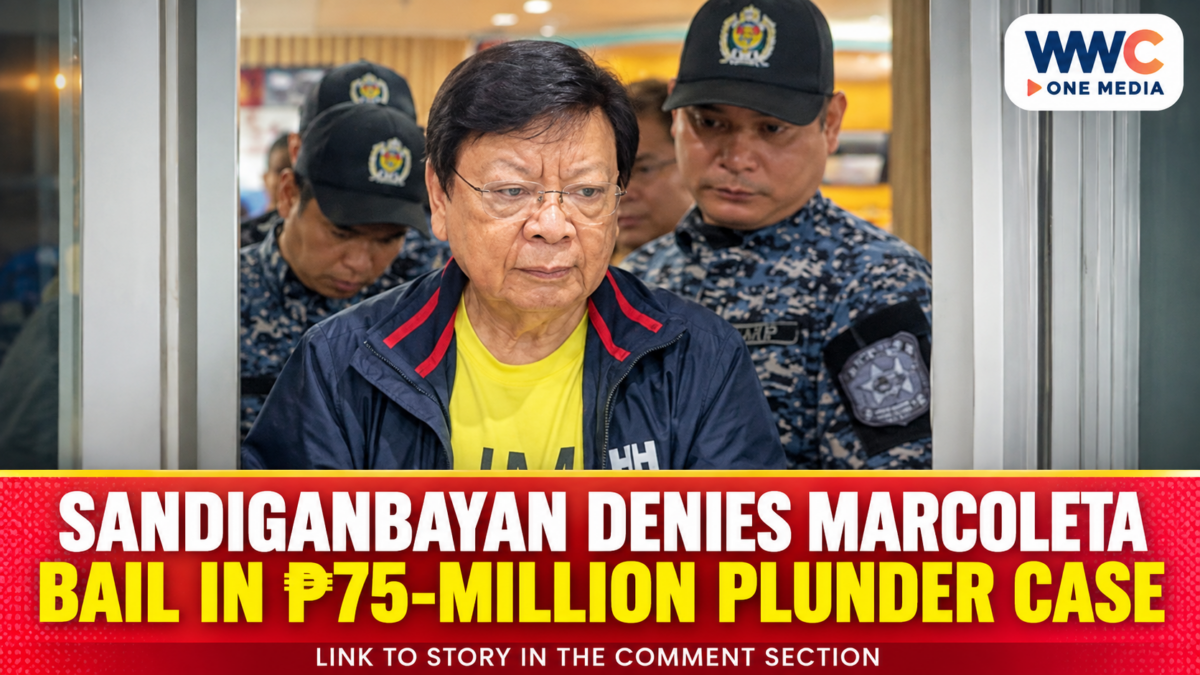
MANILA, Philippines — Senator Rodante Dizon Marcoleta and three co-accused will remain in detention after the Sandiganbayan Third Division rejected their bail petitions in a plunder case involving ₱75 million in alleged undeclared donations received in January 2025.
The ruling, promulgated on November 23, 2026, found the evidence of guilt against the four accused strong enough to deny bail while the criminal proceedings continue.
The decision covers Marcoleta, former lawmaker Michael Tan Defensor, and businessmen Aristotle Baluyut Viray and Joseph Varias Espiritu.
The case is docketed as Criminal Case No. E-SB-26-CRM-0018 and involves an alleged violation of Republic Act No. 7080, or the Anti-Plunder Act.
The denial of bail is a major procedural setback for the accused. It does not, however, amount to a final conviction or establish their criminal liability beyond reasonable doubt.
How the ₱75-million donations became the center of the case
The prosecution’s allegations involve three separate transfers made to Marcoleta in January 2025, when he was still a representative of the SAGIP party-list in the House of Representatives.
The amounts identified in the criminal information are:
- ₱30 million allegedly received from Michael Tan Defensor on January 6, 2025
- ₱25 million allegedly received from Joseph Varias Espiritu on January 8, 2025
- ₱20 million allegedly received from Aristotle Baluyut Viray on January 9, 2025
The total alleged amount is ₱75 million.
The prosecution’s theory is that the money constituted personal gifts or donations received by reason of Marcoleta’s public position and that the transactions formed part of a series of acts alleged to constitute plunder.
The Sandiganbayan’s October 19 resolution confirmed that these amounts and allegations were contained in the criminal information. At that stage, the court ruled that the charges sufficiently alleged the elements of the offenses and could proceed to trial.
That earlier ruling addressed the legal sufficiency of the charges, not whether the prosecution had already proved guilt.
Why the court rejected the bail petitions
The central issue in the November 23 ruling was whether the evidence of guilt was strong enough to justify denying bail.
In plunder cases, bail is not automatically available when the prosecution establishes strong evidence of guilt. The court must evaluate the evidence presented for that purpose.
The Third Division found the evidence against Marcoleta and his three co-accused strong.
The court’s reported findings focused on the nature of the three transfers, their timing, the treatment of the money in financial and election-related disclosures, and the relationship between Marcoleta and the alleged donors.
One major issue was the classification of the ₱75 million. The court examined the distinction between describing the money as campaign contributions and treating it as personal funds in proceedings before the Commission on Elections.
The payment of donor’s taxes also became relevant to the court’s assessment of whether the transfers qualified as electoral contributions or gifts received by reason of public office.
The court’s reported reasoning treated the three transfers as separate acts rather than simply viewing them as one combined donation.
These findings formed part of the bail determination. They must not be presented as a final judgment that the accused committed plunder.
What the law says about plunder
Republic Act No. 7080 defines plunder as the acquisition of ill-gotten wealth by a public officer, personally or in connivance with others, through a combination or series of specified overt or criminal acts.
The law sets a minimum aggregate amount of ₱50 million for the offense.
The alleged ₱75-million total in the Marcoleta case exceeds that statutory threshold. However, exceeding the amount alone does not establish guilt. Prosecutors must still prove the required elements of the offense and the accused persons’ participation beyond reasonable doubt.
The case also includes a separate charge under Presidential Decree No. 46 involving Marcoleta and Espiritu. That case is docketed as E-SB-26-CRM-0020.
The October court resolution identifies both cases and records that Marcoleta pleaded not guilty when arraigned on July 22, 2026.
A separate legal consequence: Marcoleta’s 90-day suspension
The bail ruling comes after another significant Sandiganbayan action.
On October 19, 2026, the Third Division ordered Marcoleta preventively suspended from his position as senator and from any other public office he might hold for 90 days from receipt of the resolution.
The court relied on Section 5 of the Anti-Plunder Act and the applicable provisions on preventive suspension.
The suspension is a procedural measure while the criminal case is pending. It is not a final determination of guilt.
The court’s October resolution also explained that the plunder and gift-related cases could proceed independently of election-related proceedings before the Commission on Elections.
The developments have placed the case among the closely watched anti-graft proceedings involving a sitting member of the Philippine Senate.
WWC ONE MEDIA previously examined Marcoleta’s 90-day preventive suspension and the legal consequences of the plunder charges. The publication also covered the Sandiganbayan’s earlier decision granting him a one-day medical furlough, a separate matter that did not resolve his bail petition.
The case is not over
The denial of bail means Marcoleta, Defensor, Viray and Espiritu do not obtain release through the petitions rejected by the Third Division.
But the criminal proceedings remain active. The prosecution must still establish its case, and the accused retain the right to challenge the evidence and present their defenses.
The ruling also needs to be distinguished from the separate motions for leave to file a demurrer to evidence. Those motions seek permission to argue that the prosecution’s evidence is insufficient to sustain the charges. Their filing does not automatically dismiss a criminal case.
The distinction matters because a bail ruling, a demurrer proceeding and a final judgment answer different legal questions.
WWC ONE MEDIA has also followed other high-profile Sandiganbayan cases, including the court’s continuing proceedings in the flood-control case involving Martin Romualdez and the legal proceedings involving former senator Bong Revilla.
For now, the immediate consequence is clear: the four accused have failed to secure bail in the ₱75-million plunder case.
The final question of criminal liability, however, remains for the court to decide after the full proceedings.