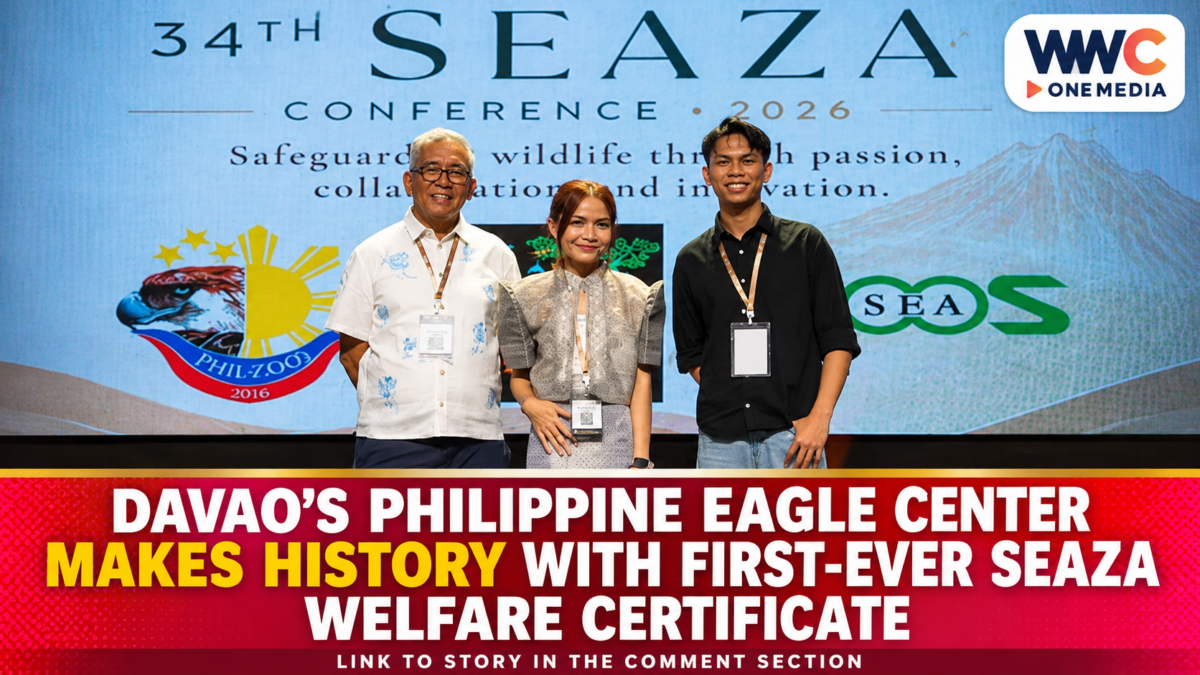
DAVAO CITY, Philippines — November 25, 2026 — The Philippine Eagle Center (PEC) in Malagos, Davao City, has secured a historic distinction in the country’s wildlife sector, becoming the first zoological facility in the Philippines to receive the Southeast Asian Zoos and Aquariums Association (SEAZA) Animal Welfare Certificate.
The recognition was announced during the 34th SEAZA Conference, held in Cebu City from November 15 to 20, 2026. It marks an important milestone for the Philippine Eagle Foundation (PEF), which operates the center and has spent decades working to protect the country’s critically endangered national bird.
But the certificate represents more than a new distinction for a Davao wildlife facility. It also places greater attention on the standards used to care for animals under human supervision — from their living environments and veterinary needs to opportunities for movement and natural behavior.
A Philippine first in regional animal-welfare certification
The Philippine Eagle Center’s recognition comes through SEAZA’s animal-welfare certification programme, developed with support from UK-based charity Wild Welfare.
SEAZA is a regional association representing zoos and aquariums across Southeast Asia and neighboring areas. Its welfare programme was designed to encourage better animal-care practices and establish standards that participating facilities can work toward.
Wild Welfare has described the initiative as a way to improve animal welfare across SEAZA institutions through a shared certification framework.
The programme is significant because animal care involves more than providing food, water and shelter. Facilities must also consider whether animals have suitable living spaces, appropriate health care, opportunities to move and activities that allow them to express natural behaviors.
For the Philippine Eagle Center, the certificate recognizes the work of the people responsible for those daily requirements.
The Philippine Eagle Foundation credited its animal keepers, veterinarians, food-preparation personnel, animal-welfare specialists and conservation-breeding staff, alongside its donors, partners, volunteers and visitors.
The achievement also creates a benchmark for other Philippine zoological facilities interested in pursuing stronger animal-welfare standards.
Why the Philippine Eagle Center matters
Located in Malagos, Baguio District, Davao City, the Philippine Eagle Center is operated by the Philippine Eagle Foundation and serves as a facility for conservation, breeding, wildlife care and public education.
Its work is closely connected to the survival of the Philippine Eagle, scientifically known as Pithecophaga jefferyi.
The species is endemic to the Philippines and classified as Critically Endangered. Forest loss and hunting remain major threats to its survival, making habitat protection and responsible conservation programmes essential.
The foundation’s conservation-breeding programme has produced 29 Philippine Eagles at the center since 1992. However, breeding birds in human care is only one part of the work. The foundation says captive-bred eagles must be healthy and suitably reared to behave like wild birds if they are to have a chance of thriving after release.
The process involves natural pairing and, in specific circumstances, cooperative artificial insemination. Pair formation can take months or even years, underscoring the difficulty of breeding a species with demanding biological and behavioral requirements.
The center also receives rescued wildlife requiring specialized attention. Earlier this year, a young White-bellied Sea Eagle named Trajan was transported from Basilan to Davao for care and rehabilitation at the facility. The case highlighted the center’s role beyond Philippine Eagle conservation, as explored in WWC ONE MEDIA’s report on Trajan’s rescue and transfer.
Conservation work extends beyond animals in captivity
The foundation’s participation in the Cebu conference also highlighted a wider conservation priority: protecting the forests and communities that determine whether endangered wildlife can survive in the wild.
During the gathering, PEF Executive Director Dennis Joseph Ilustre Salvador delivered a keynote presentation on securing the future of the Philippine Eagle through collaboration, innovation and conservation partnerships.
His message emphasized that protecting individual birds is not enough. Their forest habitats must also be protected, and communities must be part of long-term conservation efforts.
PEF biologist Julia Lynne Allong also presented research on the foundation’s effort to re-establish a wild Philippine Eagle population on Leyte Island.
The programme addresses the species’ local disappearance from the island following Super Typhoon Yolanda. Research focuses on what happens after released eagles return to the wild, including their movements, habitat use and the management responses needed to support their survival.
One of the birds featured in the research is Lyra Sinabadan. She was first released on Mount Apo, later rescued in Bukidnon and, after rehabilitation, returned to the wild in Leyte on May 8, 2025.
The work demonstrates why conservation cannot end when an animal leaves a rehabilitation facility. Continued monitoring helps researchers understand whether released birds are adapting to their environment and what additional protection may be needed.
Forest restoration is another part of the conservation effort
Protecting endangered wildlife also means restoring the ecosystems on which species depend.
The Philippine Eagle Foundation manages the Monkayo Pag-asa Carbon Forest in Barangay Banlag, Monkayo, Davao de Oro. The 22.4-hectare property has been undergoing active reforestation since March 2022.
More than 22,800 native tree seedlings representing over 80 species have been planted as part of the restoration effort.
The project received recognition under the 2026 ASEAN Green Initiative, highlighting the connection between forest restoration, biodiversity protection and community participation.
The initiative is another example of how conservation work can extend beyond a single animal-care facility. WWC ONE MEDIA previously examined the Monkayo forest restoration project and its ASEAN recognition.
Why regional standards matter for zoos and aquariums
The SEAZA certification programme was developed to address differences in animal-welfare practices among facilities in the region.
Wild Welfare has worked with SEAZA on developing welfare standards, training assessors and supporting a process through which facilities can be evaluated and encouraged to improve.
Such programmes can help institutions identify gaps in animal care and establish clearer expectations for their operations.
However, certification should not be confused with a guarantee that every aspect of animal welfare will remain perfect indefinitely. It is a recognition under a particular framework, and maintaining good practice requires continued attention, resources and improvement.
The Philippine Eagle Center’s achievement therefore carries both recognition and responsibility.
It is also important to distinguish the SEAZA certificate from a government-issued operating permit or a global accreditation. The recognition is specifically an animal-welfare certificate under the regional association’s programme.
The challenge of keeping the Philippine Eagle alive
The Philippine Eagle remains one of the country’s most threatened species.
Its survival depends on more than successful captive breeding. Forest destruction, hunting and other human-related threats continue to put pressure on the remaining wild population.
Recent eagle deaths in Mindanao have also highlighted the danger posed by infrastructure and human activity near wildlife habitats. Two Philippine Eagles died in separate incidents within three days in October, prompting renewed calls for stronger protection measures, including safer electrical structures near areas used by the birds.
The incidents underline why conservation requires cooperation among wildlife specialists, government agencies, local communities and infrastructure operators. WWC ONE MEDIA has examined the recent eagle deaths and the search for stronger wildlife-protection measures.
A milestone — and a continuing responsibility
The Philippine Eagle Center’s first-in-the-country SEAZA Animal Welfare Certificate is a significant recognition for Davao City and the Philippine wildlife-conservation community.
It acknowledges the work of the people who care for animals every day while placing the center within a wider regional effort to strengthen welfare standards.
Yet the larger measure of success will be whether those standards continue to improve and contribute to better outcomes for wildlife.
For the Philippine Eagle, that means healthy birds, effective conservation breeding, protected forests and carefully monitored releases. For other animals at the center, it means appropriate care and environments that support their physical and behavioral needs.
The certificate marks a historic first for the Philippines. The work of protecting wildlife, however, continues long after the ceremony ends.