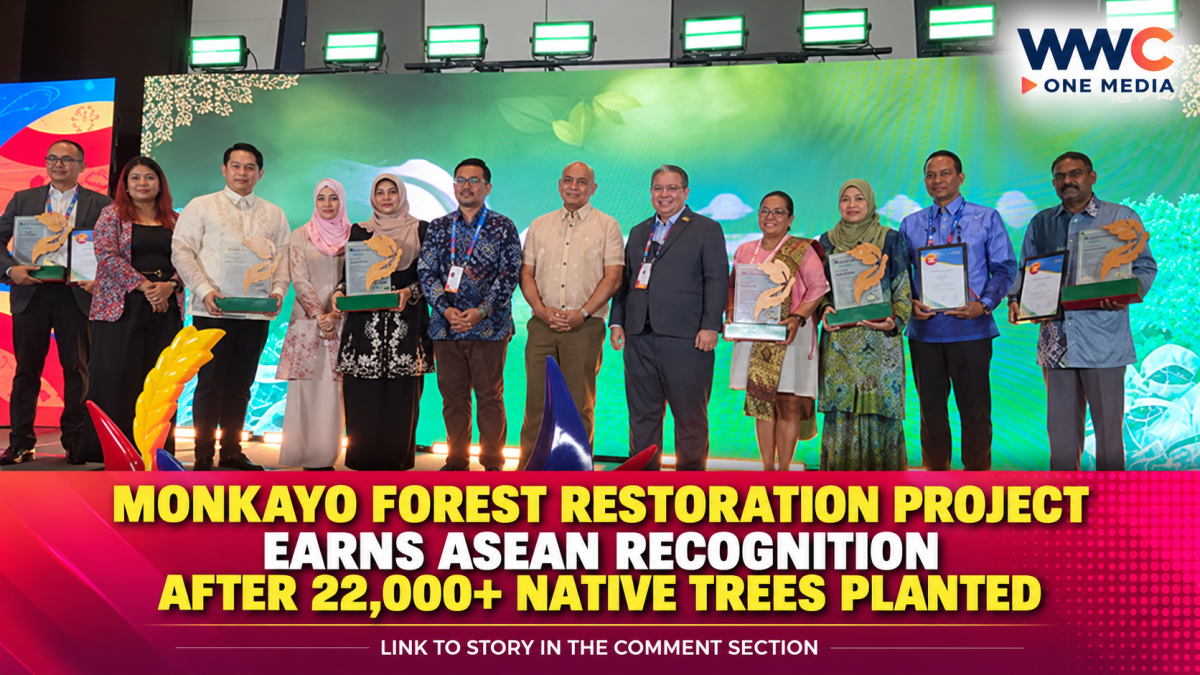
A community-led forest restoration project in Monkayo, Davao de Oro, has earned regional recognition after being named a 2026 ASEAN Green Initiative Large-Scale awardee, highlighting the growing forest and wildlife habitat rebuilt on what was once an agricultural property.
The Monkayo Pag-asa Carbon Forest (MPCF), managed by the Philippine Eagle Foundation (PEF), was recognized during the second ASEAN Green Initiative Recognition Ceremony held alongside the ASEAN Heritage Parks Forum in Quezon City from September 8 to 10.
Located in Barangay Banlag, the 22.4-hectare property has undergone active reforestation since March 2022. More than 22,800 native tree seedlings representing over 80 species have been planted as part of efforts to restore the area toward its natural lowland forest ecosystem.
The land was donated to the Philippine Eagle Foundation in 2017 by the Iloilo-based Yap family in memory of their late parents. The property was dedicated to forest preservation and biodiversity conservation rather than commercial development.
The restoration effort has also placed local communities at the center of the project. The Banlag Santol Kinaiyahan Workers Association, composed largely of local families previously displaced by conflicts in upland areas, manages nursery and field operations and helps monitor the survival of planted trees.
The emerging forest is already showing signs of ecological recovery. Field surveys have documented 45 bird species at the site, including the Vulnerable Japanese Night Heron and the endemic South Philippine Dwarf Kingfisher. Camera traps have also recorded the Mindanao tree squirrel moving through the developing forest canopy.
The ASEAN Green Initiative recognizes ecosystem restoration projects that demonstrate more than large-scale tree planting. The program considers ecological soundness, socioeconomic benefits, sustainability and governance, while encouraging communities, governments, organizations and private partners to participate in restoring degraded ecosystems.
The Municipality of Monkayo has designated the property as a Local Conservation Area, while the Department of Environment and Natural Resources and other partners provide support for restoration and conservation activities. The project’s long-term funding also includes a plot-adoption program that helps cover nursery production, planting, maintenance and monitoring.
The Monkayo project shared the Philippine Large-Scale AGI recognition with Quezon City’s Luntiang Kyusi: One Million Trees Initiative. Other Philippine projects, including the ALIMA Eco, Agri, and Heritage Park Development and the Daang Kalikasan Native Trees Arboretum and Ecological Restoration Initiative, were recognized in the Medium-Scale category.
For the Philippine Eagle Foundation, the recognition also reinforces its broader Planting for the Future: 3 Million Trees Campaign, which aims to restore about 1,200 hectares of critical Philippine Eagle habitat across Mindanao.
The Monkayo project shows how forest restoration can extend beyond planting seedlings. Its progress is being measured through tree survival, returning wildlife, community participation and the long-term protection of restored land—turning a former agricultural landscape into a growing habitat for native species.