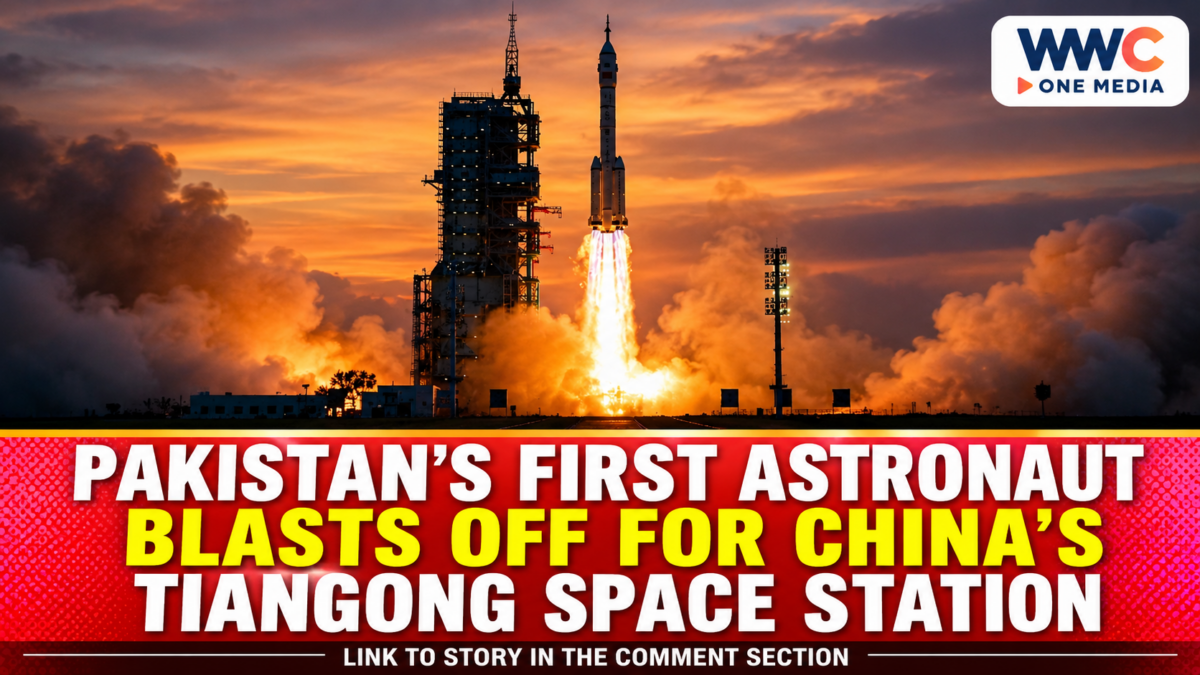
JIUQUAN, China — November 25, 2026 — Pakistan has reached a historic milestone in human spaceflight after astronaut Muhammad Zeeshan Ali launched aboard China’s Shenzhou-24 spacecraft, becoming the first Pakistani to travel into orbit and the first foreign astronaut to participate in China’s crewed space programme.
The spacecraft lifted off at 8:18 a.m. Beijing time from the Jiuquan Satellite Launch Center in northwestern China aboard a Long March-2F Y24 rocket. Approximately 10 minutes after launch, the spacecraft separated from its rocket and entered its planned orbit.
Ali is travelling with Chinese astronauts Tang Hongbo, the mission commander, and Wu Yi, the flight engineer. He serves as a payload specialist and is scheduled to undertake a short-duration mission aboard China’s Tiangong space station.
The flight represents a major development in China-Pakistan space cooperation. It also opens a new chapter for Tiangong, which is receiving its first foreign astronaut.
But the significance extends beyond the historic passenger. The mission includes approximately 90 scientific experiments and technology tests, while Pakistan is contributing research involving advanced materials, plant seeds and biological systems that could support longer human missions in space.
A FIRST FOR PAKISTAN AND CHINA’S CREWED SPACE PROGRAMME
Ali’s participation marks two important firsts.
He becomes the first Pakistani astronaut to reach orbit and the first foreign astronaut to visit China’s Tiangong space station.
For China, the mission is the first crewed flight in its human spaceflight programme to include an astronaut from another country.
The three-person crew has distinct responsibilities.
Tang Hongbo commands the mission. He has previously flown aboard Shenzhou-12 and Shenzhou-17 and is set to become the first Chinese astronaut to visit Tiangong three times.
Wu Yi, a member of China’s third group of astronauts, is undertaking his first spaceflight.
Ali is assigned as payload specialist. His responsibilities include participating in the crew’s routine work and carrying out scientific activities connected with China-Pakistan cooperation.
The arrangement required more than selecting an astronaut and placing him aboard a spacecraft. The Chinese space programme also prepared the crew for joint operations, including technical procedures, emergency responses, coordination between crew members and the use of Chinese operational commands.
SEVEN MONTHS OF TRAINING BEFORE THE HISTORIC FLIGHT
Ali travelled to China in April 2026 to train at the Astronaut Center of China.
His preparation covered spacecraft systems, space-station operations, scientific equipment and the procedures needed to work alongside Chinese astronauts.
Language training was also part of the preparation. Astronauts must understand operational instructions and technical terminology accurately, particularly when working in an environment where mistakes can have serious consequences.
The joint crew also completed coordination exercises covering operational responsibilities, procedural handovers and emergency situations.
These requirements highlight an important difference between a symbolic visit and an operational spaceflight. A visiting astronaut must be able to perform assigned tasks safely within the host country’s established mission procedures.
Pakistan’s space agency, the Space and Upper Atmosphere Research Commission (SUPARCO), identifies Ali as the country’s first astronaut aboard China’s space station and confirms his role as a payload specialist.
FOUR PAKISTANI RESEARCH PROJECTS ARE HEADING INTO SPACE
One of the mission’s most important dimensions is its scientific programme.
SUPARCO has identified four Pakistani research projects connected with the China Space Station.
The first, Hybrid Composite Shield, examines lightweight graphene-based hybrid composite materials that could improve spacecraft protection against radiation while maintaining structural strength and reducing weight.
The second, Self-Healing in Space, investigates carbon-fibre composites designed to repair micro-cracks. The research could help improve the durability and structural integrity of spacecraft components.
The third, Quinoa Beyond Earth, studies how microgravity and cosmic radiation affect quinoa seeds, including their longevity, genetic characteristics and nutritional quality.
The fourth, Green Life Beyond Earth, explores the cultivation of microalgae and cyanobacteria. These organisms could contribute to future life-support systems through oxygen regeneration, carbon dioxide removal and potential food production.
The projects address problems that become increasingly important when astronauts spend longer periods away from Earth.
Spacecraft need materials that are strong without being unnecessarily heavy. Long-duration missions also require reliable food supplies and life-support systems that do not depend entirely on repeated deliveries from Earth.
These are research objectives, not proof that the materials or biological systems are already ready for operational use. Their performance must be evaluated through experiments and further development.
CHINA PLANS 90 SCIENCE AND TECHNOLOGY EXPERIMENTS
The Pakistani projects form part of a much larger scientific programme.
China’s mission briefing outlines approximately 90 experiments and technology tests during the Shenzhou-24 mission.
The research spans several areas, including space life sciences, materials science, microgravity fluid physics, combustion research, fundamental physics, aerospace medicine and new space technologies.
Some experiments will examine how space conditions affect biological systems and human health.
Others will investigate materials that could be manufactured or tested under microgravity conditions. Researchers are also studying heat transfer, fire behaviour and physical processes that can be difficult to reproduce under normal conditions on Earth.
The station provides an environment where researchers can investigate phenomena affected by gravity, radiation and other conditions encountered in orbit.
The long-term value of such work is not necessarily an immediate commercial product. Experiments may first establish whether a scientific effect can be reproduced, identify limitations or provide data for later engineering development.
That distinction matters when assessing the mission’s potential. A successful experiment is an important research result, but it does not automatically mean a new spacecraft material, food system or medical technology is ready for widespread use.
A DIFFERENT KIND OF SPACE-STATION CREW HANDOVER
The Shenzhou-24 mission also introduces an unusual arrangement for the rotation of astronauts aboard Tiangong.
Ali is scheduled to complete a short-duration joint flight and return to Earth aboard the Shenzhou-23 spacecraft rather than remain for the full stay of the incoming Chinese crew.
Under the announced plan, he will return alongside Chinese astronauts Zhang Zhiyuan and Li Jiaying.
Meanwhile, Zhu Yangzhu, a member of the Shenzhou-23 crew, is scheduled to remain aboard the station for a one-year in-orbit research mission.
That extended stay is intended to help researchers study how the human body adapts to prolonged exposure to space and to test the systems needed to support astronauts during longer missions.
The research will examine human health, working capacity and living conditions in orbit. It will also help refine the medical and operational support systems needed for extended spaceflight.
The arrangement means the mission is not simply a conventional three-person crew replacement. It combines an international astronaut visit with a longer-duration Chinese research programme.
THE CHINA-PAKISTAN SPACE PARTNERSHIP
The mission grew out of a formal cooperation agreement signed by China and Pakistan in February 2025 in Islamabad.
The agreement established a process for selecting and training Pakistani astronauts for participation in Chinese space-station missions.
Two Pakistani candidates were selected for training in China. The programme was designed for one astronaut to undertake the flight while another served as the backup candidate.
Ali’s selection therefore represents the first operational result of that human-spaceflight cooperation.
The partnership also reflects a broader relationship between the two countries in science and technology.
However, the mission’s scientific value should be assessed through the experiments conducted, the data produced and the knowledge that can be applied beyond the immediate flight.
For Pakistan, participation offers access to a crewed space environment and the opportunity to develop experience in astronaut training and space research.
For China, the mission demonstrates that its space station can host an astronaut from an international partner within its crewed programme.
WHY TIANGONG MATTERS TO THE FUTURE OF SPACE RESEARCH
China’s Tiangong is a permanently crewed orbital research platform that operates separately from the International Space Station.
Its purpose includes supporting scientific experiments, technology development, astronaut training and long-term spaceflight research.
International participation is important because access to a crewed orbital laboratory is limited to a relatively small number of countries and organisations.
The Shenzhou-24 mission demonstrates one model of international cooperation: a partner country selects and trains an astronaut, contributes research projects and sends that astronaut to work within another country’s space infrastructure.
The broader international space sector is also developing missions with different scientific objectives.
Japan’s Martian Moons eXploration mission to collect samples from Phobos illustrates how national space agencies are building capabilities for complex planetary research and sample-return operations.
Meanwhile, the development of commercial launch systems is changing how governments and private companies approach access to orbit. WWC ONE MEDIA has also examined SpaceX Starship’s rocket-reuse tests and their importance to future lunar missions.
These programmes are not interchangeable. Tiangong focuses on crewed orbital research, Japan’s MMX mission targets the Martian moon Phobos, and Starship is being developed for a different set of transportation and exploration objectives.
Together, they show how space exploration is expanding across national programmes, scientific partnerships and commercial technology.
WHAT HAPPENS AFTER SHENZHOU-24?
The immediate priority is completing the crew’s planned operations safely and carrying out the assigned experiments.
For Ali, the mission is an opportunity to gain experience in human spaceflight while conducting research as part of an international crew.
For Pakistan, the next question will be how the experience and scientific results can strengthen its domestic space research capabilities.
For China, the mission provides an operational demonstration of international crew cooperation and supports the continuing use of Tiangong as a research platform.
The longer-term test will be whether the scientific work produces useful results and whether the partnership develops into additional joint missions.
Pakistan’s first astronaut has now entered orbit. But the significance of Shenzhou-24 will ultimately be measured not only by who travelled aboard the spacecraft, but also by what the countries involved learn from the experiments conducted during the mission.