
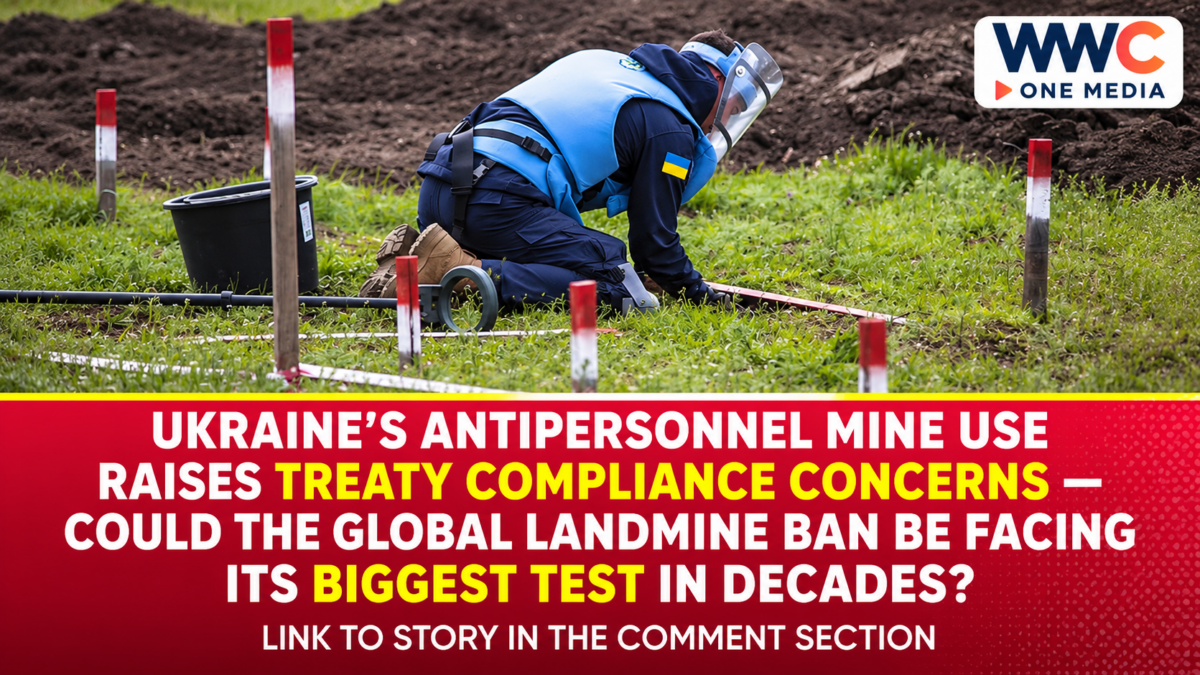
GENEVA, SWITZERLAND — Ukraine is facing renewed international scrutiny after the Landmine Monitor 2026 report documented the country’s production and use of antipersonnel landmines despite its continuing obligations under the international Mine Ban Treaty.
The findings, released on Nov. 24, 2026, come as worldwide casualties involving landmines and explosive remnants of war reached at least 6,929 people in 2025, representing a 10% increase from the previous year.
The report also documents extensive Russian antipersonnel mine use in Ukraine and raises concerns about the weakening of international restrictions on these weapons.
For governments confronting national security threats, the developments highlight a difficult policy debate. For civilians living in conflict-affected communities, they raise a more immediate question: how long will the dangers remain after the fighting ends?
Ukraine landmine ban faces renewed compliance scrutiny
Ukraine’s obligations under the Ottawa Treaty have become the subject of an international legal dispute following its attempt to suspend the agreement in July 2025.
The latest monitoring findings identify evidence of Ukrainian antipersonnel mine production and use during the continuing war with Russia.
Such activities are prohibited under the convention for participating countries.
However, restrictions on access to active conflict zones have prevented researchers from establishing a comprehensive account of all landmine use or determining the precise extent of Ukrainian deployments.
The findings must therefore be distinguished from a final judicial determination of individual criminal responsibility.
The wider humanitarian situation remains particularly significant because Russia has also extensively used antipersonnel mines since launching its full-scale invasion of Ukraine in February 2022.
Although Russia is not a party to the Ottawa Treaty, it remains subject to applicable international humanitarian law.
The latest developments add another dimension to the human cost previously examined in WWC ONE MEDIA’s coverage of Russia’s mounting military losses and the wider consequences of the war in Ukraine.
Why Ukraine attempted to leave the Ottawa Treaty
On June 29, 2025, Ukrainian President Volodymyr Zelenskyy issued Presidential Decree No. 441/2025, implementing a decision by Ukraine’s National Security and Defence Council concerning withdrawal from the Mine Ban Treaty.
The council identified the protection of Ukraine’s territorial integrity, sovereignty and national interests as objectives behind the decision.
Ukraine subsequently communicated its intention to suspend the convention’s operation through a notification to the United Nations on July 18, 2025.
The communication invoked the 1969 Vienna Convention on the Law of Treaties.
However, submitting that notification did not independently establish that the suspension was legally effective.
Article 20 of the Ottawa Treaty establishes restrictions on withdrawal during armed conflict. The convention’s participating countries subsequently affirmed that Ukraine remained bound by its treaty obligations.
The disagreement illustrates the distinction between a government’s domestic security decision and its continuing responsibilities under an international agreement.
What does the Ottawa Treaty prohibit?
The Anti-Personnel Mine Ban Convention, commonly known as the Ottawa Treaty, was adopted in 1997 and entered into force in 1999.
It prohibits participating countries from developing, manufacturing, acquiring, retaining, transferring or using antipersonnel mines, subject to narrowly defined treaty exceptions.
Its obligations also address stockpile destruction, clearance of contaminated areas and assistance to survivors.
The convention was developed in response to the persistent humanitarian consequences of weapons that can remain dangerous after military operations have ended.
The central concern is that antipersonnel mines cannot reliably distinguish between combatants and civilians.
For communities affected by contamination, the risks can continue for years, delaying the return of displaced families and preventing the safe use of agricultural land and public infrastructure.
Global landmine casualties reach a five-year high
The latest global monitoring figures reveal a humanitarian problem extending well beyond the Russia–Ukraine war.
At least 6,929 people were killed or injured by landmines and explosive remnants of war during 2025, the highest annual total recorded since 2020.
Among casualties whose status was established, civilians represented 84%.
Children accounted for half of civilian casualties where the victims’ ages were known.
These figures underline the importance of civilian protection during and after armed conflicts.
Myanmar recorded the highest number of casualties for the third consecutive year, while Syria also experienced a substantial increase.
For humanitarian organisations, preventing additional contamination is only one part of the challenge.
Survivors may require long-term medical treatment, rehabilitation, psychological support and assistance returning to education or employment.
Five European countries leave the global landmine ban
The international treaty framework is also experiencing an unprecedented period of change.
Estonia, Finland, Latvia, Lithuania and Poland have completed their withdrawals from the Mine Ban Treaty, marking the first effective departures since the convention entered into force.
The withdrawals reflect national security concerns among European governments confronting a changing regional defence environment.
However, humanitarian organisations have warned that renewed production and use could weaken international restrictions and increase long-term civilian exposure.
The treaty has also continued attracting new members. Lebanon, the Marshall Islands and Tonga recently joined, bringing the number of countries bound by the agreement to 162.
These contrasting developments demonstrate that the international campaign against antipersonnel mines has not lost all momentum.
Nevertheless, maintaining its effectiveness will require existing members to uphold their commitments while encouraging additional countries to participate.
The wider geopolitical tensions have previously been examined in WWC ONE MEDIA’s coverage of G7 diplomatic discussions and European security concerns surrounding negotiations to end the Russia–Ukraine war.
Why landmine contamination threatens economic recovery
At least 65 countries and other areas are suspected or confirmed to contain antipersonnel mine contamination.
The consequences extend beyond immediate physical danger.
Contaminated farmland can prevent agricultural production, while unsafe infrastructure can delay reconstruction and the restoration of essential public services.
Businesses may also face difficulties resuming operations in affected areas until appropriate surveys and clearance programmes have been completed.
Even if an eventual peace agreement ends military hostilities, contaminated communities could continue facing significant economic and humanitarian challenges.
For Ukraine, reconstruction planning must therefore account for both physical infrastructure damage and the long-term process of making affected land safe.
International financing and sustained humanitarian assistance could become increasingly important as recovery progresses.
What happens next for Ukraine and the Mine Ban Treaty?
The immediate international challenge involves addressing the documented compliance concerns while preventing additional civilian harm.
Further developments could include diplomatic consultations, updated treaty compliance reporting and continued humanitarian clearance operations.
Ukraine’s security concerns arise within the context of an ongoing Russian invasion. However, those circumstances do not eliminate the need to examine its existing treaty obligations.
Diplomatic efforts to end the conflict could provide opportunities to address humanitarian priorities alongside wider security arrangements.
WWC ONE MEDIA previously examined these competing considerations in its analysis of US sanctions policy, Ukraine peace negotiations and the requirements for a durable settlement.
Ultimately, a sustainable peace must involve more than ending immediate hostilities.
It must also provide affected communities with the opportunity to rebuild their lives without continuing exposure to the weapons left behind.
Frequently Asked Questions
Is Ukraine still bound by the Ottawa Treaty?
Yes. The meeting of states parties affirmed that Ukraine remains bound by the Mine Ban Treaty despite its attempted suspension in July 2025.
Has Ukraine used antipersonnel landmines during the war?
Landmine Monitor 2026 documents Ukrainian production and use of antipersonnel mines. The full extent of their deployment remains difficult to establish independently.
Is Russia a member of the Mine Ban Treaty?
No. Russia has not joined the Ottawa Treaty, although applicable international humanitarian law continues to govern its conduct during armed conflict.
How many people were affected by landmines in 2025?
At least 6,929 people worldwide were killed or injured by landmines and explosive remnants of war in 2025.
Which countries recently withdrew from the Ottawa Treaty?
Estonia, Finland, Latvia, Lithuania and Poland completed their withdrawals, representing the first effective departures in the convention’s history.










