
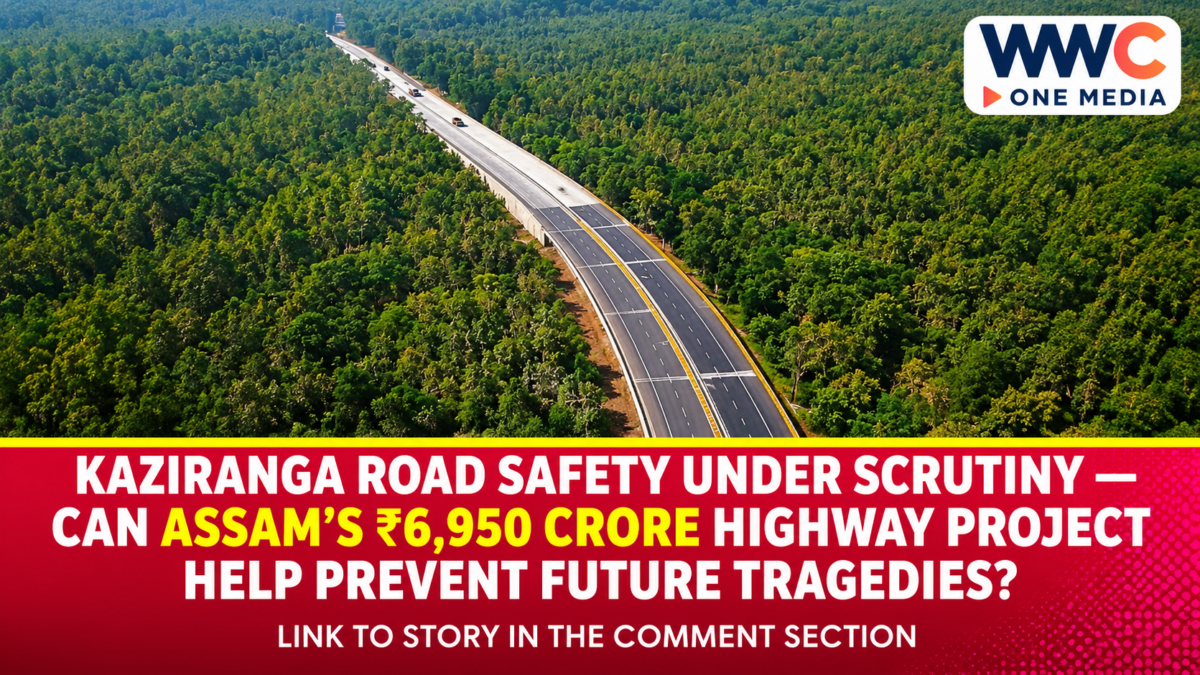
ASSAM, India — Kaziranga road safety remains an important public policy concern as India’s northeastern state of Assam pursues major infrastructure improvements intended to strengthen regional connectivity, protect wildlife and reduce traffic risks.
An infrastructure project valued at more than ₹6,950 crore, or ₹69.5 billion, was formally launched in January 2026 to improve the Kaliabor–Numaligarh section of National Highway 715.
The development comes against a wider national road-safety challenge. Historical government statistics show that India recorded 461,312 road accidents and 168,491 associated fatalities in 2022.
Assam alone recorded 7,023 road accidents during that year.
Beyond financial assistance for accident victims and their families, these figures highlight the importance of preventive measures capable of reducing the likelihood of serious collisions.
Kaziranga Road Safety: A ₹6,950 Crore Infrastructure Investment
On January 18, 2026, Indian Prime Minister Narendra Modi performed the groundbreaking ceremony for the Kaziranga Elevated Corridor Project in Kaliabor, Assam.
The 86-kilometre project includes an elevated wildlife corridor, highway bypasses and improvements to existing road sections.
| Project component | Planned length |
|---|---|
| Elevated wildlife corridor | 35 kilometres |
| Highway bypass sections | 21 kilometres |
| Existing highway widening | 30 kilometres |
| Total project length | 86 kilometres |
| Announced project value | More than ₹6,950 crore |
The project will pass through Nagaon, Karbi Anglong and Golaghat districts.
Its objectives include strengthening connections to Upper Assam, reducing travel times, improving road safety and allowing wildlife to move beneath elevated highway sections.
The planned bypasses at Jakhalabandha and Bokakhat are also intended to reduce congestion in those communities.
However, infrastructure investment should not automatically be interpreted as a guarantee that every traffic accident can be prevented.
Effective road safety requires appropriate engineering, consistent enforcement, responsible vehicle operation and dependable emergency services.
Financial Assistance Provides Relief but Cannot Replace Prevention
Assam’s existing disaster-management guidelines establish financial assistance arrangements for eligible families affected by certain accidents.
The published ex-gratia framework identifies ₹200,000, commonly expressed as ₹2 lakh, in assistance for the next of kin of people killed in qualifying accidents in public places or public transport.
District authorities are responsible for sanctioning payments under the applicable guidelines.
This general framework should be distinguished from additional financial assistance that governments may announce following particular emergencies.
An announced payment is also different from assistance that has already been distributed to beneficiaries.
For families affected by serious road accidents, financial support may help address immediate household expenses and other obligations following the loss of a relative.
Nevertheless, compensation cannot undo the consequences of a fatal collision.
The longer-term public policy objective must include reducing preventable injuries and deaths while ensuring that eligible families receive the assistance available to them.
India’s Road Accident Statistics Reveal the Scale of the Challenge
Historical government statistics demonstrate the significant burden of road accidents across India.
| Year | Reported road accidents | Road fatalities |
|---|---|---|
| 2018 | 470,403 | 157,593 |
| 2019 | 456,959 | 158,984 |
| 2020 | 372,181 | 138,383 |
| 2021 | 412,432 | 153,972 |
| 2022 | 461,312 | 168,491 |
In 2022, accidents on national highways and expressways accounted for approximately 32.94% of recorded road accidents and 36.22% of road fatalities.
Assam’s recorded road accidents declined from 8,350 in 2019 to 7,023 in 2022.
The state also recorded 5,637 road accident injuries in 2022.
These historical statistics provide a documented foundation for examining road-safety policy. They do not establish present-day accident rates or the circumstances of any individual November 2026 collision.
The importance of independently establishing individual accident details has also been examined in WWC ONE MEDIA’s coverage of the Kanpur pilgrim bus crash and the evidence investigators must verify.
Speed Enforcement Remains a Major National Priority
India’s Ministry of Road Transport and Highways identifies excessive speed as a significant category in its historical road-fatality statistics.
Of the 168,491 road fatalities recorded nationally in 2022, 119,904 were classified under speeding-related traffic violations.
Other categories included driving on the wrong side of the road, mobile phone use and driving under the influence of alcohol or drugs.
These figures support the importance of traffic enforcement and responsible vehicle operation.
However, national statistics cannot establish whether excessive speed caused a specific accident.
An individual investigation must examine relevant evidence, potentially including vehicle condition, authenticated recordings, road conditions and witness accounts.
Similar questions were explored in the Kochi bus-motorcycle crash and the importance of verifying speeding allegations.
Vehicle speed-control technology can form part of a broader prevention strategy, but its effectiveness depends on appropriate installation, maintenance and enforcement.
Why Road Safety Requires More Than Highway Construction
India’s national road-safety strategy addresses four principal areas: education, engineering, enforcement and emergency care.
Each serves a different purpose.
Education can help drivers and passengers understand transportation risks. Engineering can address hazardous road layouts and vehicle safety requirements.
Enforcement aims to discourage dangerous conduct, while emergency care supports people who are injured when collisions occur.
The Ministry of Road Transport and Highways has also established the electronic Detailed Accident Report project to improve the collection and analysis of accident information.
Electronic enforcement regulations provide for monitoring equipment on selected high-risk and high-density transport corridors.
These measures illustrate why safer transportation requires coordination between road authorities, police departments, vehicle operators and healthcare providers.
The importance of such institutional responsibilities has also emerged in Karachi’s road-safety enforcement and accident-prevention challenges.
For Assam, improving infrastructure alongside effective transport oversight could help address different aspects of road-related risk.
Emergency Medical Care Is Another Important Consideration
In July 2024, India’s Ministry of Road Transport and Highways confirmed that it had worked with the National Health Authority to implement a pilot programme providing cashless medical treatment for road accident victims in Assam and Chandigarh.
The initiative formed part of broader efforts to strengthen post-accident emergency assistance.
For seriously injured passengers, timely access to medical treatment can be particularly important.
Emergency response arrangements should be supported by clear communication between responders, hospitals and relevant government institutions.
However, the existence of a general medical assistance programme does not independently establish that particular accident victims received treatment under it.
Case-specific medical and administrative records remain necessary to confirm the assistance delivered.
What Happens Next for Kaziranga Road Safety?
The effectiveness of Assam’s infrastructure investment will ultimately need to be assessed through completed construction, operational safety assessments and subsequent accident statistics.
The January groundbreaking ceremony establishes the launch of the Kaziranga Elevated Corridor Project, not its completion.
Future evaluations should examine whether road improvements reduce dangerous traffic conflicts, whether enforcement measures are functioning effectively and whether emergency services can respond appropriately.
The government’s national commitment to reducing road fatalities and injuries by 50% by 2030 provides an important policy objective.
Achieving that objective will require sustained implementation rather than infrastructure announcements alone.
For families affected by serious road accidents, meaningful accountability includes both appropriate assistance and credible efforts to prevent similar incidents.
Assam’s highway development represents a substantial investment in regional transportation.
Its most important measure of success, however, will be whether the completed infrastructure and associated safety measures provide more dependable protection for road users.
Frequently Asked Questions
What is the Kaziranga Elevated Corridor Project?
It is an 86-kilometre highway improvement project in Assam covering elevated wildlife crossings, bypasses and road widening.
How much will the Kaziranga highway project cost?
The announced project value exceeds ₹6,950 crore, equivalent to ₹69.5 billion.
How many road accidents did Assam record in 2022?
Official historical statistics record 7,023 accidents and 5,637 injuries in Assam during 2022.
What financial assistance does Assam provide for qualifying fatal accidents?
Published disaster-management guidelines identify ₹2 lakh in ex-gratia assistance for the next of kin of people killed in qualifying public-place or public-transport accidents. Additional incident-specific assistance may be announced separately.
Can highway improvements alone prevent serious road accidents?
No. Road engineering must be supported by appropriate vehicle maintenance, traffic enforcement, driver education and emergency medical services.










