
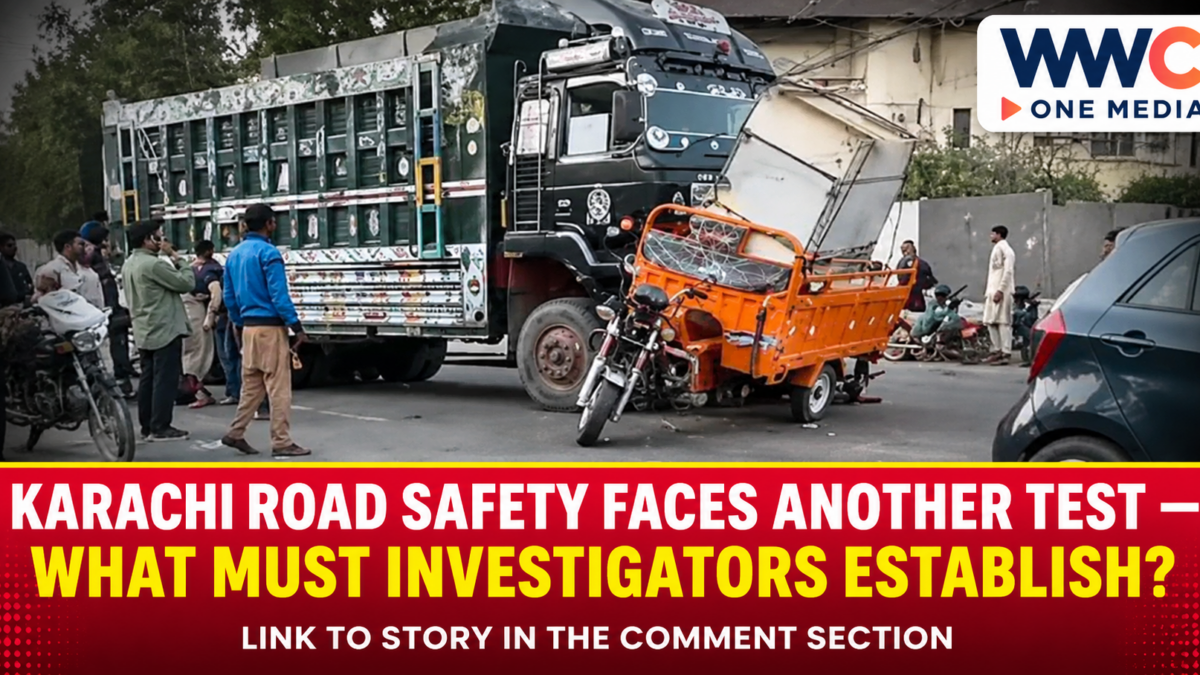
KARACHI, Pakistan — Nov. 22, 2026. Karachi Police’s published public-safety instructions identify traffic enforcement, accident prevention and road-user awareness as continuing responsibilities of its dedicated traffic unit. Following new reports of a serious collision in the city, an authenticated incident record is still needed before a particular death toll, injury count or arrest can be reported as established fact.
For Karachi road safety, the larger question is how authorities document serious collisions and distinguish early reports from conclusions that survive investigation. The available public records establish the relevant police responsibilities and safety advice; they do not establish what caused the latest reported incident.
Karachi Road Safety: What Is Officially Documented?
The Karachi Police website describes its Traffic Police as a specialist unit tasked with regulating vehicle movement, enforcing traffic rules, preventing accidents and managing road conditions. Its published description includes handling violations such as speeding and illegal parking, alongside traffic direction and awareness campaigns.
That institutional remit matters whenever an incident attracts public attention. It establishes which functions the traffic authorities perform, but it is not a finding that any rule was broken in a particular collision.
The police website also maintains a directory of traffic sections, with named section officers and contact information. This organisational map is a starting point for establishing the appropriate authority for follow-up questions; it cannot replace an incident-specific report.
Why a Reported Casualty Count Needs an Original Record
A news report may describe the number of people killed or injured, but the standards for publishing those numbers as confirmed require more. A dated police record could identify the incident location and initial assessment. Emergency-service documentation could help establish how many people were transported, while hospital information could clarify the clinical status of those treated.
These records serve different purposes. A transport count is not necessarily an injury count, and an early injury count may later be revised. A publication must avoid combining them as if they were interchangeable.
For this story, the original police incident bulletin, authenticated emergency-response record and hospital confirmation have not been obtained. That means the reported figures circulating about the latest Karachi collision remain outside this article’s verified factual account.
A similar distinction underlies WWC’s earlier analysis of truck-crash investigation and technical evidence. The Philippine incident is unrelated; the relevance is the reporting standard, not the transfer of any conclusion from one crash to another.
What Investigators Would Need to Establish
An investigation into a serious road collision can raise questions about vehicle positions, traffic controls, visibility, road condition and mechanical performance. Those are possible lines of inquiry, not claims about what occurred in Karachi.
Whether speed contributed to a crash requires evidence. The same applies to brake condition, driver distraction, vehicle maintenance or the conduct of other road users. None should be named as the cause until there is a finding supported by an authentic record.
The sequence also matters. Investigators would need to determine which vehicles were involved, how they moved before contact and what happened immediately afterwards. Photographs or witness accounts may be useful, but neither should be presented as a complete reconstruction without corroboration.
WWC has separately explained the need for verification of casualty reports after a bus incident. That separate case illustrates why precise injury totals and explanations of driver conduct require records rather than repeated headlines.
What Karachi Police Says About Prevention
In an official May 13, 2025 safety announcement, Karachi Police urged pedestrians to use pedestrian bridges and zebra crossings, follow signals and avoid rushed crossings. It also asked drivers to remain alert, obey speed limits and respect pedestrian rights.
The police published a separate road-safety message in November 2024 stressing precautionary driving practices. These are public education measures. Their publication does not demonstrate that a particular motorist ignored them, or that the precautions would necessarily have prevented the latest reported collision.
Another WWC article considers vehicle-movement evidence in a Canadian truck crash. The incidents have no demonstrated connection. The shared issue is that an observed movement and its underlying cause are distinct questions.
Why the Public Record Matters to Accountability
Karachi’s road-safety response must be assessed through records that identify events, decisions and outcomes. An agency’s published responsibilities show what it is supposed to do. An incident report explains what authorities have established about a particular event. A final investigation may determine whether further enforcement or corrective work is justified.
Confusing those stages can lead to premature blame. Naming an individual as responsible because a vehicle was reportedly involved would go beyond the evidence currently available. Similarly, an early account of detention is not confirmation of guilt or of a filed charge.
Public accountability also requires making useful information accessible. Karachi Police publishes a traffic emergency number, 1915, for motorists needing assistance with road emergencies. That is an official contact channel, not an assurance of a particular response time.
What Happens Next?
The next meaningful document would be an original, dated notice from the responsible police unit establishing the location, vehicles, verified casualty figures and investigation status. Subsequent hospital or emergency-service records could reconcile any differences between the first report and the final count.
Until those documents are accessible, the incident-specific story should remain on editorial hold. The wider road-safety questions are legitimate, but presenting a reported death or arrest as an established official fact would not meet a primary-record-only standard.
Frequently Asked Questions
How many people were confirmed killed or injured in the latest reported Karachi collision?
No primary police or hospital record was located that independently verifies the numbers circulating in news reports. WWC therefore cannot certify an incident-specific casualty count.
Has Karachi Police officially established the cause?
No original investigative finding about this reported event was available in the records reviewed. Speed, vehicle defects and driver conduct should not be asserted as causes.
What does Karachi Traffic Police do?
Its official mandate includes traffic regulation, enforcement, accident prevention, road monitoring and public awareness campaigns.
What number does Karachi Police publish for traffic emergencies?
The Karachi Police website lists 1915 for traffic emergency assistance.
What would make an incident report ready for publication?
A dated original police bulletin, verified casualty information and clear attribution of any preliminary findings would establish a defensible account. A later investigative report may answer questions the first announcement cannot.










