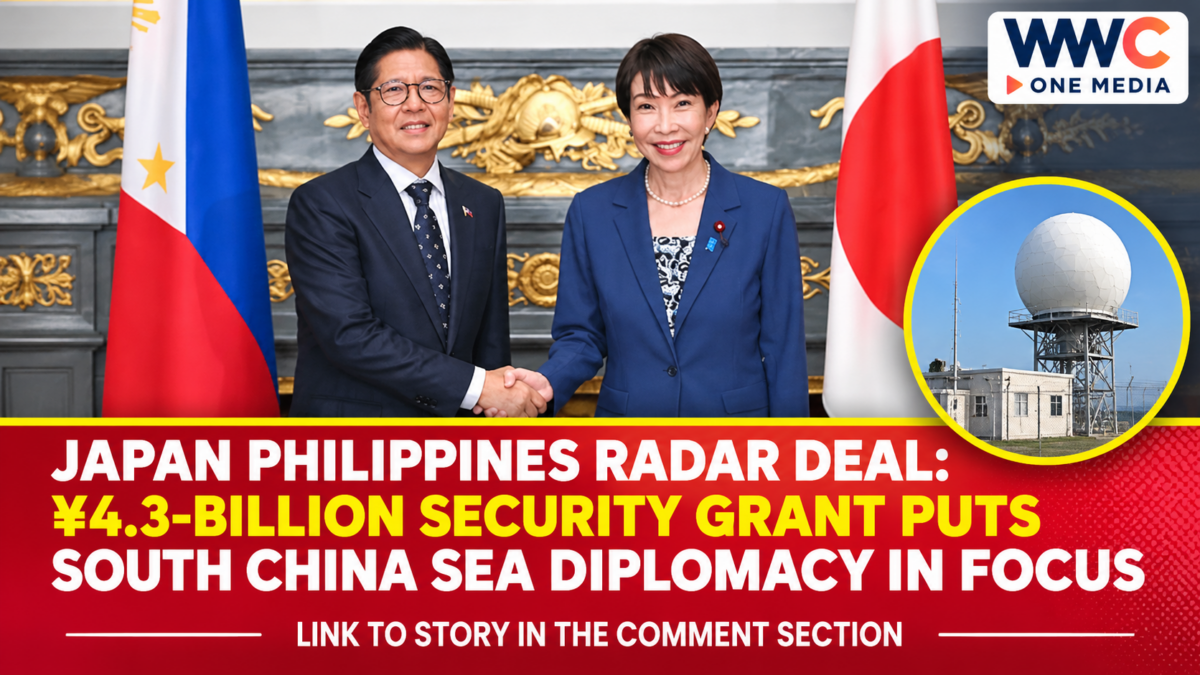
MANILA, Philippines — The Japan Philippines radar deal is opening a new chapter in bilateral defence cooperation, with Tokyo committing ¥4.3 billion in security assistance to strengthen Philippine maritime surveillance capabilities.
Philippine Foreign Affairs Secretary Maria Theresa Lazaro and Japanese Ambassador Katsuro Kitagawa signed and exchanged diplomatic notes in Manila on Nov. 9, 2026, formalising the assistance under Japan’s Official Security Assistance (OSA) programme.
The agreement comes against the backdrop of longstanding diplomatic differences between China, Japan and the Philippines over maritime security and international law in the South China Sea.
Japan Philippines Radar Deal Marks a Historic First
The November agreement includes a coastal radar system for the Philippine Navy and unmanned aerial vehicles for the Philippine Air Force.
The aircraft are intended for monitoring and surveillance.
The coastal radar component represents the first transfer of equipment classified as defence equipment under Japan’s OSA programme, marking a significant development in Tokyo’s approach to international security assistance.
OSA provides grants for equipment, supplies and infrastructure supporting the security capabilities of recipient countries.
Unlike commercial equipment purchases, the November agreement falls within a government security assistance framework.
The initiative forms part of Japan’s expanding defence partnerships across the Indo-Pacific, which increasingly incorporate equipment assistance, institutional cooperation and maritime security.
The announcement establishes the financial commitment and intended recipients of the equipment. It does not establish that the systems have already been delivered or are operational.
Why China Opposes Greater Foreign Involvement in the South China Sea
Beijing has consistently opposed what it considers interference by countries outside the immediate maritime disputes.
In its official statement issued on July 12, 2026, China reaffirmed its claims to sovereignty over South China Sea island groups and asserted historic maritime rights in the area.
Beijing also criticised increased foreign military involvement, arguing that such activities contribute to regional tensions.
China maintains that maritime disagreements should be addressed through consultations and negotiations involving the countries directly concerned.
Japan and the Philippines have articulated a different approach, placing greater emphasis on international maritime law, security cooperation and opposition to unilateral changes imposed through coercion.
These competing positions provide the diplomatic context surrounding Japan’s latest assistance package.
The disagreement also demonstrates why equipment intended to strengthen surveillance can carry political significance beyond its immediate practical purpose.
Japan and the Philippines Deepen Defence Cooperation
The November assistance package follows a bilateral defence ministerial meeting held on Oct. 28, 2026.
Japanese Defence Minister Koizumi Shinjiro and Philippine Defence Secretary Gilberto C. Teodoro Jr. reaffirmed their commitment to closer cooperation under the two countries’ Comprehensive Strategic Partnership.
Both governments expressed concern about developments in the East China Sea and South China Sea and reiterated their opposition to attempts to change existing conditions through force or coercion.
The two sides also identified the need for stronger institutional arrangements governing the protection and exchange of classified information.
These developments illustrate how the relationship is expanding beyond equipment assistance into longer-term cooperation between government institutions.
The changes are part of a wider evolution in Japan’s defence policy under Koizumi Shinjiro.
Japan and the Philippines have also established an Acquisition and Cross-Servicing Agreement, commonly known as ACSA.
The agreement was signed on Jan. 15, 2026, and Japan’s formal diplomatic notice specified Aug. 22, 2026, as its entry-into-force date.
It establishes arrangements for exchanging military supplies and services between the two countries.
South China Sea Arbitration Remains Central to the Dispute
The wider diplomatic disagreement continues to involve the international legal framework governing maritime rights.
On July 12, 2026, Japan, the Philippines and 12 other countries issued a joint statement commemorating the tenth anniversary of the 2016 South China Sea arbitral award.
The participating governments reaffirmed that the award is legally binding on China and the Philippines concerning the maritime claims addressed by the tribunal.
They also reiterated that China’s expansive claims based on historic rights lack legal foundation.
China rejected that position in a separate statement issued on the same day, disputing the tribunal’s jurisdiction and maintaining that it does not recognise the award.
The competing diplomatic positions remain important when assessing regional security developments.
The 2016 proceedings addressed maritime entitlements and related legal questions. The award should not be interpreted as a comprehensive settlement of sovereignty over every disputed island or maritime feature.
Why the Agreement Matters Across the Asia-Pacific
Japan has identified the South China Sea and Luzon Strait as maritime routes of considerable importance to its security interests.
The country’s assistance to the Philippines therefore has relevance beyond bilateral defence relations.
For Asia-Pacific economies, maintaining stable maritime conditions is important to commercial connectivity, international shipping and economic cooperation.
However, stronger surveillance capabilities do not automatically resolve disagreements over maritime jurisdiction.
Diplomatic communication and the peaceful management of disputes remain important alongside investments in national security.
The relationship between strategic competition and economic cooperation is particularly relevant to Japan’s diplomatic engagement with China following its discussions in Manila.
Japan, the Philippines and the United States have also maintained a trilateral maritime dialogue. During their June 8, 2026 meeting in Manila, the three governments agreed to continue strengthening cooperation.
These initiatives reflect an increasingly interconnected regional security environment in which bilateral partnerships and wider diplomatic arrangements operate alongside one another.
What Happens Next?
The next phase of the ¥4.3-billion Japanese assistance project will involve implementing the commitments established through the November exchange of diplomatic notes.
The official announcement does not specify the complete delivery timetable, the number of unmanned aircraft involved or the date when the equipment will become operational.
Those details require further official confirmation.
For Japan and the Philippines, the agreement represents another step towards institutionalised defence cooperation. For the wider region, it adds to an ongoing discussion about the relationship between national security, international partnerships and maritime stability.
The central question is whether closer defence cooperation can proceed alongside constructive diplomatic engagement and the peaceful management of disagreements in the South China Sea.
Frequently Asked Questions
How much is Japan’s radar and drone assistance to the Philippines worth?
The security assistance project is valued at ¥4.3 billion under Japan’s fiscal year 2026 Official Security Assistance programme.
What equipment will Japan provide to the Philippines?
The agreement covers a coastal radar system for the Philippine Navy and unmanned aircraft intended for surveillance and monitoring for the Philippine Air Force.
When was the Japan–Philippines radar agreement signed?
The diplomatic notes were signed and exchanged in Manila on Nov. 9, 2026.
Why does China oppose greater foreign military involvement in the South China Sea?
China maintains that involvement by countries outside the immediate maritime disputes contributes to regional tensions and challenges its asserted sovereignty and maritime rights.
Has Japan already delivered the radar and drones?
The November agreement confirms the intended assistance, but its announcement does not establish that the equipment has already been delivered or is operational.