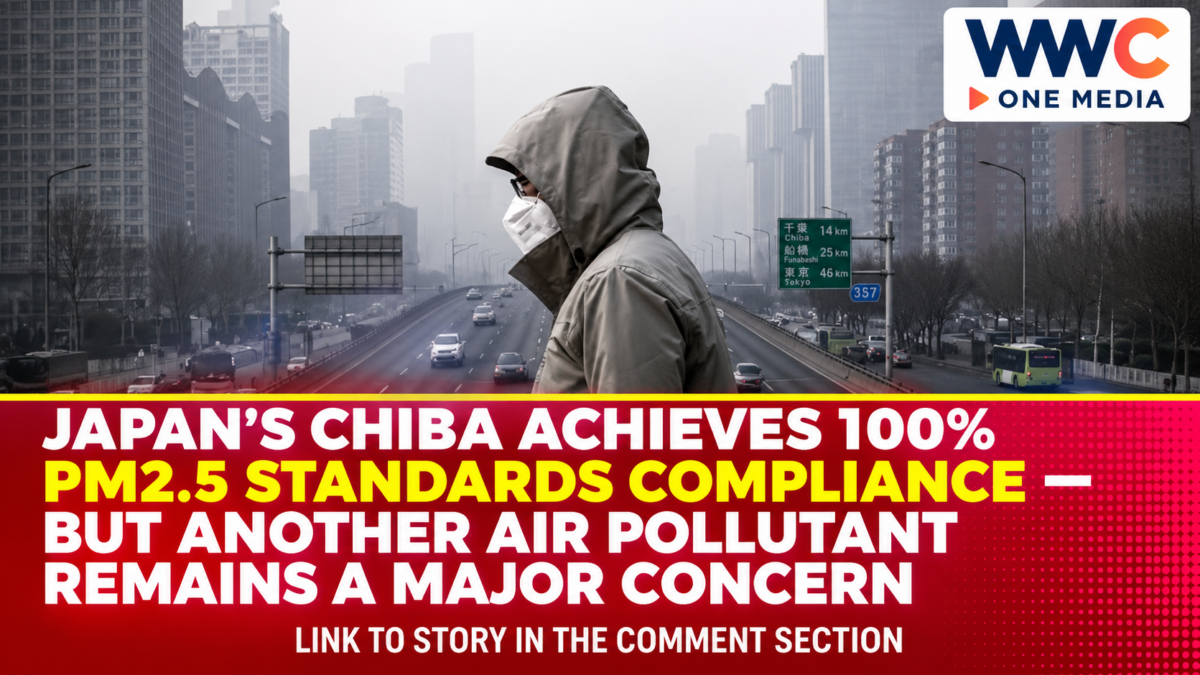
KISARAZU, Japan — Chiba Prefecture has recorded significant progress in controlling fine particulate air pollution, with all 65 eligible general and roadside monitoring stations meeting Japan’s environmental standards for PM2.5 during fiscal year 2025.
However, the latest official environmental assessment reveals a contrasting challenge: none of the prefecture’s 83 eligible general air-monitoring stations achieved the environmental standard for photochemical oxidants.
The findings provide important context for understanding Kisarazu air quality and the broader environmental conditions across Chiba Prefecture.
While improvements in particulate pollution represent a positive development for environmental protection, other atmospheric pollutants continue to require sustained monitoring and mitigation.
Kisarazu Air Quality Monitoring Reveals a Broader Environmental Picture
Kisarazu City maintains an air-monitoring network to evaluate atmospheric conditions and support environmental protection.
The municipal monitoring programme includes stations at Kaneda, Hatazawa, Mariyatsu and Josei, while Chiba Prefecture operates additional monitoring facilities at Chuo and Ushibukuro.
These facilities measure different combinations of atmospheric pollutants, including nitrogen oxides, sulphur dioxide, suspended particulate matter and photochemical oxidants.
The Chuo station also monitors PM2.5 concentrations.
Kisarazu’s fiscal year 2025 environmental monitoring assessment found that sulphur dioxide, nitrogen dioxide and suspended particulate matter remained within the applicable environmental standards at the city’s monitoring facilities.
However, photochemical oxidant concentrations exceeded the relevant environmental standard during certain periods.
The findings demonstrate why assessing air quality requires consideration of several pollutants rather than relying exclusively on a single particulate measurement.
All 65 Eligible Chiba Stations Meet PM2.5 Environmental Standards
Chiba Prefecture’s official fiscal year 2025 assessment established a 100% achievement rate for PM2.5 environmental standards among eligible monitoring stations.
All 51 general environmental air-monitoring stations satisfied the applicable requirements, alongside all 14 roadside monitoring stations.
The improvement also reflects a longer-term environmental trend.
General monitoring stations have maintained a 100% achievement rate for PM2.5 standards since fiscal year 2018, while roadside stations have recorded the same achievement since fiscal year 2020.
Annual average particulate concentrations have generally declined over the longer term.
Japan’s PM2.5 environmental standards establish an annual average concentration limit of 15 micrograms per cubic metre and a short-term benchmark of 35 micrograms per cubic metre, evaluated using the annual 98th percentile of daily average concentrations.
These measurements provide a structured basis for evaluating environmental conditions over extended periods.
They should not be confused with instantaneous air-quality readings.
Similar distinctions between pollution measurements and applicable environmental benchmarks have emerged in Canada’s New Brunswick industrial air-quality review, where monitoring results were evaluated against specific regulatory objectives.
Why Photochemical Pollution Remains a Challenge
Despite progress in reducing fine particulate pollution, Chiba Prefecture continues to experience difficulties meeting its photochemical oxidant environmental standard.
None of the 83 eligible general monitoring stations achieved the standard during fiscal year 2025.
The prefecture has also documented a decade of non-attainment across its general photochemical oxidant monitoring stations.
Japan’s environmental standard for photochemical oxidants establishes an hourly concentration benchmark of 0.06 parts per million.
Ground-level ozone is an important component of photochemical pollution. It can develop through atmospheric reactions involving other pollutants and sunlight.
Chiba’s environmental assessment identifies periods during summer when hourly photochemical oxidant concentrations can become elevated.
Unlike PM2.5 concentrations, which have generally declined over the long term, the prefecture’s annual average photochemical oxidant concentrations have remained broadly stable.
The distinction demonstrates that improvements in one pollution category do not necessarily produce equivalent improvements across all atmospheric pollutants.
However, the annual non-attainment figures do not establish that dangerous pollution levels persist continuously throughout the prefecture.
Understanding the Difference Between AQI and PM2.5
The Air Quality Index, commonly known as AQI, provides a numerical framework for communicating air-pollution conditions.
PM2.5, meanwhile, describes fine airborne particles with an aerodynamic diameter of approximately 2.5 micrometres or less.
These particles can originate from combustion activities or develop through chemical reactions in the atmosphere.
An AQI value and a PM2.5 concentration therefore represent different measurements.
Air-quality classifications also depend on the methodology used to calculate the index, while environmental standards may apply to specific averaging periods.
An individual hourly measurement cannot independently establish whether a location meets an annual environmental standard.
The importance of understanding these measurement differences has also emerged in Cebu’s proposed unified air-pollution and school suspension guidelines.
For residents and international travellers, understanding the reporting method is essential when comparing air-quality conditions across different locations.
Japan Continues Monitoring Air Pollution and Public Health Risks
Exposure to atmospheric pollution remains an international public health concern.
Fine particulate matter, ozone, nitrogen dioxide, sulphur dioxide and carbon monoxide are among the pollutants associated with adverse health effects.
Both short-term and long-term exposure can affect human health.
Chiba Prefecture continues to monitor atmospheric conditions under Japan’s Air Pollution Control Act and uses the resulting measurements to support public advisories concerning PM2.5 and photochemical smog.
The prefecture operates an online environmental information system that provides continuous access to monitoring data and relevant warning announcements.
Preliminary readings may subsequently be revised as monitoring results undergo verification.
Air-pollution management also remains relevant across Asia-Pacific economies, particularly amid regional discussions surrounding Indonesia’s transboundary haze and environmental cooperation with Singapore and Malaysia.
Different pollution events have different causes, and the existence of regional haze does not establish that it is responsible for atmospheric conditions in Kisarazu.
What Happens Next for Kisarazu and Chiba Prefecture?
Chiba Prefecture intends to continue environmental measures addressing emissions from industrial establishments and motor vehicles.
The continuing monitoring programme will help authorities evaluate whether improvements in particulate pollution can be maintained while addressing persistent challenges involving photochemical oxidants.
Future environmental assessments will provide additional information about changes in atmospheric concentrations and the effectiveness of pollution-control measures.
For residents, visitors and businesses across Japan and the wider APEC region, regularly updated environmental information remains important for understanding local conditions.
Chiba’s achievement in meeting PM2.5 standards represents measurable progress.
The next challenge is achieving comparable improvements across other pollutants that continue to affect the region’s environmental performance.
Frequently Asked Questions
Does Kisarazu monitor air quality?
Yes. Kisarazu City and Chiba Prefecture operate monitoring facilities that measure different atmospheric pollutants, including PM2.5 and photochemical oxidants.
What is Japan’s environmental standard for PM2.5?
Japan establishes an annual average benchmark of 15 µg/m³ and a short-term benchmark of 35 µg/m³, assessed using the annual 98th percentile of daily average concentrations.
Did Chiba meet its PM2.5 standards?
Yes. All 65 eligible general and roadside monitoring stations achieved Japan’s PM2.5 environmental standards during fiscal year 2025.
What air pollutant remains a concern in Chiba?
Photochemical oxidants remain an environmental challenge. None of the prefecture’s 83 eligible general monitoring stations achieved the corresponding environmental standard during fiscal year 2025.
Where can residents check Kisarazu’s latest air quality?
Chiba Prefecture provides an official online air-monitoring system containing atmospheric measurements and public pollution advisories.